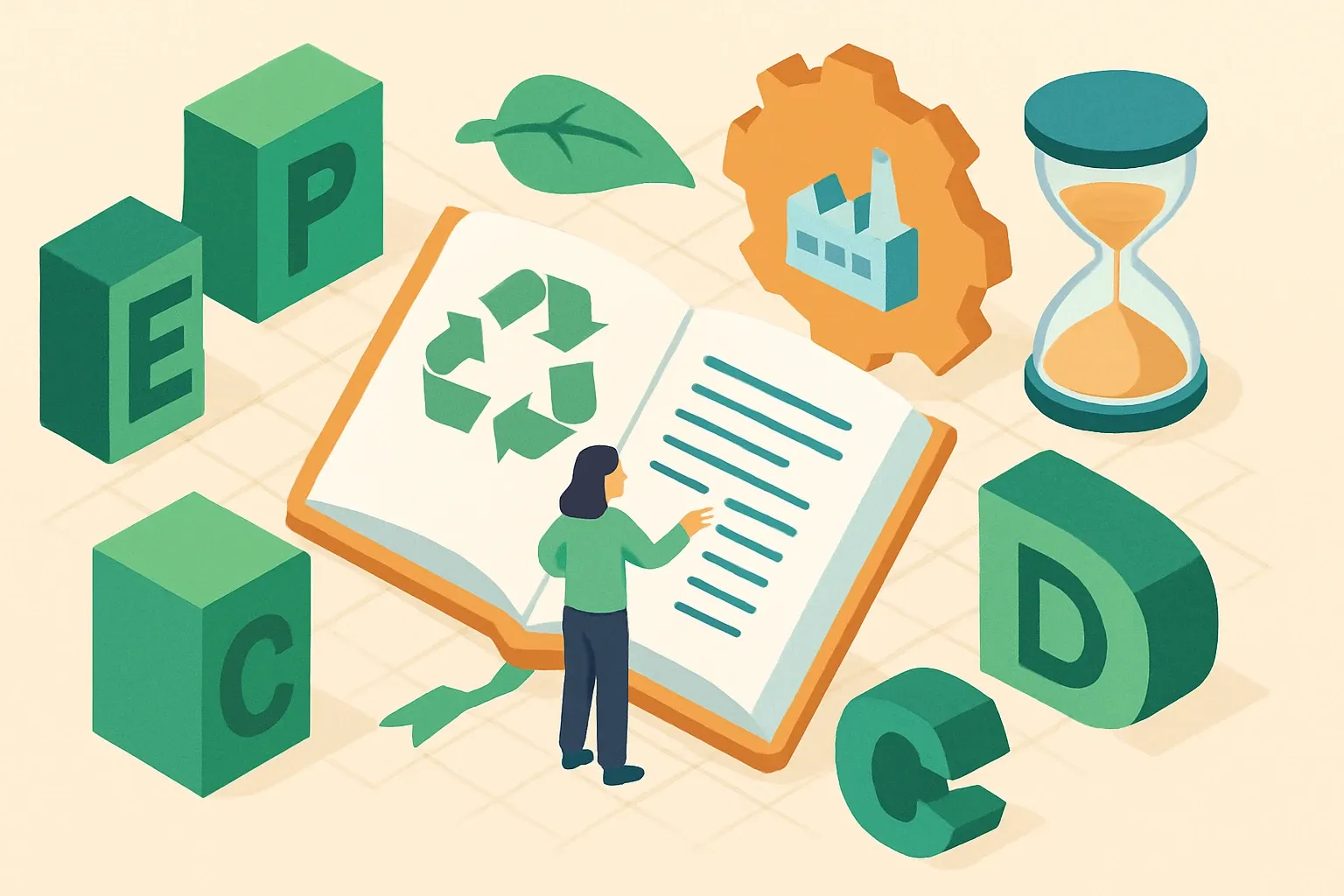
Start here: the big three
- EPD (Environmental Product Declaration). Think nutrition label for a product’s environmental impacts. It is third party verified, follows a specific rulebook, and is typically valid for five years in most programs (ISO 14025, 2018).
- LCA (Life Cycle Assessment). The recipe and the math behind the label. It traces inputs and outputs across a product’s life so the numbers on an EPD are defensible.
- PCR (Product Category Rules). The rulebook of Monopoly. Ignore it and the game falls apart. A PCR defines scope, units, and methods for a given product family.
What the footprint actually measures
- GWP (Global Warming Potential). The headline carbon number, usually GWP total. Reported per declared or functional unit and by life cycle module.
- Impact categories. Besides GWP, expect acidification, eutrophication, smog formation, and resource use as defined by the chosen standard. Treat GWP as the scoreboard buyers read first.
Units that make or break comparability
- Declared unit. A consistent quantity for comparison when performance varies. Example: 1 kilogram of adhesive.
- Functional unit. Adds performance to the unit so comparisons are fair. Example: adhesive quantity required to bond 1 square meter for 10 years.
- Density and coverage. Quiet inputs that steer carbon per square foot outcomes. Measure them carefully.
System boundaries and modules
- Cradle to gate. Raw material extraction through the factory gate. Often reported as modules A1 to A3.
- Cradle to site. Adds transport and installation. That brings in A4 and A5.
- Cradle to grave. Full life. Use, maintenance, and end of life appear as B1 to B7 and C1 to C4. Benefits beyond the system boundary, like recycling credits, are reported in module D. These letters behave like chapters in a series.
Data quality in plain language
- Reference year. The 12 month period your data represents. Choose it and stick to it across plants where possible.
- Primary data. Measurements from your own operations. Think of it as cooking with your tomatoes.
- Background data. Databases for upstream processes. More like store sauce. The PCR governs which libraries you can use.
- Cut off rules. Small inputs you exclude to keep work practical. Use them sparingly and document why.
Confused by sustainability acronyms in your bids?
Follow us on LinkedIn for clear insights that help you meet project specifications and win more tenders.
People and organizations involved
- Program operator. The publisher that hosts your EPD and sets program rules. Examples include national and regional operators in the US and EU.
- LCACP. A practitioner qualified to perform LCAs. They connect process engineers, purchasing, and QA to model reality quickly.
- Independent verifier. The referee who checks conformance before publication. Expect document reviews and spot checks on calculations.
Common EPD flavors
- Product specific EPD. Based on your product and your data. Strongest for bids where product differentiation matters.
- Industry wide EPD. Averages from a trade group. Helpful to meet a minimum spec when product specific is not available. Less persuasive in competitive evaluations.
- Prospective EPD. Built from partial-year production for a new line. Useful to enter specs early, then refreshed once a full year of data exists.
Manufacturing choices that move the number
- Energy mix. Electricity source and on site fuels often dominate A1 to A3 for many products. Document contracts and meters.
- Yield and scrap. Small improvements upstream can ripple into double digit carbon changes at the unit level. Track regrind and rework.
- Transport. Distance and mode change A4 quickly. Rail beats truck in most cases when available.
- Packaging. Light but cumulative. Specify recycled content and right-size to reduce waste at install.
Standards you will see in PCRs and EPDs
- ISO 14025. The umbrella for Type III environmental declarations. Sets principles, including typical five year validity (ISO 14025, 2018).
- EN 15804. Core rules for construction products in Europe. Defines impact categories and module structure used worldwide.
- ISO 14040 and 14044. The LCA method standards that underpin modeling choices.
Related credentials in specs
- HPD (Health Product Declaration). Ingredient disclosure for human health considerations. Complements an EPD rather than replacing it.
- VOC emissions and content claims. Often required for interior products. Follow the specified test method.
- Chain of custody claims. FSC and recycled content documentation travel with delivery paperwork the way mill certs do for steel.
Policy and market signals
- LEED v5. The next version of the rating system is moving through development. Expect continued preference for product specific EPDs in materials credits.
- CSRD. The EU sustainability reporting law will cover about 50,000 companies as it phases in through 2028, which pulls supplier data into scope sooner than many expect (European Commission, 2024).
- Public procurement. Cities, states, and agencies increasingly write EPD requirements into bid language to compare embodied carbon. Exact thresholds vary by owner.
Publishing basics buyers care about
- Validity date. Buyers scan this first to ensure the EPD is current. Renew on cycle to avoid scramble.
- Declared scope. Cradle to gate EPDs are common for components. If a spec compares full life, make the boundary clear and provide the rationale.
- Comparability note. Two EPDs are only comparable when they follow the same PCR and the same rules of the standard. Flag this in submittals to steer fair read-throughs.
How to pick LCA and EPD help
Look for a partner that reduces your internal time cost. That means structured data requests, plant friendly templates, and experienced project management that chases details so engineers stay on the line. Favor teams who are program operator agnostic and comfortable publishing where your market buys.
Ask how they handle multi-plant models, supplier outreach, and evidence storage. If the process sounds like spreadsheets by email, expect delays. If it sounds like guided intake with clear checkpoints, expect speed and fewer surprises.