From siloed credits to one materials conversation
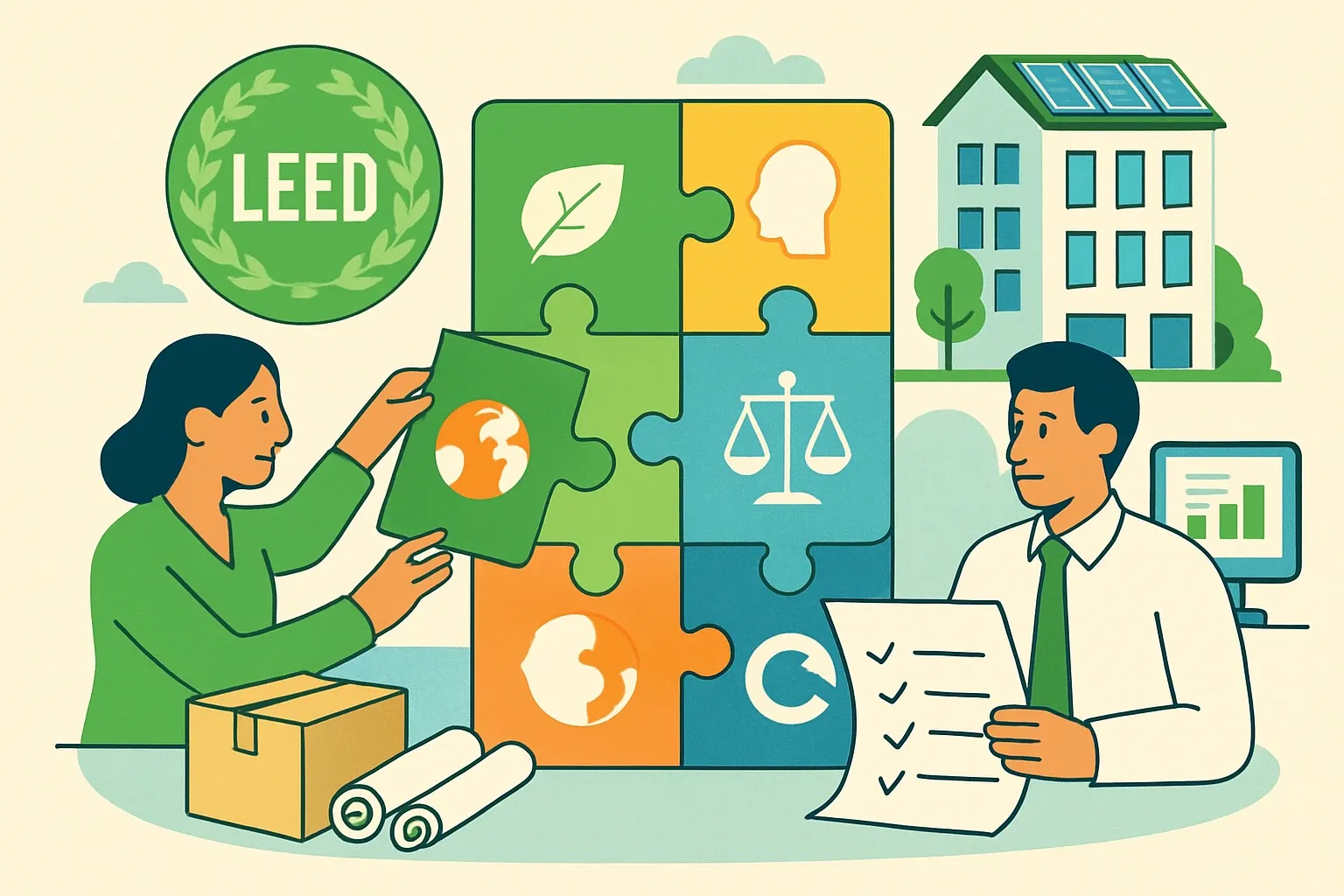
LEED v5’s MR credit Building Product Selection & Procurement (BPSP) replaces the old split between EPDs, material ingredients, responsible sourcing, circularity pilots, and supply‑chain equity. Architects and specifiers evaluate one combined submission per product rather than stitching together separate proof trails. That shifts the sales moment from “we have an EPD” to “here is our multi‑attribute profile.”
The five criteria areas in plain English
Think of the framework as a balanced plate. Every product can contribute to some combination of:
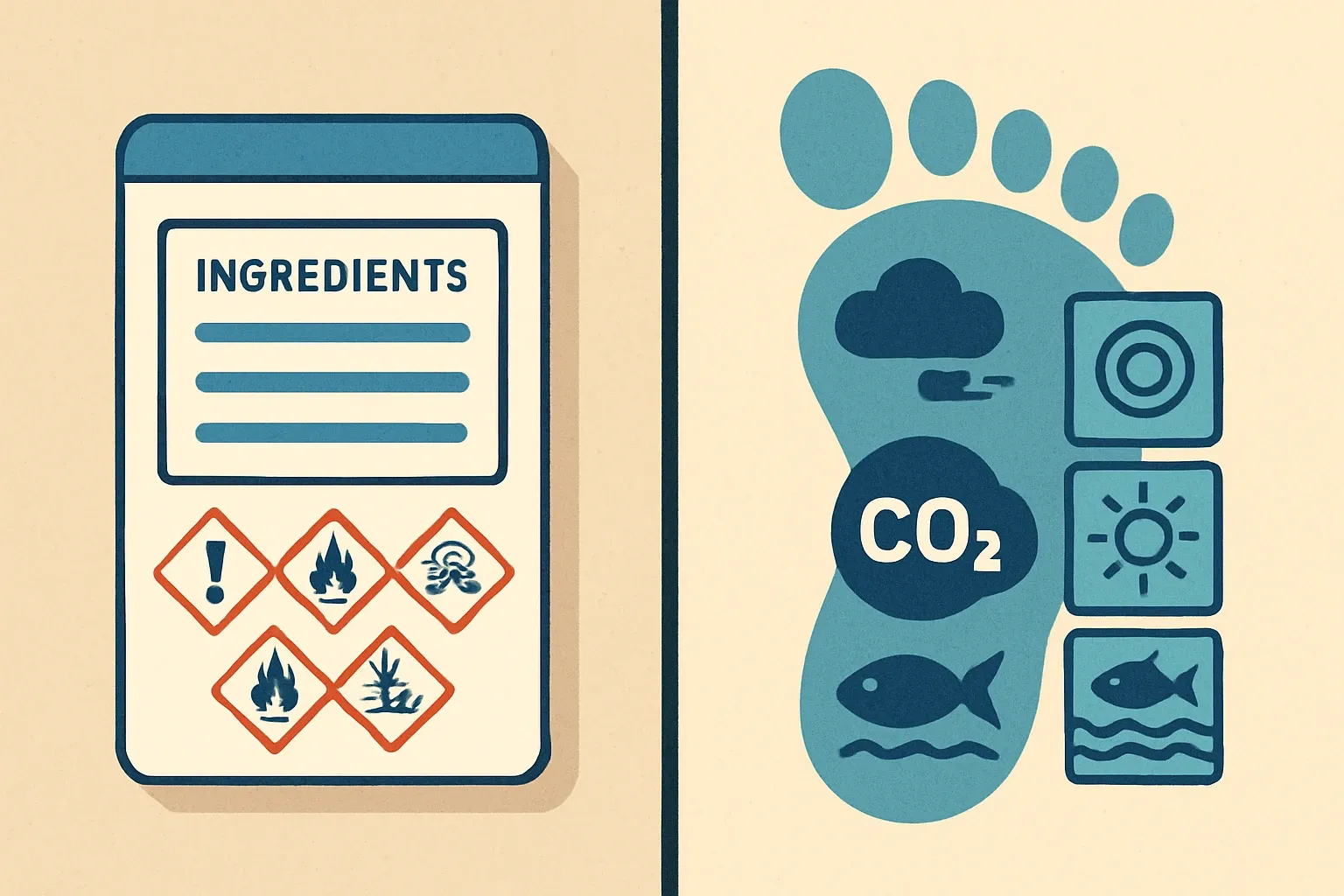
- Climate health, centered on embodied carbon.
- Human health, centered on ingredient disclosure and hazard avoidance.
- Ecosystem health, centered on biodiversity, legality, and stewardship.
- Social health and equity, centered on working conditions and community impact.
- Circular economy, centered on recycled, reused, take‑back, and design for longevity.
How scoring actually works
Products earn achievement levels that act like multipliers. Level 1 is good practice, Level 2 is leadership, Level 3 is elite. They are worth 1x, 2x, and 3x respectively, and a single product can stack scores across different criteria areas up to a maximum combined multiplier of 5x. You cannot double count inside the same criteria area, and the Arc calculator totals it for the project (USGBC BPSP Guidance v1.1, 2025).
Here is what that means in practice. A product‑specific Type III EPD secures Climate Health Level 1. Verified optimization beats the baseline, with thresholds like >20% GWP reduction for Level 2 and >40% plus improvement in three more impact categories for Level 3. On the Human Health side, an HPD pre‑checked to 1,000 ppm supports Level 1, while a third‑party‑verified HPD to 100 ppm with avoidance of chemicals of concern supports Level 2 (USGBC BPSP Guidance v1.1, 2025).
What stays familiar from v4/v4.1
The tools are recognizable. EPDs follow ISO 14025 and EN 15804 or ISO 21930. HPDs, Declare, and Cradle to Cradle still matter. Recycled content claims use clearly documented percentages. Wood legality and chain‑of‑custody disclosures remain relevant. What changes is the container. The same documents now roll up into one scorecard that reflects how designers actually weigh tradeoffs across performance, health, and circularity.
Join Parq Pulse!
Stay ahead in sustainable building practices with our weekly insights on LEED v5 and multi-attribute product standards.
What is materially new
Two structural shifts affect go‑to‑market plans. First, achievement levels and multi‑attribute stacking create a ladder that rewards teams who bring more than one kind of documentation for the same product. Second, the credit awards up to 5 points per project based on category‑level thresholds in the BPSP calculator. The points vary by project path, but the 1–5 point range is explicit for BD+C in USGBC materials (USGBC Smart Surfaces Crosswalk, 2025).
Position your product the way specifiers now evaluate
Lead with a one‑page “BPSP profile” for each product family. Show the criteria areas you cover, the highest level achieved in each, and the combined multi‑attribute score you expect the calculator to recognize. Translate technical proof into buying language, for example, “Climate Health Level 2 via EPD optimization” or “Human Health Level 2 via verified HPD at 100 ppm.” Add a short roadmap that names which attribute you plan to optimize next and by when. It’s simple, and it signals momentum.
Documentation to prepare now
- Product‑specific Type III EPD with clear scope and declared unit, plus a short explanation of what changed since the last issue and why it matters commercially.
- HPD published in the HPD Repository, either pre‑checked to 1,000 ppm or third‑party verified to 100 ppm depending on your ambition level.
- One multi‑attribute certificate where realistic, such as Cradle to Cradle, to bundle multiple criteria areas in a single mark.
- Recycled, bio‑based, or reused content statements with auditable calculations, and any Extended Producer Responsibility details that prove a real take‑back or repair program.
- For wood or bio‑based inputs, legality and sourcing disclosures mapped to the ecosystem criteria area.
Workflow shifts manufacturers will feel
Sales and A&D teams need a unified submital kit rather than a folder of loose PDFs. Product managers should target the fastest Level 1 to Level 2 jumps first, because that can move a product from acceptable to preferred in a shortlist. Procurement needs supplier attestations aligned to the five criteria areas, not just to a single credit. Marketing should build a permanent “BPSP proof” section on product pages so specifiers can self‑serve.
What this changes in conversations with architects
Expect fewer questions about whether a specific document is “good for a point” and more about how a product helps the project hit a category threshold. The winners will be products that make the math easy. Clear SKUs, clear documentation dates, and one place to download everything. If you sell systems, pre‑bundle compatible components and publish a combined BPSP profile that shows the multi‑attribute score of the kit.
Timelines and the registration switch you cannot ignore
LEED v5 becomes the only option for new commercial BD+C, ID+C, and O+M registrations on July 1, 2026, with v4 and v4.1 projects already in the queue continuing on their own deadlines. Plan for a mixed market during the transition window and align launch calendars accordingly (USGBC Help Center, 2026).
Quick playbook for product marketers
- Build a BPSP profile template that maps your documents to the five criteria areas and labels each with the achievement level.
- Prioritize one near‑term optimization, like a verified 20% GWP reduction that upgrades Climate Health from Level 1 to Level 2 (USGBC BPSP Guidance v1.1, 2025).
- Update spec sheets with a small “How this contributes to BPSP” panel that mirrors the Arc calculator fields so submittals are copy‑paste ready.
- Coordinate with procurement on supplier disclosures that unlock Social Health & Equity or Circular Economy marks.
- Train reps to talk in multi‑attribute outcomes, not single certificates.
Bottom‑line for manufacturers
BPSP rewards complete, organized proof across multiple attributes. Bring more than one kind of documentation, present it in one place, and make it easy for project teams to tally. That is how products get positioned at the top of a short list, even when specs are tight and schedules are tighter.