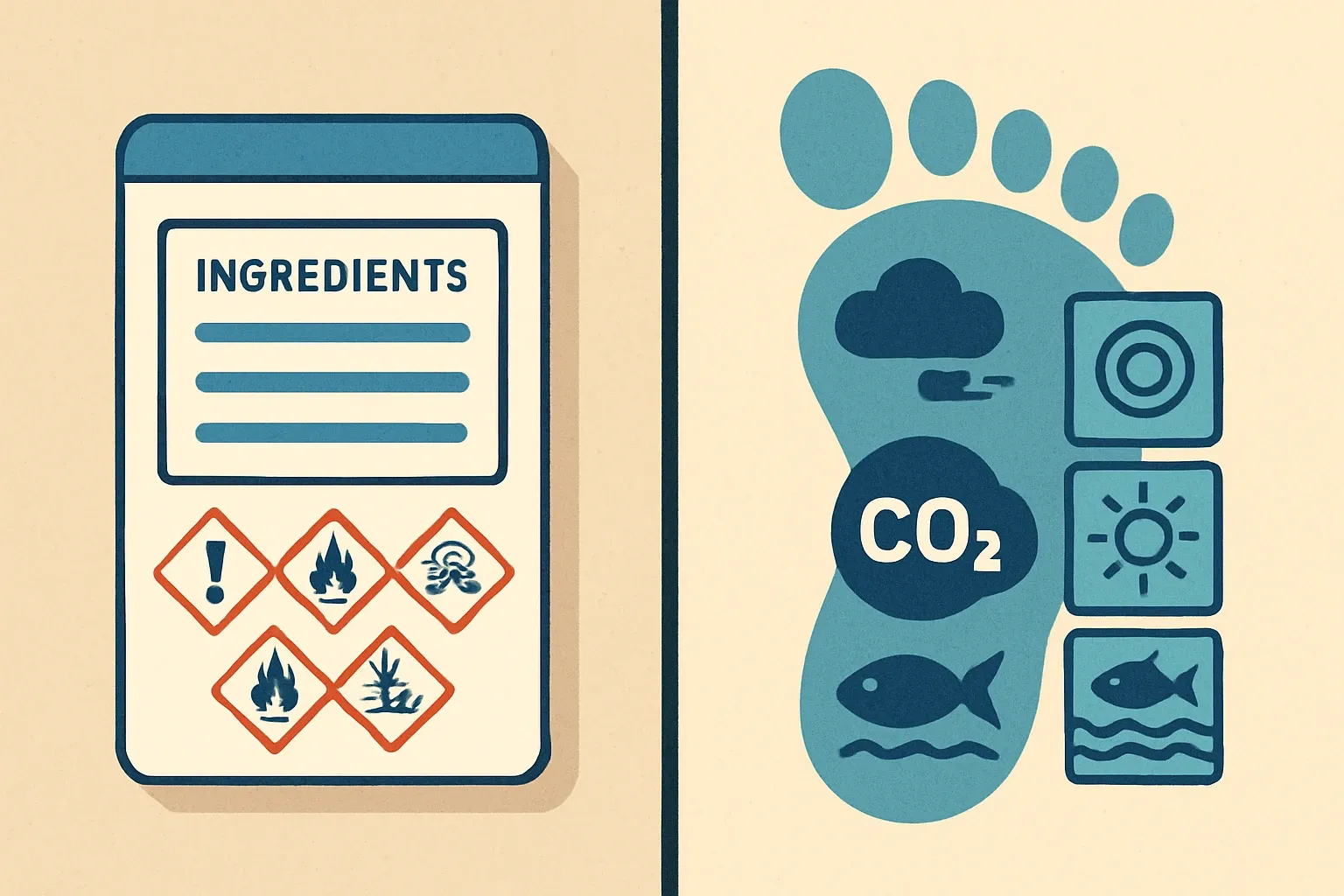
Three acronyms, three jobs
An LCA is the full technical study of a product’s environmental burdens across its life. Think director’s cut, every scene intact.
An EPD is the public, third‑party‑verified summary built from that LCA and formatted to a rulebook so buyers can compare apples to apples.
PEF is the EU’s method for calculating those impacts consistently across sectors, with sector rules called PEFCRs. It is a calculation playbook first, not a marketing document by default.
What data they demand
LCAs collect site, supplier, and logistics data for a defined reference year, usually twelve months. The EPD distills that into a fixed indicator set governed by a PCR, typically for construction under EN 15804. PEF uses the same kind of inventory but evaluates 16 midpoint impact categories and can optionally produce a single weighted score for internal comparisons (JRC, 2023) (JRC, 2023).
Where each shows up in your sales cycle
The LCA guides design choices and cost‑to‑carbon tradeoffs before launch. The EPD is what specifiers and procurement teams ask for on submittals and in digital product libraries. PEF is increasingly referenced inside EU policy and buyer guidance for comparability. If you sell in North America and Europe, you will likely touch all three at some point.
Want to unlock more spec wins with EPDs?
Follow us on LinkedIn for insights that help you navigate standards and boost your ROI.
Indicator sets, quickly compared
PEF covers 16 categories including climate change, particulate matter, land use, water use, toxicity and resource use. That breadth supports portfolio hot‑spotting and internal targets (JRC, 2023) (JRC, 2023).
EN 15804+A2 requires EPDs to report 13 core environmental impact indicators, including four climate lines: fossil, biogenic, land use change, and total. Major program operators require EF 3.1 characterization factors for these indicators for EPDs published from 1 September 2024 (EPD International, 2024) (EPD International, 2024).
Verification, validity, and timing
EPDs are independently verified before publication, then typically valid for five years. That validity period is printed on the declaration and an update is required to stay market‑useful after it expires (IBU, 2026). International EPD System rules also require EF 3.1 methods for new publications since September 2024, so results align with the latest factors without extra debate during reviews (EPD International, 2024) (EPD International, 2024).
Why buyers care
Buildings drive a big slice of climate math. In 2022 the sector used 34 percent of global energy and accounted for 37 percent of energy and process‑related CO2 emissions, which is why verified, comparable product numbers matter at bid time (UNEP/GlobalABC, 2024) (UNEP/GlobalABC, 2024). Clear EPDs help teams avoid conservative proxies that can penalize your product on carbon accounting.
One dataset, three outputs
Do the hard data work once, then route it to the right format.
- LCA report for engineers and product managers, rich detail for decisions.
- EPD for market access, listings, and specifications in construction.
- PEF profile for EU buyers and internal benchmarking against PEFCRs.
The common thread is clean, auditable data collection and a PCR or PEFCR that actually fits your product.
Choosing the right path for your goal
If the target is more specs in construction, a product‑specific EN 15804 EPD is the shortest commercial path. If you are pressure‑testing supply options or materials, start with an LCA. If you are preparing claims or tenders that reference EU methods, add a PEF‑conform assessment. You can definately layer these without redoing the groundwork when the inventory is organized well.
A practical way forward
Pick a recent reference year, confirm the applicable PCR or PEFCR, and line up verification early. Use the same inventory to populate both EPD tables and any PEF deliverables. Keep module coverage consistent so results travel into building‑level LCAs without rework. Do this, and reviews move faster, your team stays focused on production, and your product stands on its real performance rather than a generic proxy.