ISO 14025 in one minute
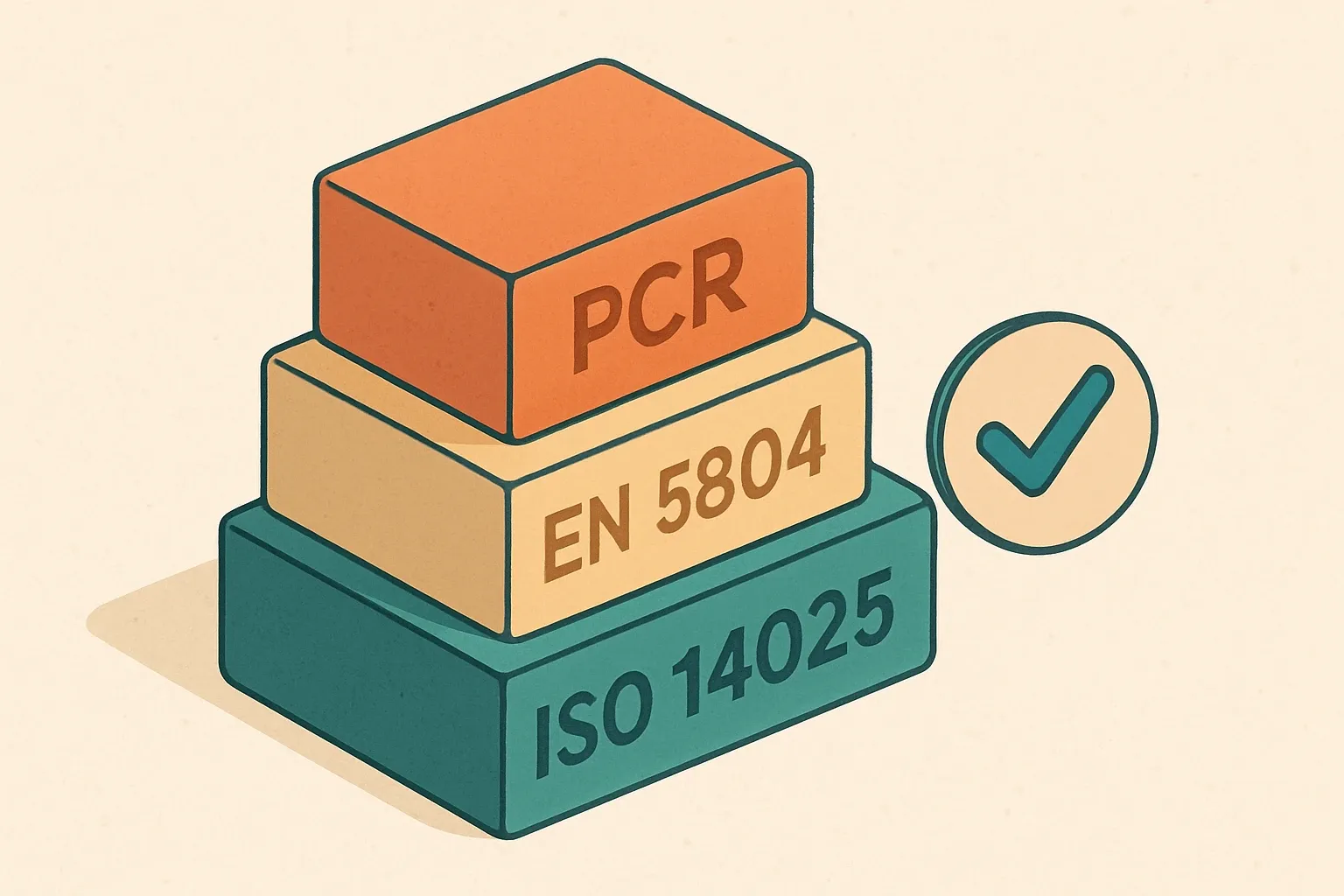
ISO 14025 defines Type III environmental declarations built on life‑cycle assessment and verified by an independent third party. Think of it as the league rulebook that every sport in the arena must respect. It points to ISO 14040 and 14044 for the LCA method, then adds how results are declared so buyers can compare apples to apples.
How it pairs with EN 15804 for construction
For building products, ISO 14025 sets the meta rules. EN 15804 is the playbook for the sport of construction materials. In practice, most construction EPDs follow ISO 14025 plus EN 15804, which spells out impact categories, life‑cycle modules, scenarios, and mandatory disclosures. Outside Europe, many programs mirror EN 15804 to keep results comparable across projects.
PCRs are the rulebook of Monopoly
A Product Category Rule (PCR) tells you what counts, what does not, and how to model it for a given product family. Ignore the PCR and the game falls apart. Smart teams scan which PCR competitors use, check its revision timeline, and confirm it aligns with the intended program operator and market.
Program operators, decoded
Program operators run the process, host the PCR, appoint verifiers, and publish the EPD. Examples in common use include Smart EPD in the United States and IBU in Germany, alongside global schemes that accept EN 15804 content. The best choice is usually the operator your buyers recognize and your category already gravitates toward.
Navigating ISO 14025 for EPD success?
Follow us on LinkedIn for straightforward insights that help you meet standards and win more projects.
Verification and validity windows
Third‑party verification is not optional under ISO 14025. Most major operators set the validity of an EPD at 5 years, after which it must be reviewed and renewed to stay current (EPD International General Programme Instructions, 2024) (Smart EPD General Program Instructions, 2024).
What data the standard expects
Plan for a clear reference year, production volumes, energy and fuel by process, inbound and outbound transport, waste, packaging, and any additives or auxiliary materials. For scope, EN 15804 requires at least the product stage A1 to A3. Many manufacturers add A4 and A5 to meet specs that ask for delivery and installation scenarios. Prospective EPDs for new lines are possible when production has just started, then refined once a full year of data exists.
Compliance checklist to stay audit ready
- Confirm the correct PCR and version, note its revision date.
- Map data owners by plant and process, collect from the source system, not summaries.
- Document assumptions and cut‑offs in a model log, keep reviewer questions in mind.
- Choose operator, verifier, and language variants early to avoid rework.
Why it matters to sales and specs
On projects that track embodied carbon, a product‑specific, third‑party verified EPD avoids penalties from generic default factors. That means fewer pricing standoffs and faster movement through submittals. The cost is typically dwarfed by even a single mid‑sized win because it keeps the product in contention when carbon targets are tight.
Get it done without derailing operations
Pick a partner that takes on the heavy lifting of data collection, scheduling, and reviewer management. Insist on white‑glove support that interviews process owners, extracts utility data directly, and chases any missing invoices so your engineers are not stuck babysitting spreadsheets. We prefer platforms that make multi‑plant rollups, BOM changes, and verifier clarifications quick, because speed, ease, quality and completeness beat heroics every time. One more thing, keep a shared folder with raw exports and calculation notes so your next renewal is a sprint, not a scavenger hunt.
Make ISO 14025 work for your spec life
Treat ISO 14025 as the frame, EN 15804 as the canvas, and your PCR as the color palette. With the right operator and a team that wrangles data for you, an enviromental claim becomes a reliable declaration buyers can trust. That is the difference between answering carbon questions and winning the spec.