ILCD in plain English
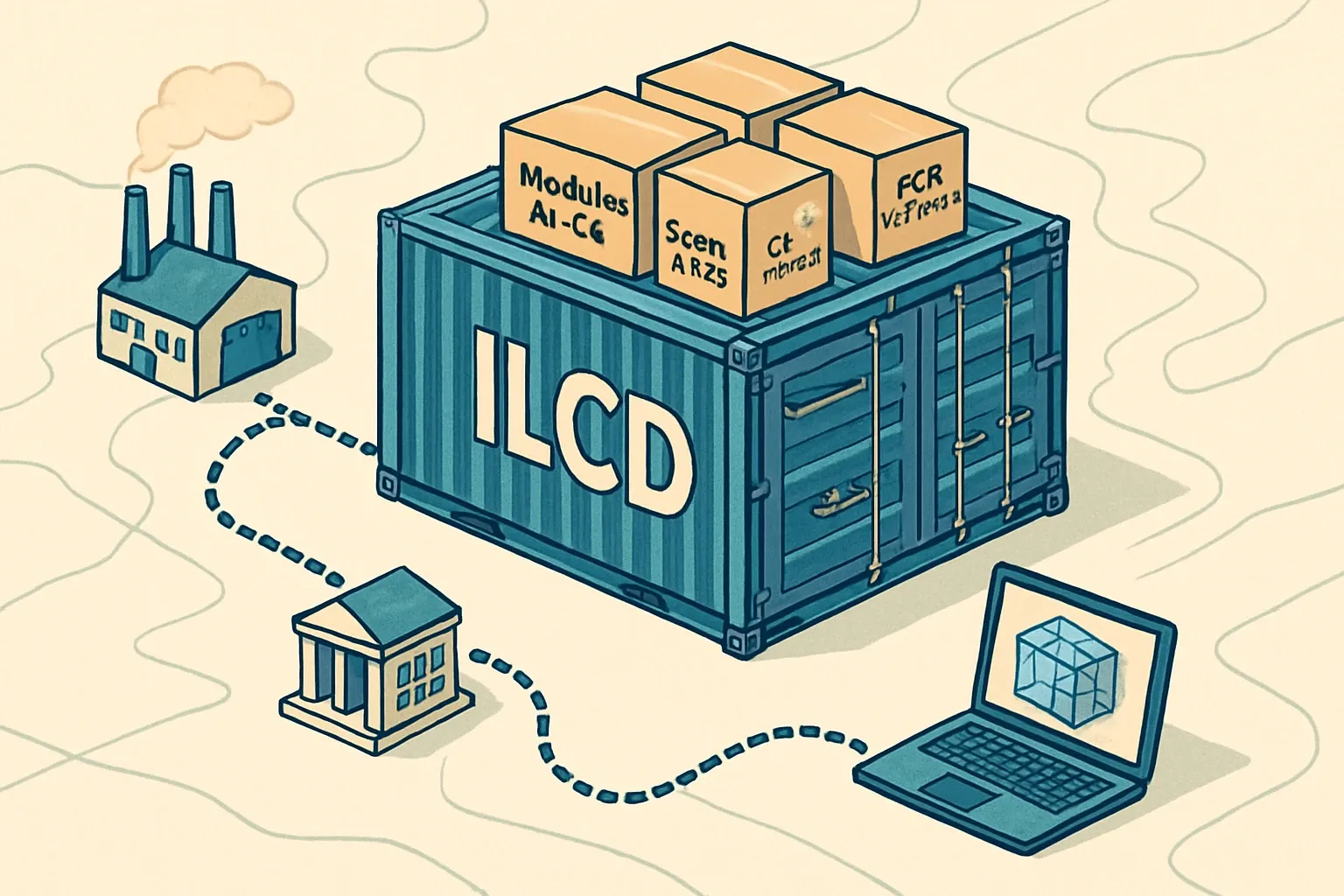
Think of ILCD as a structured way to store life‑cycle data so software can read it, not as a new method for calculating impacts. It is an XML schema that organizes flows, units, processes, and documentation so your LCA model is portable between tools and databases.
ILCD does not replace ISO 14040 or EN 15804. It carries the results and the modeling choices they require, with enough metadata for others to understand and reuse them.
ILCD+EPD, openEPD, and PDFs, side by side
ILCD+EPD adds EPD‑specific fields to ILCD, such as modules, scenarios, declared unit, and verification details. It was designed so program operators and tools can exchange EPDs digitally across Europe.
openEPD is a newer JSON schema focused on easy API exchange. Many organizations are testing bridges between ILCD+EPD and openEPD so data can move cleanly between regions. PDFs remain the legal record in many programs, yet machine‑readable files do the real heavy lifting in design tools and procurement.
Where ILCD shows up in construction EPDs
Several European program operators ingest and publish digital EPDs in ILCD+EPD. Their portals and the InData network rely on it so BIM and LCA tools can pull results without manual copy‑paste. Global exchanges like GLAD list ILCD among accepted dataset formats, which helps when you want one model to travel across markets.
If your portfolio sells in Europe, ILCD+EPD support is becoming table stakes. If you sell mainly in North America, openEPD may be the first request, but ILCD remains useful for modeling and for collaboration with European partners.
Confused by EPD standards and formats?
Follow us on LinkedIn for clarity that helps you win tenders and streamline project specifications.
What goes into a clean ILCD dataset
Start with unambiguous identifiers for every process and flow, then lock in units early. Record declared unit, system boundary, and the reference year for data. Map modules A1 to C4 and Module D clearly, and document scenario parameters rather than burying them in a narrative.
Add links to the governing PCR and program operator rules, list versions of characterization factors, and stamp the file with the verifier’s details. That metadata is what turns a static file into a reusable asset across product families.
Digital EPDs are not hypothetical anymore
The International EPD System crossed 10,000 valid EPDs in 2024, with construction products taking the lion’s share (EPD International, 2024) (EPD International, 2024). In May 2025, they also reported 62 fully digital EPDs live in their library, a signal that machine‑readable delivery is moving from pilots to production (EPD International, 2025) (EPD International, 2025).
For manufacturers, digital files shave weeks off submittals and reduce rework when product variants share most inputs. The PDF still matters, yet the XML or JSON is what your customers’ tools actually consume.
EN 15804 and EF 3.1, why the version matters
EN 15804 A2 broadened what must be reported compared to the older A1 era, which is why your data model needs room for more indicators and inventory metrics. Characterization factors used by European programs were updated to EF 3.1, with EF 3.0 no longer allowed for new IES EPDs from September 1, 2024 (EPD International, 2024) (EPD International, 2024).
Ask your LCA partner to state the CF version inside the file and in the project plan. A quiet mismatch here can ripple into conflicting numbers on the same project tender.
Frequent pitfalls when exporting ILCD files
Small unit mistakes multiply. Keep density, moisture, and energy lower heating values aligned to the PCR. Scenario transparency matters, so declare transport distances and end‑of‑life rates in parameters that others can read, not in free text.
Mind data lineage. If you substitute generic upstream data, record source and version so future updates are painless. Finally, validate against the program operator’s checks before verification. It sounds basic, but it is definately the fastest way to avoid late rebuilds.
A practical path that pays back
Pick one canonical format per region, then maintain a tested translation to the other. For Europe, keep ILCD+EPD authoritative, and export openEPD for customers that request it. For North America, do the inverse. Either way, invest in a tidy bill of materials, clean utility data, and a verification‑ready metadata set. That is the part that wins specifications more often than shiny tooling names.
Strong partners make the difference on speed and completeness. The best workflows remove internal bottlenecks, collect data once, and publish through the operator your market prefers, with machine‑readable files ready for immediate reuse.
Threading it all together
ILCD is not a buzzword, it is the box your LCA travels in. If it is structured, versioned, and validated, you can publish faster, update with less friction, and plug into digital procurement without copy‑paste marathons. Choose formats that match your markets, keep the math current, and treat the dataset like a product you will reuse across launches.