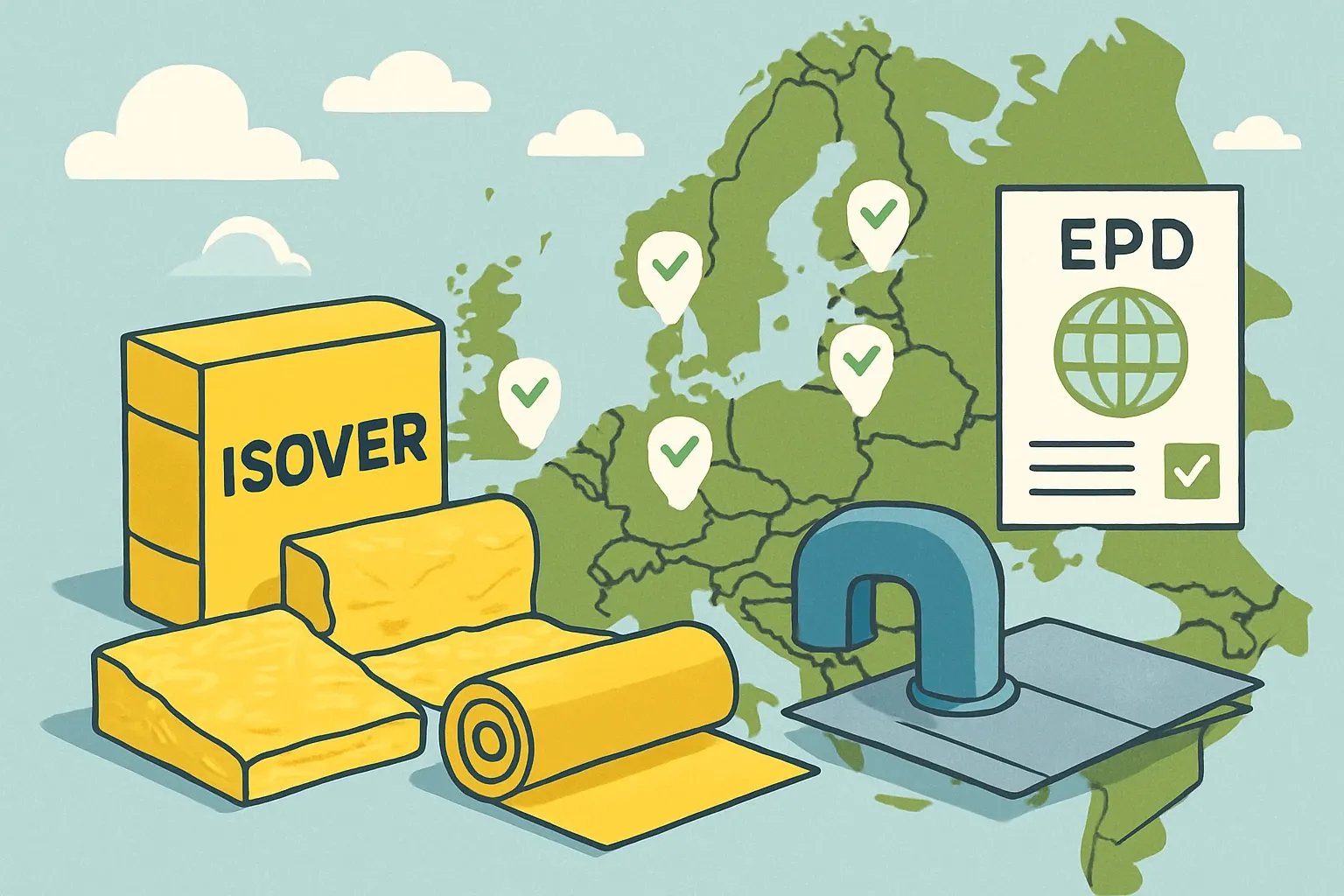
Who ISOVER is
ISOVER is Saint‑Gobain’s dedicated insulation brand, active across Europe, the Middle East, Asia Pacific, and the Americas. Their focus is thermal and acoustic performance for envelopes and systems, from homes to hospitals to industry.
A sustainability hub lives on their regional sites, for example Spain’s overview of targets and initiatives at ISOVER Sostenibilidad.
What they sell
ISOVER is not a single‑product play. They span several product families that show up together on real jobs:
- Building insulation made from glass mineral wool in rolls, batts, and slabs for walls, roofs, and floors.
- HVAC and technical insulation including CLIMAVER duct boards, duct liners, and CLIMPIPE sections for pipes and equipment.
- Façade and ETICS solutions, often paired with system components tested as assemblies.
- Air and vapor control layers under the Vario line, plus tapes and accessories that make airtightness measurable.
- Blowing wool for attics and hard‑to‑reach cavities.
How many categories and SKUs
Across regions, they cover five to seven core categories with hundreds of SKUs when you count thicknesses, facings, dimensions, and country‑specific variants. Catalog depth varies by market, which is normal for a global brand serving local codes and installers’ preferences.
EPD coverage at a glance in 2026
Coverage is strong across European catalogs. Examples include building insulation families and HVAC products published with EPD International and national operators such as INIES and EPD Norway, plus a growing UK library that ISOVER updates on its resources page (Isover UK EPD Certificates). These are product‑specific Type III declarations aligned to EN 15804 and ISO 14025, the formats specifiers actually use.
In practical terms, most mainstream glass wool boards, batts, rolls, and several HVAC lines already have EPDs in multiple countries. That makes it easier for design teams to keep the same brand from shell to services without paperwork friction.
Join Parq Pulse!
Stay ahead in sustainability and project wins by mastering product and environmental data insights with our weekly newsletter.
Where gaps still appear
Two patterns pop up:
- Regional outliers. A given thickness or facing might be listed in a local catalog but not yet appear in that country’s EPD library. When that happens on a LEED‑tracked job, specifers often reach for a nearest technical equivalent that does have a current EPD.
- Accessories. Membranes and tapes are increasingly covered, yet coverage is not universal across every market. If an air‑barrier accessory lacks an EPD, a project team can prefer a fully documented system package from a rival to simplify credit reviews.
Neither issue is unique to ISOVER. They are fixable prioritization problems.
Competitive set on projects
ISOVER most often meets:
- ROCKWOOL for stone wool boards and batts in exterior walls, rainscreens, and fire‑rated partitions, with product‑specific EPDs widely available through IBU and UL in key markets (IBU, 2025; UL, 2025).
- Knauf Insulation and Owens Corning for fiberglass batts, rolls, and loose fill in residential and light‑commercial envelopes, each publishing broad EPD ranges on their sites (Knauf, 2025).
- Kingspan for rigid phenolic and PIR boards in façades and HVAC ductwork, with product EPDs available in European program operators like IBU (IBU, 2025).
- Armacell and K‑FLEX for elastomeric foam in chilled water, refrigeration, and acoustic pipe lagging, both with program‑operator EPDs in select regions.
That mix shifts by application. Education and healthcare lean on airtightness and acoustics, offices on flexibility and services density, and industrial on temperature, safety, and maintainability.
If a bestseller lacks a local EPD
Pick one market’s high‑volume SKU, for example a standard cavity‑wall slab or staple HVAC duct liner. If that exact variant is missing in the country library at bid time, teams can and do substitute to a similar product that carries a current, program‑operator EPD in that country, such as a stone wool cavity batt from ROCKWOOL or a phenolic duct board from Kingspan published with IBU. That swap keeps their documentation clean and their embodied‑carbon accounting defensible in LEED v5’s materials framework (USGBC, 2025).
Plays that close the gap quickly
Here is the simple, high‑leverage order of operations:
- Prioritize top‑selling thicknesses and facings in each country. One well‑scoped, product‑specific EPD usually covers a range of sizes if declared correctly.
- Match the common PCR and program operator your competitors use in that category so comparability holds up in reviews.
- Line up timely renewals so nothing lapses during active tenders. Focus first on SKUs used in public frameworks and corporate programs that gate on EPDs.
- Choose an LCA partner that handles cross‑plant data collection and publishes with your preferred operator without pushing extra homework back to your engineers. That keeps calendars and costs predictable while your team stays on core work.
What this means for specs in 2026
ISOVER already brings breadth across envelopes and services, with EPDs that cover most of what project teams touch day to day. The commercial unlock now is boringly tactical. Map bestsellers to declarations country by country, fill the two or three missing puzzle pieces per line, and keep the renewal queue tight. Do that and you win more often without cutting price, because the paperwork simply works. It’s not glamorous, but it is how specifications get won.