What Fräsch makes
Fräsch focuses on acoustical products fabricated from PET felt. Expect wall tiles and panels, ceiling baffles and clouds, drop‑in tiles and linear systems, plus acoustical lighting that doubles as a sculptural element. The line covers offices, education, hospitality, and healthcare settings.
How broad is the catalog
The range spans dozens of named families and, once sizes and finishes are counted, likely hundreds of SKUs. Hero lines like SKINNY BAFL, BRIK, PLANK, FAZR, and VIBE TILE show how they mix modular geometry with quick install hardware. Their site touches on sustainability themes and materials transparency here: About Fräsch.
EPD coverage today
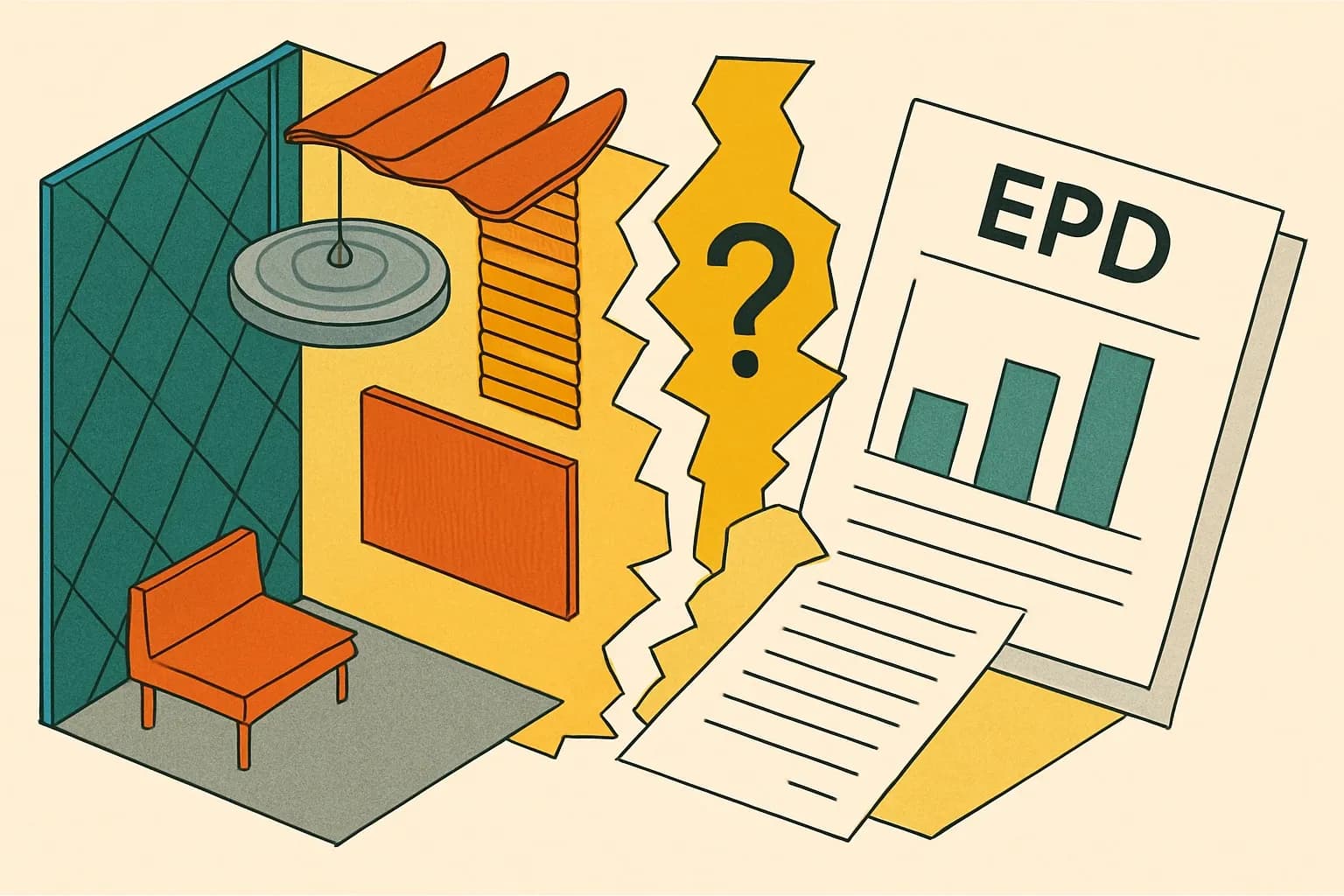
As of January 7, 2026, we could not locate any Fräsch product‑specific, third‑party verified EPDs in major public program‑operator libraries or on the company’s site. If one exists, it is not easy to find. That discoverability gap matters at bid time when project teams must document disclosures fast.
Why EPDs change spec math
In LEED v4.1, the Materials and Resources credit for Environmental Product Declarations commonly asks for at least 20 qualifying products, and a product‑specific Type III EPD with external verification counts as 1.5 products toward that total (USGBC Credit Library, 2024) (USGBC Credit Library, 2024). LEED v5, ratified on March 28, 2025, keeps disclosure while elevating embodied‑carbon performance, so being EPD‑ready still smooths approvals and keeps schedules on track (USGBC, 2025) (USGBC, 2025).
Work for Fräsch or selling against them?
Follow us for product-by-product EPD analysis and insights on which Fräsch SKUs get spec'd over competitors like Acoufelt and Woven Image.
Competitors who show up with EPDs
Several direct alternatives bring current declarations to the table.
- Woven Image’s EchoPanel, distributed broadly in North America, publishes EN 15804+A2 EPDs with validity through March 2030 for 9 mm and 12 mm panels, which designers can fabricate into tiles, baffles, and screens (EPD International, 2025) (EPD International, 2025).
- Acoufelt lists multiple EN 15804+A2 EPDs, issued April 2024 and valid to April 2029, covering acoustic cut panels, printed and laminated panels, single‑plane clouds, SoftenUp, and Truss Baffles. That breadth lets specifiers swap shapes without hunting for new paperwork (Global GreenTag, 2024) (Global GreenTag, 2024).
When a team must hit a disclosure count, the brand with easy‑to‑download, product‑specific EPDs feels like the safer pick.
A likely missed layup
Ceiling baffles are a Fräsch staple. SKINNY BAFL is called out prominently, yet we do not see an associated EPD. Meanwhile, baffle and panel systems from Acoufelt and EchoPanel‑based fabrications are frequently covered by current EPDs. In LEED‑driven interiors, that means specifers will often shortlist the documented option first to avoid penalties or rework on the MR credit tally (USGBC Credit Library, 2024) (USGBC Credit Library, 2024).
Where Fräsch competes most often
Peer sets on projects typically include Autex Acoustics, Kirei or Woven Image, Turf Design, Acoufelt, BuzziSpace, Unika Vaev, and Arktura. These brands overlap on PET felt walls, ceilings, and dividers. In head‑to‑head specs, consistent EPD availability is increasingly a tie‑breaker, not just a marketing line.
How to close the gap fast
Start with a material‑level or assembly‑level EPD for the highest‑velocity families. Ceiling baffles, drop‑in tiles, and wall panels that repeat across projects are prime candidates. Pick the same PCRs competitors use so reviewers can benchmark apples to apples. Make data collection ruthlessy simple for plants, lock a five‑year validity window, and publish with an operator that your core markets recognize.
The thread to pull
Fräsch has the design equity and a catalog that plays well across modern interiors. Adding visible, product‑specific EPDs where it counts would convert that equity into easier specs and fewer substitutions. On many jobs, even one mid‑sized win repays the work to publish the declaration. Don’t leave that value on the table.