What Module D actually covers
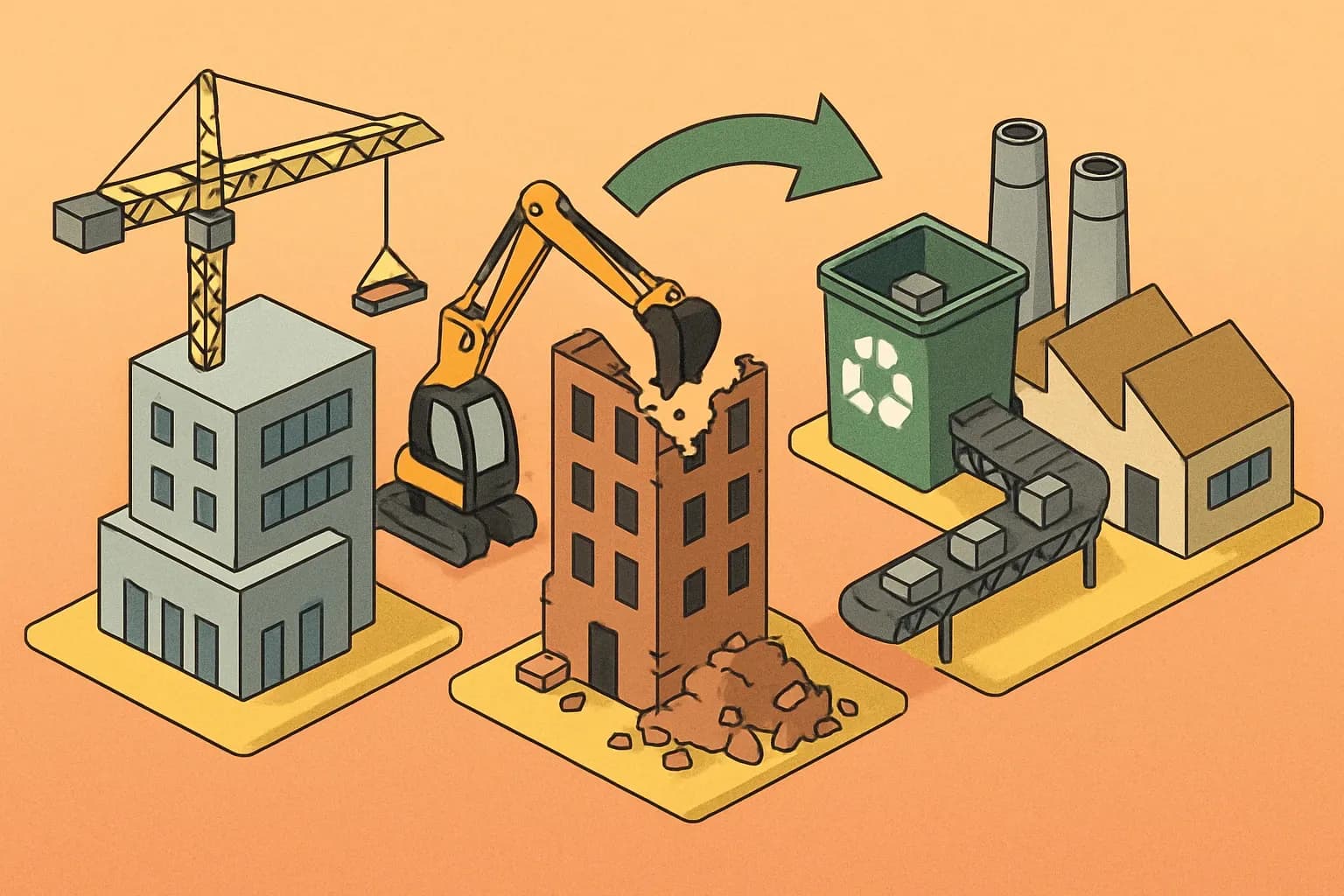
Module D reports potential benefits and loads beyond the product’s life cycle boundary. Think of it as credit for what happens after C1 to C4. If your product becomes feedstock for the next life (reused, recycled, or used for energy), D captures the avoided impacts from displacing virgin production or conventional energy. That’s its defintion in practice, not theory.
Why 2026 matters
By 2026, most EN 15804 A2 programs treat C1 to C4 and D as expected scope for construction products. Program operators in Europe clarified calculation details in 2024, so the market now sees D as part of a complete EPD, not an optional appendage (IBU, 2024).
The short math (substitution, net flows)
Module D uses a substitution approach. You model net outputs that leave your system at end‑of‑life, then credit or debit impacts for what those outputs replace in a realistic next system. Export scrap and you claim the difference between virgin and secondary production. Export energy from incineration and you credit what grid energy it substitutes. Keep it conservative, keep it documented.
Example, illustrative only: if 1 kg of recycled aluminum displaces 1 kg of virgin aluminum and the difference in GWP is X kg CO₂e per kg, your D credit is roughly X times kilograms recovered (with quality and contamination limits reflected in your scenarios).
Why the upside can be large for metals
Metals are durable currency in circularity. Around 630 million tonnes of recycled steel are used annually in global steel production, a scale that underpins credible displacement assumptions for many building products (BIR, 2025) (BIR, 2025). Recycling aluminum saves about 95% of the energy required for primary production, which often turns into a sizable D credit when scenarios are well supported (Aluminum Association, 2025) (Aluminum Association, 2025).
Why it matters in demolition‑heavy markets
Construction and demolition waste is more than a third of all waste generated in the EU. That volume explains why public clients scrutinize end‑of‑life routes and potential recovery benefits that show up in D (European Commission, 2025) (European Commission, 2025). If your product has a credible recovery pathway, not declaring D leaves competitive points unused.
Ready to unlock value in your EPDs with Module D?
Follow us on LinkedIn for insights that help you win tenders and maximize ROI.
2024 clarifications that carry into 2026
European operators integrated ECO Platform LCA calculation rules and clarified renewable energy handling in 2024. For teams publishing in 2026, that means fewer gray areas and clearer reviewer expectations (IBU, 2024) (IBU, 2024). North American PCRs aligned with EN 15804 still vary by operator, so always check the Part A and Part B that govern your category before modeling scenarios.
What building assessors do with D
Whole‑life carbon frameworks often keep D as supplementary information for buildings, even as product EPDs must declare it. The latest Nordic guidance notes D may be split into sub‑parts (D1 material recovery and D2 exported utilities), and its relative importance can shrink under deep grid decarbonization scenarios (Nordic Council of Ministers, 2024) (Nordic Council of Ministers, 2024). Product teams should still provide D because project‑level rules evolve and tenders frequently request it.
Data to assemble now (so modeling doesn’t stall)
- End‑of‑life mass balance by material with expected sorting yields (include coatings, inserts, packaging)
- Documented recovery routes per geography with realistic rates (recycling, reuse, energy recovery)
- Quality factors or downgrading assumptions that affect displacement
- Substitution references for the next life (what your output replaces and where the data comes from)
- Evidence for transport and processing burdens outside your factory fence
Common traps that cost time
Treating theoretical 100% recycling as default without local evidence triggers review delays. Mixing allocation methods between A and D breaks comparability. Forgetting to show where recovered energy goes makes credits look speculative. Declare what is exported, where it goes, and what it plausibly replaces.
Commercial angle without the fluff
Module D tells a better end‑of‑life story on page one of your EPD. It helps teams competing in circular procurement, where credible recovery potential supports scoring and narrative. We see faster reviews when data is gathered once, cleanly, then reused across product families (same rules, documented scenarios). That saves calendar time when it matters most.
Quick material cues
Steel and aluminum usually show positive D credits when scrap is realistically recovered and displacement is justified. Mineral products may show modest D benefits through aggregate recycling. Wood products must reflect biogenic accounting correctly to avoid double counting between C and D. Plastics vary with sorting yields and energy recovery policy.
Use it in bids the smart way
If a buyer allows A1 to C only, include D as supplementary information in your technical appendix and in the EPD. If the tender asks for whole‑life carbon, align your D scenarios with the project’s end‑of‑life assumptions and geography. State limits plainly when national averages are missing. Better a careful number than a heroic one.
The takeaway for 2026
Publish with C1 to C4 and D declared, supported by transparent, local scenarios. That signals readiness for circular procurement and avoids last‑mile verification surprises. If your team lines up the recovery evidence early, Module D stops being hard and starts being helpful.