What the C modules actually cover
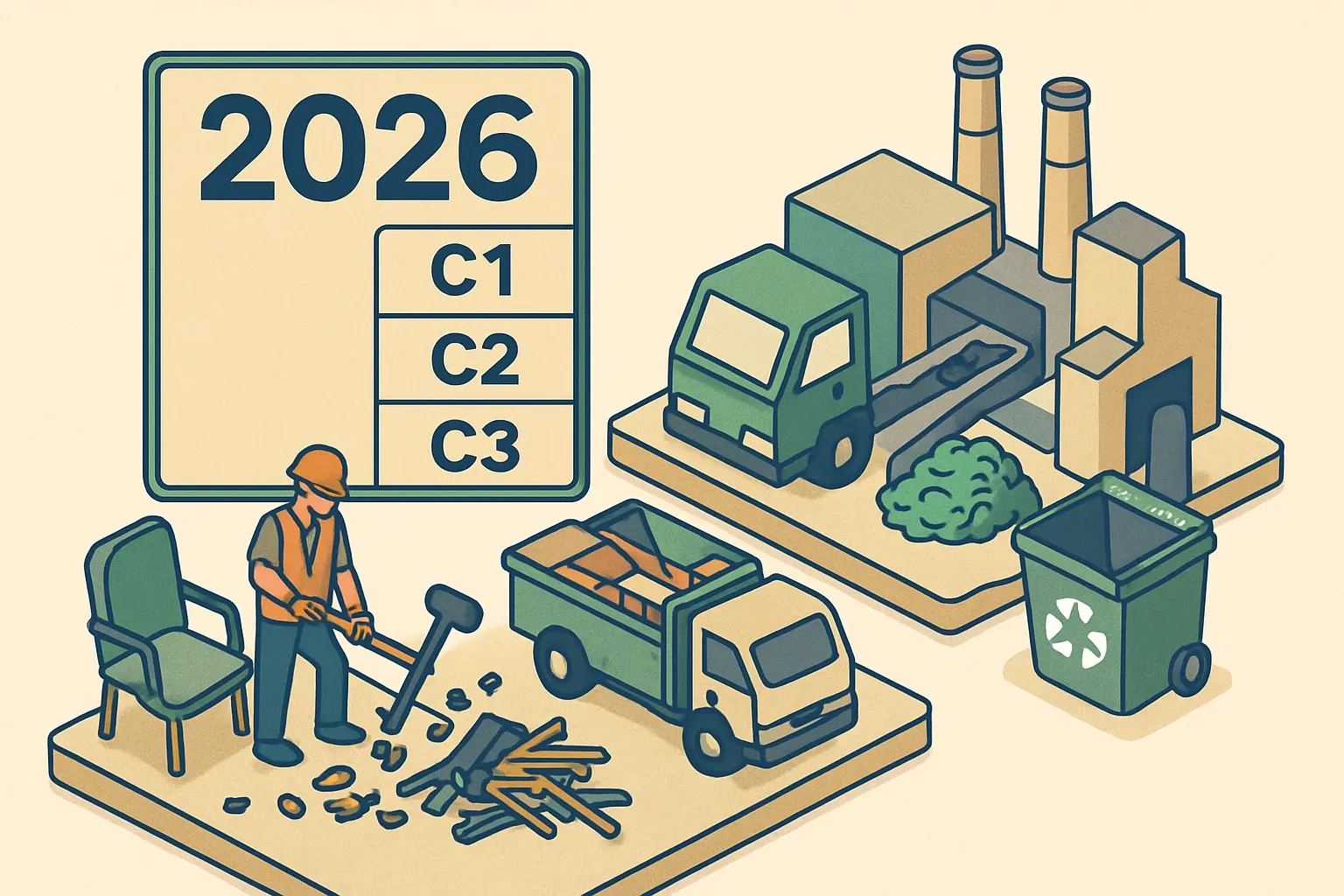
C1 captures deconstruction or demolition. Think crews, tools, fuel, and site energy.
C2 is the trip. Distances, payloads, and modes to the next stop.
C3 models waste processing like sorting, shredding, cleaning, or re-melting when material is recovered.
C4 is final disposal such as landfill or incineration. Keep it separate from recovery. Module D holds the benefits and burdens beyond your product system.
Why owners care in 2026
Public buyers and large GCs now screen bids for credible end of life. Construction and demolition debris is still massive, topping 600 million tons in the United States for 2018, which dwarfs municipal trash and keeps regulators focused on the back end of products (EPA Construction and Demolition Materials, 2024).
Across the EU, construction made up roughly 35 percent of total waste by mass in recent reporting, so reviewers expect clean C1 to C4 reporting and transparent Module D logic (Eurostat Waste Statistics, 2024).
Scenario design that passes a sniff test
Pick realistic routes. If dismantling happens on site with light equipment, say so and quantify it. If heavy demolition is typical, model the fuel and runtime accordingly.
Use credible distances. Start with the actual transfer station or recycler network you sell into. Round numbers without a source look lazy.
Split flows by what really happens. Landfill, energy recovery, and recycling shares should match contracts, takeback programs, or published municipal rates. When data is thin, state that plainly in the EPD instead of guessing.
Are you ready for EPD Modules C1 to C4 in 2026?
Follow us on LinkedIn to learn how mastering these modules can strengthen your bids and enhance project specifications.
How Module D fits without stealing the show
Module D reports the net impacts outside your system from recovered material or energy. Recycled steel or aluminum can show large benefits because primary production is energy intensive. Recycling aluminum typically avoids about 95 percent of the energy of primary production, which is why C3 plus D matter so much for metal-heavy products (International Aluminium Institute, 2023).
Keep D separate from C. C1 to C4 are what happens within your boundary. D is what happens next in another product’s boundary.
Data to collect once, reuse everywhere
- Disassembly method and average crew hours or machine hours per functional unit.
- Typical end-of-life sites by geography, with transport modes and distances.
- Material composition at removal, including coatings, fasteners, and packaging.
- Sorting yields and contamination rates at recyclers where available.
- Disposal fees or permits that hint at the real pathway when direct data is sparse.
We find teams already have half of this in maintenance manuals and logistics files, it just isnt centralized.
Common modeling pitfalls to avoid
Do not double count energy in C1 and C3 when preprocessing occurs at the same site. Choose the stage that truly owns the activity.
Do not bury residuals. Ash, slag, or rejects from C3 should flow to C4 unless recovered with evidence.
Do not let Module D mask a weak C2. Long empty backhauls and unrealistic payloads signal risk to reviewers.
Material quick cues for better C results
Metals often gain from clean separation, magnet recovery, and high recycling value. Small design tweaks that ease fastener removal can cut C1 time and lift C3 yields.
Composites typically face higher C4 burdens. If a viable grinding or cement co-processing route exists, document it and model it explicitly.
Plastics vary. Some streams have established mechanical recycling, others do not. Use the site’s actual capability rather than a regionwide average when you can.
Program operator expectations you should meet
Follow EN 15804+A2 structure for C1 to C4 and report assumptions in plain language. Align the functional unit with the declared unit used in A1 to A3 so reviewers can reconcile totals.
Show data quality for each C dataset and the reference year. If you rely on industry averages, label them and state limits.
Turning end of life into a spec advantage
Clear C1 to C4 modeling proves you understand real handling, not just factory gate numbers. It removes guesswork for design teams and keeps your product in play when carbon targets tighten.
Tidy data capture, pragmatic scenarios, and transparent Module D math let you publish faster and with fewer review cycles. That saves calendar time and helps bids move sooner, which is where the ROI shows up.