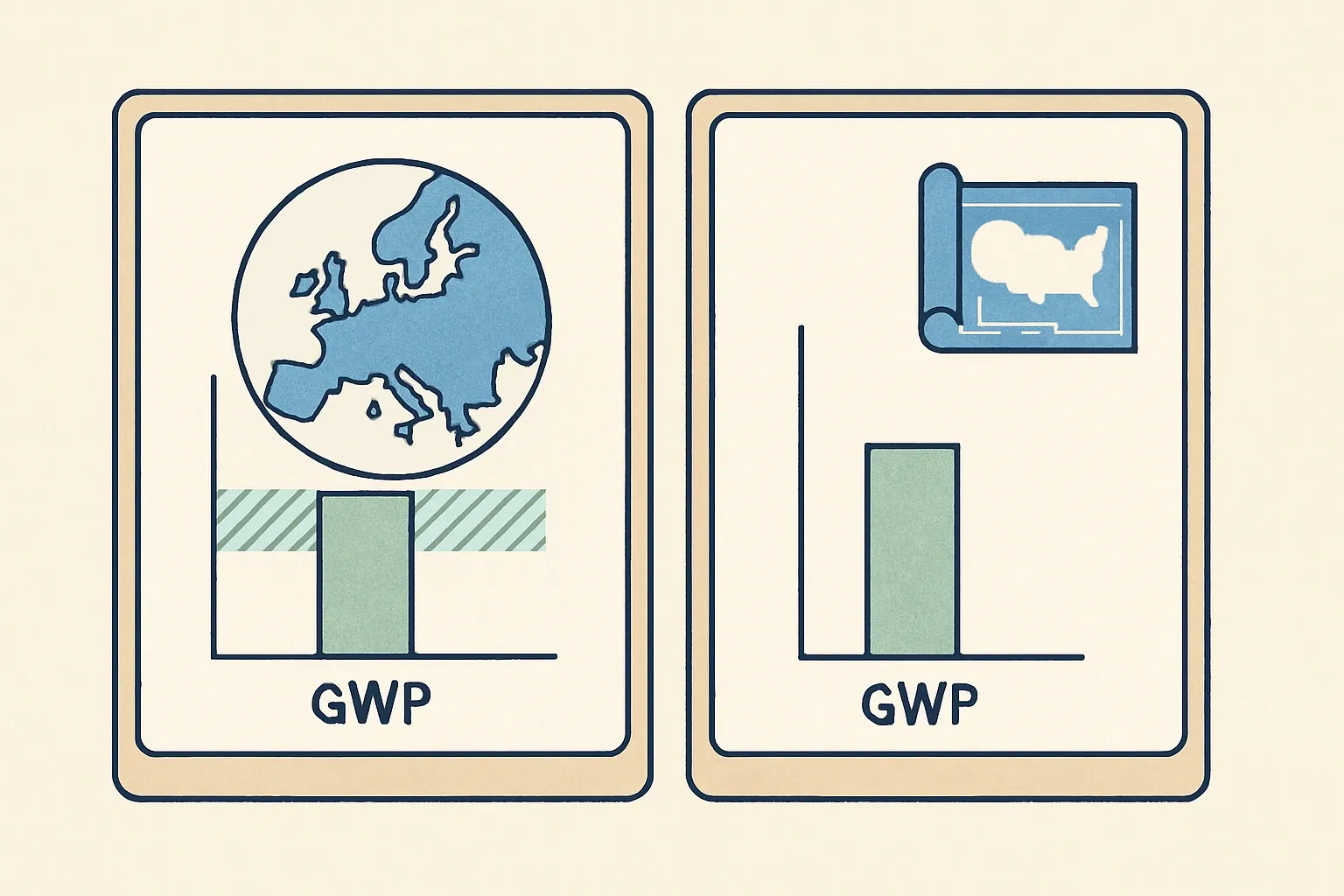
What each term really means
A site specific EPD reports impacts for one manufacturer’s product made at a named facility, using that facility’s real energy mix, materials, and yields. An industry average EPD represents a category using pooled data from multiple producers, typically a weighted mean under a shared PCR.
Think of the PCR as the rulebook of Monopoly. Ignore it and the game falls apart.
What specifiers actually value
Project teams want predictable carbon math. Product specific data reduces risk in bid models and whole building LCA tools, so it’s more likely to stay in the spec when targets tighten. Drafts of LEED v5 continue to differentiate between industry-average and product-specific submittals in materials credits, which keeps the incentive structure intact for higher resolution EPDs.
The carbon math problem with averages
Industry-average EPDs are useful, but they rarely reward above-average operations. Some markets even apply conservative multipliers to generic data. The Netherlands’ NMD adds roughly a 30 percent factor to category 3 generic datasets in its building environmental method, which can push a product over a project carbon threshold even if the real plant performs better (NMD, 2025).
When an industry average EPD is enough
You need a credible placeholder now to avoid automatic penalties for “no EPD.” You sell a low-volume SKU where plant-by-plant modeling would delay launches. Your market is early-stage on embodied carbon and simply asks for any verified Type III EPD.
Need clarity on EPD options for winning tenders?
Follow us on LinkedIn to learn how to leverage site specific and industry average EPDs for better project specifications.
When a site specific EPD pays off
Your plant runs on cleaner electricity, high recycled content, or tight scrap control, and you want that advantage quantified. You are in competitions where owners compare GWP line items side by side. You want resilience against tightening procurement baselines that increasingly prefer product-specific declarations.
Timelines, effort, and renewal cycles
The heavy lift is almost always data wrangling across utilities, bills of materials, and QC yields. A partner that runs white-glove collection inside your org shortens the clock and keeps senior engineers on core work rather than spreadsheet archaeology. Validity typically runs five years, so the effort amortizes across multiple bid cycles and product refreshes (EPD International GPI, 2024).
Multi-plant products without the headache
If the same SKU ships from several plants, use site specific EPDs per facility where performance diverges most, then route orders to the strongest EPD for carbon-critical projects. For uniform lines with tiny variance, a carefully built company-average EPD under the right PCR can be pragmatic.
Data quality that moves the needle
Foreground data from your reference year should be complete and auditable. Background datasets should be current and consistent with the PCR. If exact benchmarks for your category are scarce, say so in your submittal and document assumptions. That honesty protects submittals when reviewers kick the tires.
Quick decision checklist
- Is being above the industry mean credible for this product and plant. If yes, lean site specific.
- Is the immediate goal to meet a baseline requirement with minimal lift. If yes, industry average works.
- Do key buyers apply multipliers to generic data. If yes, site specific can avoid a hidden penalty.
The practical call
Both paths are valid. The question is whether you want to be graded on your plant or your peers. If your operations outperform, a site specific EPD turns that into spec power and protects price. If the priority is speed to compliant bids, an industry-average EPD gets you on the field today. That tradeoff is realy about control.