The quick verdict
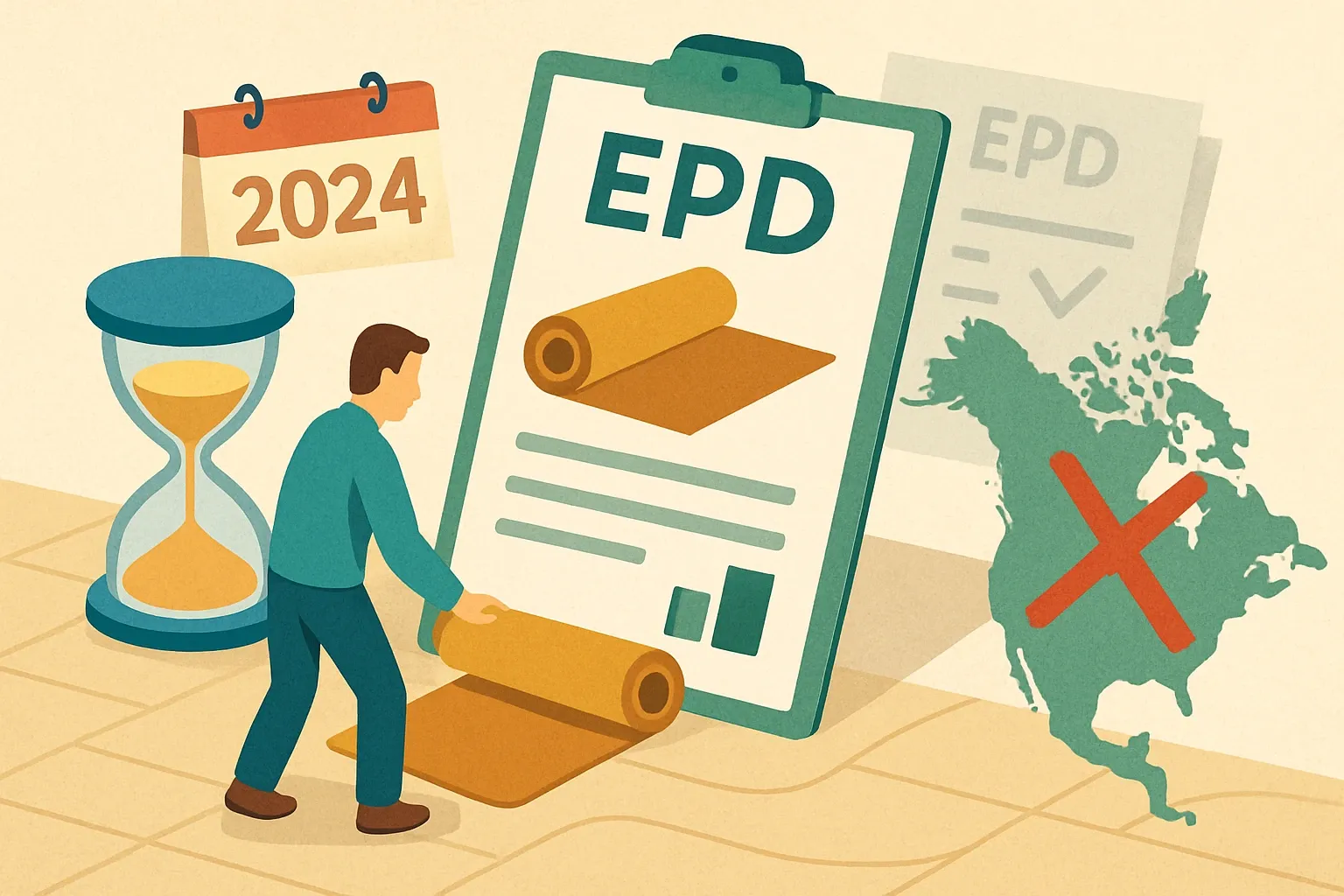
As of December 11, 2025, there is no active industry‑wide Environmental Product Declaration for linoleum flooring in North America. Europe previously had an association EPD for linoleum coordinated by the European Resilient Flooring Manufacturers’ Institute (ERFMI) and published through IBU, but that document reached its end of validity in March 2024 (ERFMI linoleum EPD, 2019).
Region snapshot: what exists where
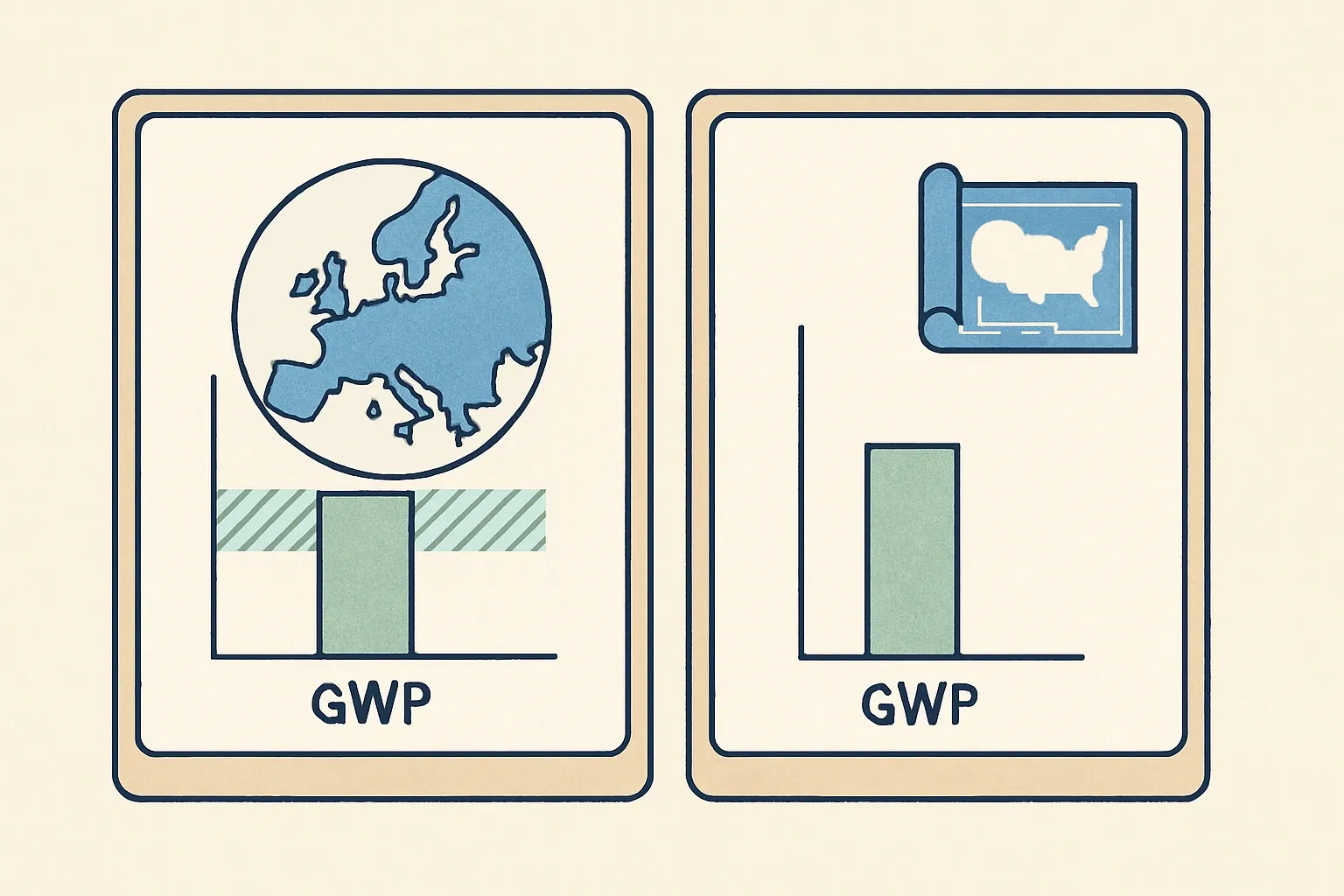
In the United States and Canada, the Resilient Floor Covering Institute hosts nine industry‑wide EPDs for resilient flooring categories like LVT, VCT, SVT, rubber, and rigid core. Linoleum is not on that list (RFCI, 2025). In Europe, ERFMI’s sector EPD covered plain and decorative linoleum under EN ISO 24011 and EN 15804, then expired in 2024. We did not find a published A2‑update by the association as of today.
Why that matters in projects
Many whole‑building LCA tools treat missing product‑specific EPDs conservatively. When a linoleum line lacks its own EPD, modelers often pull a generic factor that bakes in a safety margin. It is the equivalent of bowling with the bumpers up, useful yet rarely flattering to your product.
At a linoleum manufacturer or competing for specs?
Follow us for product-by-product insights that reveal EPD gaps and help you understand which linoleum lines win in today’s market.
The upside of going product‑specific
A product‑specific, third‑party verified EPD lets design teams use your measured global warming potential rather than a padded estimate. That reduces the risk your product gets dropped late in design when carbon budgets tighten. It also travels well across rating systems like LEED v5, national low‑carbon tenders, and client ESG requests.
Who already has product‑specific linoleum EPDs
Competitors are not waiting.
- Forbo Marmoleum lists multiple current linoleum EPDs, including sheet and modular variants with expiration dates running into 2028 and 2029 on its global EPD page (Forbo, 2025).
- Tarkett confirms new linoleum EPDs and communicates portfolio‑wide claims around low and even negative lifecycle results, verified by UL and tied to specific EPD numbers on its site. See Tarkett’s 2025 release for details and links.
- Gerflor’s DLW linoleum line communicates UL‑verified EPD coverage on its product page, signaling active, product‑specific transparency in the North American market.
What an association EPD is good for, and its limits
Industry‑wide EPDs are helpful when a sector wants a baseline and a common rulebook. They are inherently conservative because they average inputs and often exclude process improvements a single plant has achieved. If your plant already runs renewables, optimized formulations, or higher yields, an average masks that edge. A product‑specific EPD, built on your actual utility bills and formulations, captures the gains you have earned.
Practical next steps for linoleum manufacturers
Start by aligning on the reference year, data owners, and which program operator your customers prefer. Map your bill of materials, energy, and scrap flows at the recipe level, then confirm the correct PCR family used by peers. A focused data pull across purchasing, production, and EHS typically unlocks the LCA fast. Keep the door open for a future EPD renewal cadence so updates are routine rather than a scramble. Even small teams can move quickly if thier data handoff is clear.
Final word
If you were hoping to lean on a sector average EPD for linoleum, the market does not offer a current one in North America, and Europe’s last association document has lapsed. The manufacturers winning specs today show their work with product‑specific EPDs. That is where credibility, better numbers, and commercial leverage live.