From compliance to commercial orchestration
Freshly renewed EPDs are not a library. They are a searchable proof kit that shortens qualification, removes guesswork in submittals, and lets product teams talk in the same language as specifiers. Treat the portfolio like inventory that needs turnover, not storage.
Wire your EPD catalog into the funnel
Map every declaration to SKUs, regions, and key attributes like system boundaries and PCR versions. Sync that map to your CRM and bid tools so a rep can see at quote time if a product already satisfies a project’s EPD requirement. Think of it as turning on subtitles for the sales pipeline.
Spot the bids you can already win
Set up tender monitoring for keywords tied to standards, program operators, and rating systems. Public construction alone was roughly 493 billion dollars in 2024, a material slice of opportunity that often references EPDs in specs (U.S. Census Bureau, 2025) (U.S. Census Bureau, 2025). If your catalog covers the asked‑for format and scope, auto‑flag those RFPs and notify the account owner the same day.
Quote faster with fewer RFIs
Give sales teams a one‑pager per product that answers the usual blocker questions. Scope and modules. Reference year. Program operator and verifier. Machine‑readable file location. When procurement asks, the response is ready in minutes, not days. Fewer back‑and‑forth emails means you hold pricing conversations on time.
Want to turn EPDs into revenue-generating assets?
Follow us on LinkedIn for insights on leveraging EPDs to win more tenders and boost your bottom line.
Measure the uplift from EPD‑backed bids
Track performance at deal level and by product line.
- Tag opportunities where the submitted package included a product‑specific EPD.
- Compare win rate, discount depth, and cycle time against similar deals without EPD backing.
- Roll up insights monthly so product leads can see where EPDs are defending margin or accelerating close. If the numbers are noisy, say so plainly and expand the sample before you act.
Decide the next EPDs with evidence
Use three lenses. Demand lens: where RFP monitoring shows repeated EPD asks by region or owner type. Revenue lens: high‑volume SKUs with close‑loss notes citing “no EPD.” Risk lens: PCR updates that will force work anyway. Prioritize the overlap and time renewals to keep the portfolio balanced across your biggest bid markets.
Keep the portfolio fresh without the panic
Most construction EPDs carry a five‑year validity window, set at verification, with mid‑cycle updates if impacts worsen beyond thresholds (EPD International FAQ, 2025) (EPD International, 2025). Build an annual internal review rhythm into sales operations so expiries never surprise a bid team. Where markets run on national databases, growth signals are clear. INIES listed 5,213 FDES and 1,846 PEP on January 14, 2026, showing active use by design teams who expect current declarations in their tools (INIES, 2026) (INIES, 2026).
What “platform‑led” looks like in practice
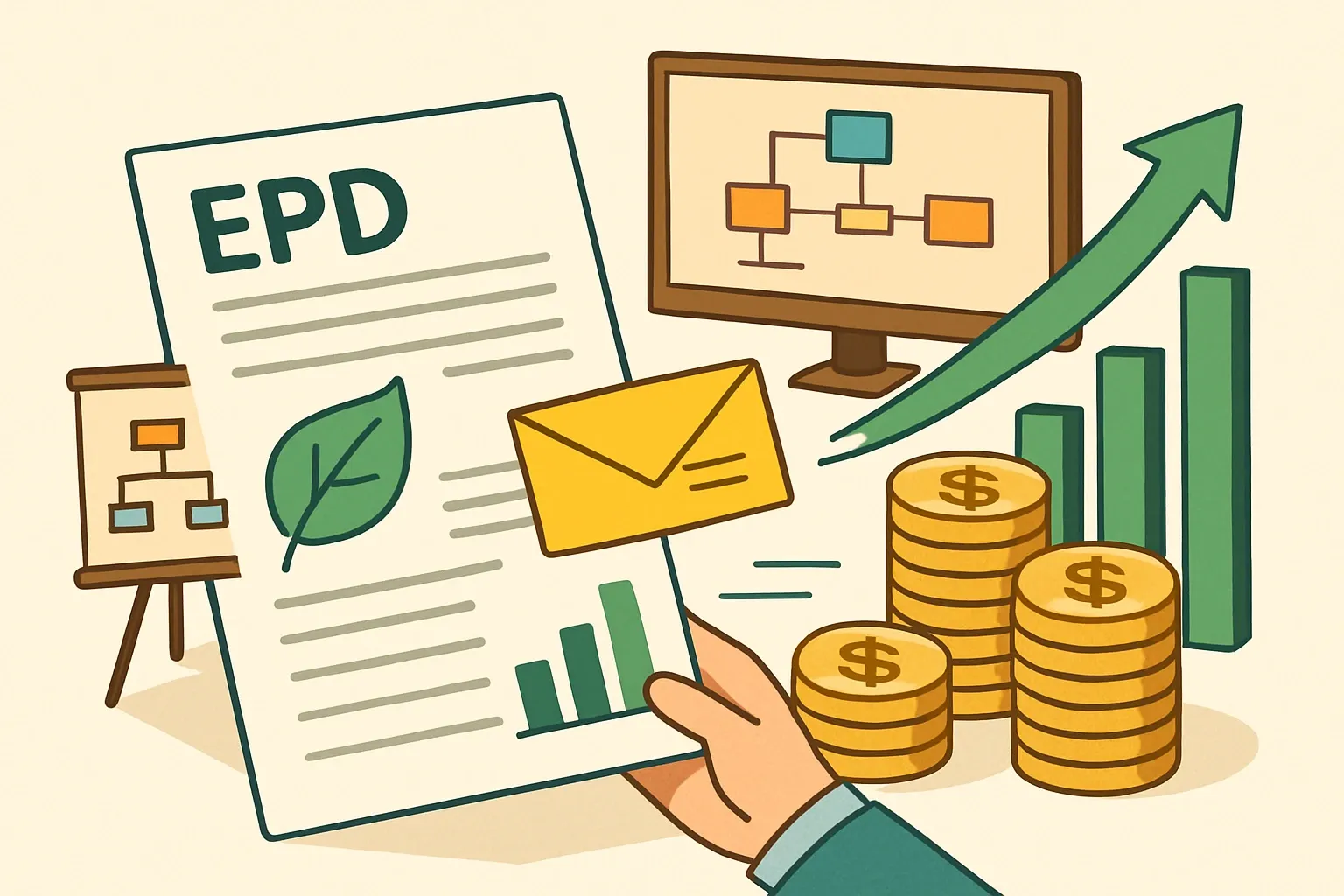
The platform connects your EPD catalog to bid intake, normalizes document metadata, and writes results back to CRM. It also scores tenders by “ready to submit” versus “needs new work,” then surfaces pricing and win‑rate patterns tied to EPD‑backed offers. The payoff is practical. Reps chase more qualified work. Product managers see proof on where to invest the next declaration. Finance sees a cleaner link from environmental paperwork to earned revenue.
Make the declarations earn their keep
We do not need to over‑sell the idea. Use the renewals as the start line, wire the data into the front office, and let the feedback loop direct your next EPD. When environmental documentation lives inside sales workflows, it stops being a static archive and starts behaving like a growth asset.