Where the 2026 range comes from
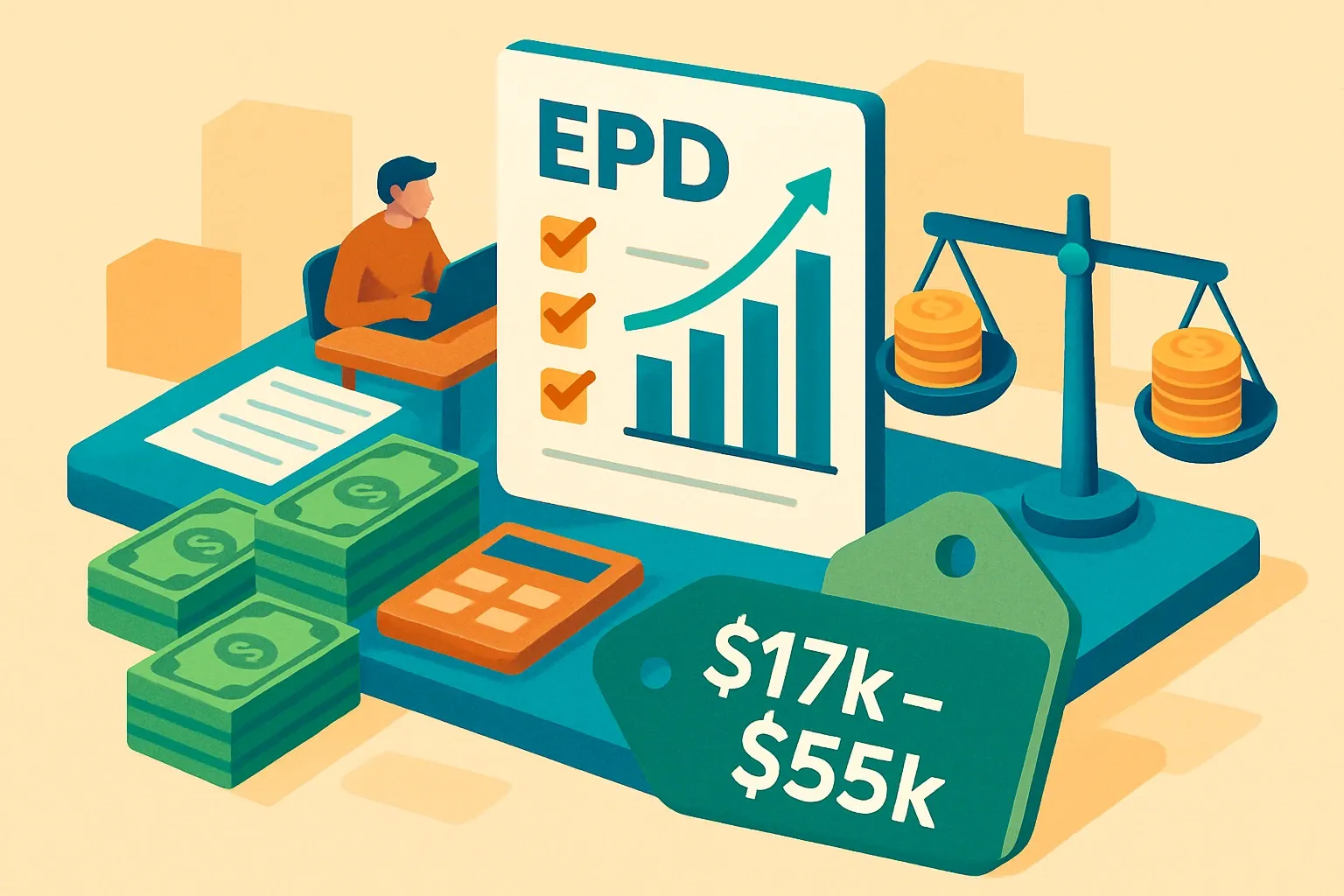
The most cited survey of EPD costs put the total for an EPD and the associated PCR at USD 13,000 to 41,000 in 2017 (Tasaki et al., 2017). Using the U.S. Consumer Price Index-U from November 2017 to November 2025, prices rose about 31 percent, which lifts that band to roughly USD 17,000 to 54,000 in early 2026 dollars (BLS CPI News Release, 2025). That is why we say plan for about $17k to 55k.
Publication and verification fees are a slice, not the pie
Program operators publish their fee tables, which helps you separate fixed platform costs from the LCA lift. The International EPD System lists a registration fee of €1,000 for the first EPD in a year and annual fees of €500 to €2,500 depending on organization size (EPD International, 2025). IBU announced a verification fee adjustment to €2,700 effective September 1, 2025, citing higher external verifier costs (IBU, 2025). NRMCA verification fees begin around $1,250 for small plant sets, with higher tiers for larger submissions (NRMCA, 2025). These numbers are meaningful, yet most of the budget still sits in the LCA modeling and data work.
Why one product costs more than another
Think of an EPD like producing a season of a show. One location and one cast is quick. Multiple locations, special effects, and guest stars add cost. Common cost drivers include the number of plants, supply chains, and SKUs modeled, whether site energy data and bills are easy to pull, and whether a current PCR is available that truly fits the product. Multi-region supply mixes and custom formulations lift effort. A clean data room and a clear PCR keep the scope tight.
Curious about what an EPD for your product would cost?
Follow us to get a free instant quote for your EPD project. No commitment required.
Scale changes the math
Very similar products can often be modeled as a family with shared data and parameter variation. That reduces marginal cost for each added EPD in the set because process maps, background datasets, and quality checks are reused. This is why multi-EPD portfolios often land below a simple per-product multiple. It is also why operators offer stepped or volume-based publication fees that reward batches (EPD International, 2025).
What you actually pay for
An all-in project typically covers scoping, data collection and QA, LCA modeling, drafting the EPD to the chosen standard, independent verification, and publication under a program operator. Expect third-party verification to account for only a portion of the total even with the recent fee updates (IBU, 2025). The heavy lift is collecting dependable primary data and turning it into a robust, auditable model.
Inflation and 2026 planning
We inflation-adjusted the 2017 survey to today using BLS CPI-U so you can plan in current dollars. BLS reported the November 2025 CPI-U at 324.122 versus 246.669 in November 2017, which is roughly a 31 percent step up (BLS CPI News Release, 2025). If inflation runs close to recent monthly prints, your 2026 budgets will stay in the same corridor. If tariffs or energy prices flare, build a small contingency.
How to keep the bill in check without cutting corners
Aim for data readiness first. Decide on the PCR and program operator early. Lock the product list and plant set so the model does not creep. Use a process that does the legwork for you and reduces internal time from engineering and operations. That time saved is often the real ROI, since product teams can keep shipping instead of spreadsheeting.
When costs move above the band
Two patterns push above USD 55k. First, complex portfolios that require separate, bespoke models for many variants. Second, brand new categories that need a fresh PCR, which adds time and expert effort on top of the EPD itself (Tasaki et al., 2017). If you see either pattern, expect a wider range and a longer clock.
Want a tailored ballpark for your products
Every scope is different. If you want a quick estimate for your specific mix of SKUs and plants, we can share a defensible band in a short call. Message me on LinkedIn and we will reply with a rough number that fits your case.
P.S. If you want more detail on cost components, our earlier explainer is a good companion read. And yes, an EPD still pays for itself on even one mid sized spec win.