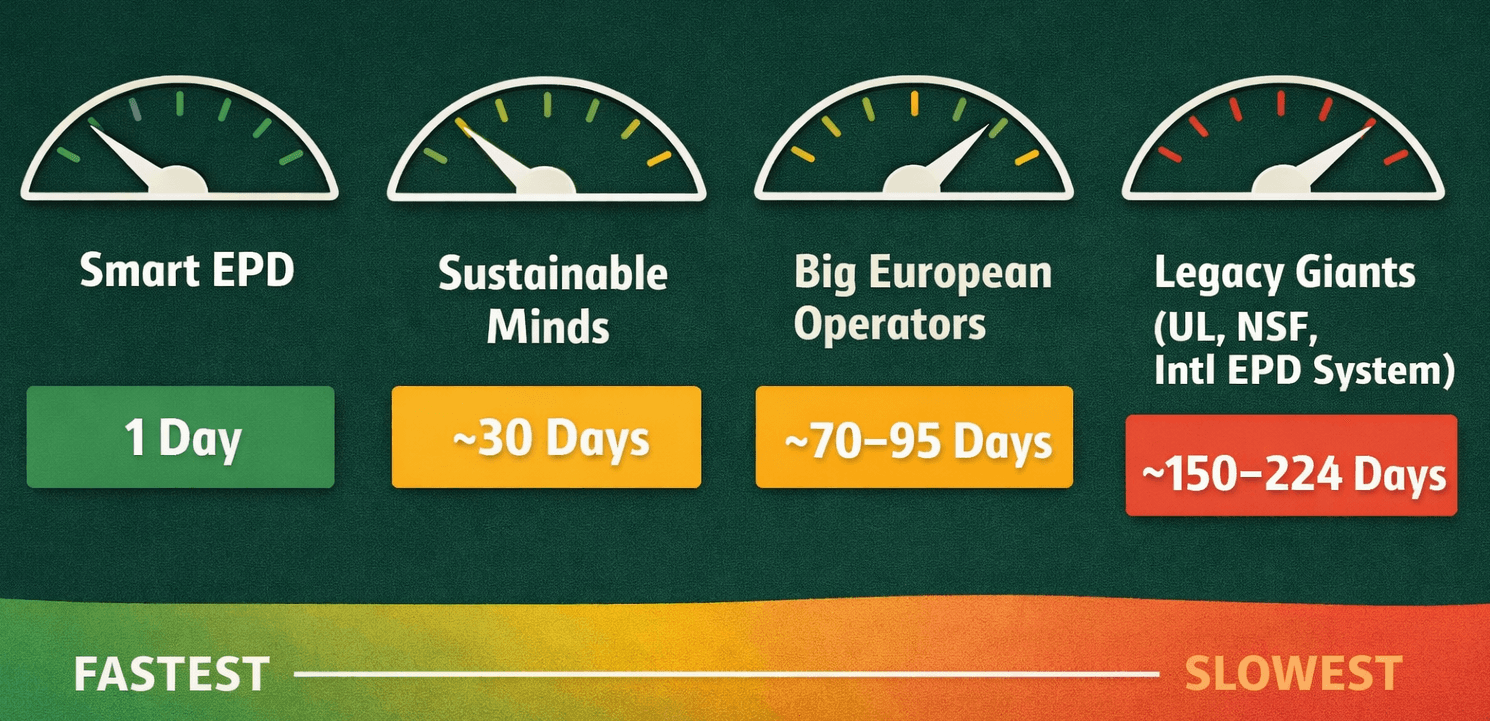
Architect & Specifier Visibility beats Issuance
An EPD is a runway light. It guides specs only when it is on. Time-to-EC3 governs how quickly your product shows up in the shortlists that teams use during design and procurement.
Fast visibility means your sales team starts having better conversations sooner. Slow visibility means projects move on without you. Simple as that.
What we measured
We looked at 37,017 EPDs with both an official issue date and an EC3 publish timestamp. For each record, we measured Mhe lag between those milestones, and filtered out delays longer than one year so edge cases from multi‑year batch uploads would not skew results. We then calculated median lag by program operator.
The leaderboard: Median Days from Issue to EC3
Here is the distribution, ordered from fastest to slowest. Same EPD rigor, very different time to market.
| Program operator | Median days to EC3 visibility |
|---|---|
| Smart EPD LLC | 1 |
| Sustainable Minds | 30 |
| EPD Ireland | 47.5 |
| ASTM International | 57 |
| ift Rosenheim GmbH | 61 |
| Labeling Sustainability Inc. | 65 |
| INIES | 72 |
| EPD International AB | 86 |
| Association P.E.P | 95 |
| EPD Hub | 116 |
| SCS Global Services | 117 |
| UL | 154 |
| EPD Australasia | 155 |
| NSF International | 167.5 |
| EPD Italy | 169 |
| Danish Technological Institute | 177 |
| EPD Norway | 182 |
| ITB | 202 |
| IBU | 208 |
| SuMPO | 210 |
| The International EPD® System | 224 |
| BRE Global | 289 |
| NREL | 340 |
Why this gap exists
Some operators run digital-first workflows that push records into EC3 within hours. Others rely on periodic batching, manual ingestion, or rely on Building Transparency (the team behind EC3) to do the work. Think airport immigration. One line moves with e‑gates, another crawls with paper forms and a single open lane.
The sales math of lost days
Most program operators set EPD validity at five years, which defines the commercial life of a declaration. A 154 day median lag trims roughly 8 percent of that life. A 224 day lag trims about 12 percent. That is time when architects and specifiers might not discover your EPDs in the tool belt they're familiar with (e.g. AutoDesk Revit which integrates EC3 data).
Cohort check for stability
We repeated the calculation by issue year to test for flukes. For 2024, Smart EPD LLC and ASTM International stayed under two weeks, while Association P.E.P, UL, and The International EPD System remained in the 66 to 224 day lane. For 2023, SCS Global Services was quicker at 32 days and the same European and global operators clustered at 170 to 276 day medians. The same general pattern holds.

What to ask before you pick a program operator
- What is the typical lag from EPD issue to EC3 publication for your program operator you're considering, measured in days?
- Do they have a direct, automated handoff into EC3 or is it a periodic batch upload/manual?
ROI framing your CFO will accept
EPDs change the pricing conversation because many project teams apply conservative default factors when a product lacks a product-specific EPD. That penalty disappears once your declaration is visible, which improves win rate without cutting price. One mid sized project can cover the full effort, yet months of avoidable lag delay that payback.
Architects and specifiers increasingly look up EPDs in the tooling they're used to, so that means they'll model with what's available in AutoDesk Revit. Procurement teams at companies like Google use custom EC3 portals to check suppliers they're considering for EPDs, so EC3 is gaining importance to get considered in billion-dollar data center projects without specifiers having to hunt down your EPD through Google searches.
How to move faster without cutting corners
Pick the operator based on time-to-visibility, verification clarity, and data portability. Ask your LCA partner to handle the operator onboarding, manage the submittal, and confirm the EC3 availability. Keep data collection ruthlessly organized so your experts are not stuck hunting meters and invoices for weeks. Quality and rigor stays high. Speed improves. Everyone sleeps better, speficiers included.
The takeaway
Operator choice is not a paperwork footnote. It is a sales lever. If your median sits in the 150 to 224 day band, you are gifting competitors a quarter to half a year of first look. Smart performers get visible in a day. Decide which line you want to be in.