LEED v5 flips embodied carbon from nice‑to‑have to must‑do
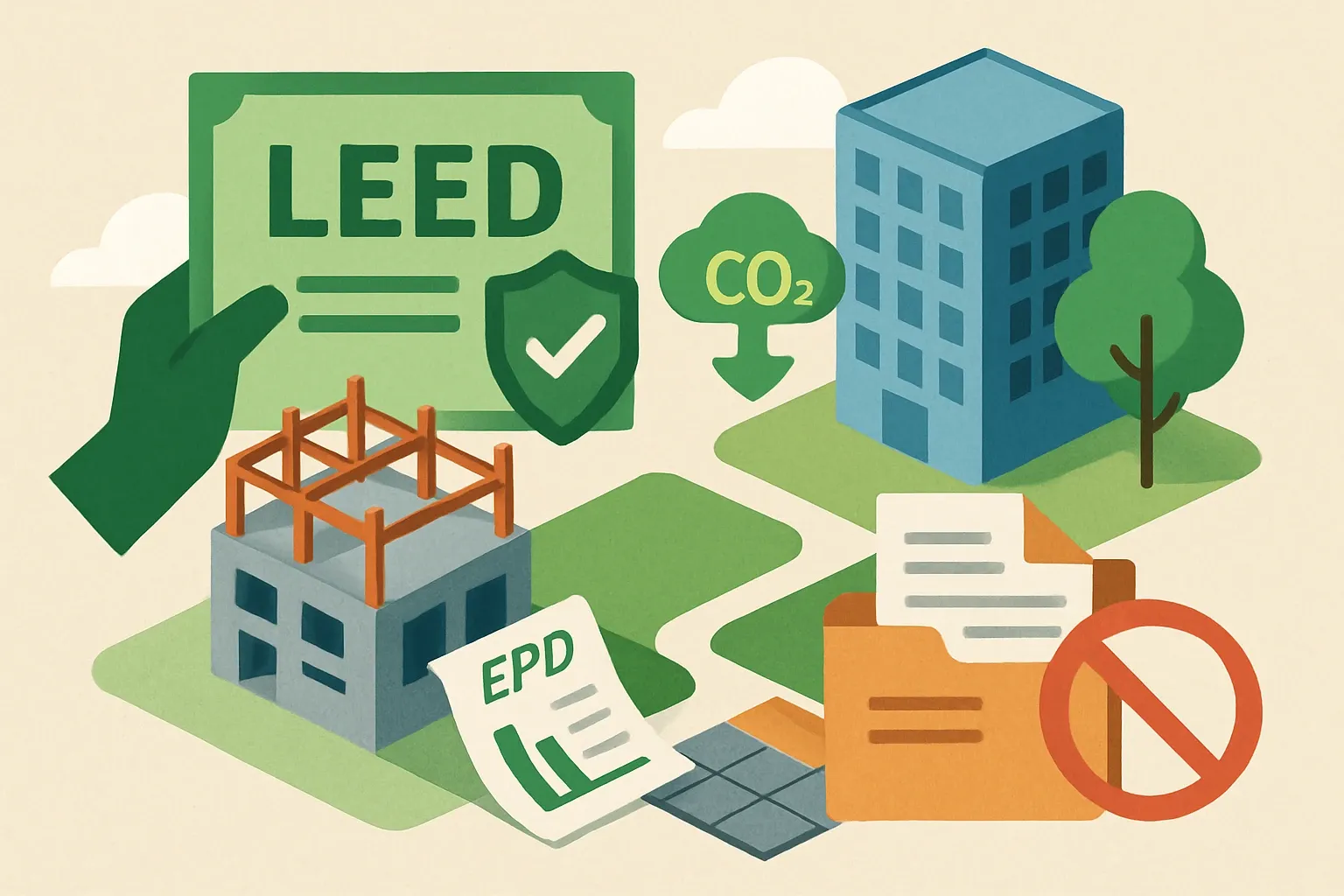
LEED v5 was ratified in 2025, and it adds a new prerequisite to quantify cradle‑to‑gate embodied carbon for core building materials, across projects that want to certify at any level (USGBC, 2025) (USGBC Summary of Changes, 2025). Think of it like showing up at airport security. No ID, no gate. No verified carbon numbers, no LEED.
Why product‑specific EPDs are now the market passport
The new Materials and Resources framework gives credit value to products that disclose impacts with product‑specific Type III EPDs, and it reserves higher recognition for verified reductions shown through comparative EPDs. Industry‑average EPDs serve mainly as baselines and do not unlock the higher scoring levels in v5’s product selection credit (USGBC BPSP Criteria, 2025). In plain terms, generic data got downgraded, specific data got promoted.
Platinum raises the bar to a 20% cut
LEED v5 introduces a 20% embodied carbon reduction requirement associated with Platinum pathways, with reductions documented via WBLCA or EPD‑based analysis as defined in the new credit structure (USGBC Summary of Changes, 2025). This moves decisions from counting paperwork to proving performance.
The spec effect of “industry average” in v5
In v4.1, industry‑average EPDs could still contribute, although often at half value. In v5, they mainly act as the comparison floor while product‑specific EPDs earn Level 1 recognition and enable Level 2 or 3 when verified improvements pass 20% or 40% respectively (USGBC BPSP Criteria, 2025). That is why teams chasing high‑level certification are far more likely to shortlist products with current, product‑specific EPDs.
Join Parq Pulse!
Our weekly newsletter for manufacturers mobilizing product and environmental insights to remain competitive and win more projects.
Registration sunsets are forcing project choices now
USGBC and allied councils have set clear timelines to close most v4 and v4.1 registrations by June 30, 2026, with sunset windows for completion after that date (CAGBC, 2026) (CAGBC, 2026). Design teams are planning to v5 scorecards, so missing product‑specific EPDs increasingly removes products from early alternates lists.
How reductions are actually documented
Teams have two practical routes. A whole‑building LCA that shows lower GWP for major assemblies, or an EPD analysis where category totals beat industry baselines using product‑specific Type III EPDs for the products that carry the most carbon. Level 2 crediting hinges on a verified comparative EPD that proves at least a 20% GWP drop from a baseline EPD or an industry‑wide benchmark, with clear narratives on what changed in manufacturing (USGBC BPSP Criteria, 2025).
ROI, without the hand‑waving
Reliable cost averages are hard to pin down because every product and plant boundary is different. What is consistent is the commercial math. Product‑specific EPDs remove penalty assumptions in v5 analysis, keep products eligible for EPD‑based pathways, and protect access to a global pipeline of 195,000+ LEED projects that continue to expand year over year (USGBC Impact Report, 2024). One spec win on a mid‑size job can repay the paperwork, then some.
Getting from data chaos to a publishable EPD quickly
Speed lives in the data collection. The fastest paths centralize utility pulls, bill of materials, and transport data, then map them to the right PCR with an operator‑agnostic plan to publish in the US or EU, for example Smart EPD or IBU. A white‑glove approach that chases internal data on your behalf is often worth more than a marginal tooling discount, because it frees R&D, product, and plant teams to focus on improvements instead of inbox archaeology.
What manufacturers should do this quarter
- Identify the top three carbon‑intensive SKUs by sales volume or steel‑and‑concrete adjacency, then commission product‑specific Type III EPDs.
- Confirm the PCR and program operator path that aligns with your competitors, renewal timing, and target geographies.
- Set a realistic 12‑ to 18‑month plan to document at least a 20% improvement on one flagship product, so design teams can claim Level 2 value in v5.
The takeaway for specs and sales
LEED v5 rewrites the rules of engagement. Product‑specific, externally verified EPDs are the entry ticket, and verified reductions are the playoff run. If a product only carries an industry‑average EPD, it is definitley starting on the bench in projects pursuing ambitious v5 outcomes.