Why EPDs change revenue conversations
Specifications increasingly penalize products without a product specific EPD, which means teams compete on price instead of performance when the document is missing. With LEED v5 moving through beta and placing more weight on embodied carbon transparency, product level data is becoming table stakes for many projects (USGBC, 2024).
The ROI equation you can defend
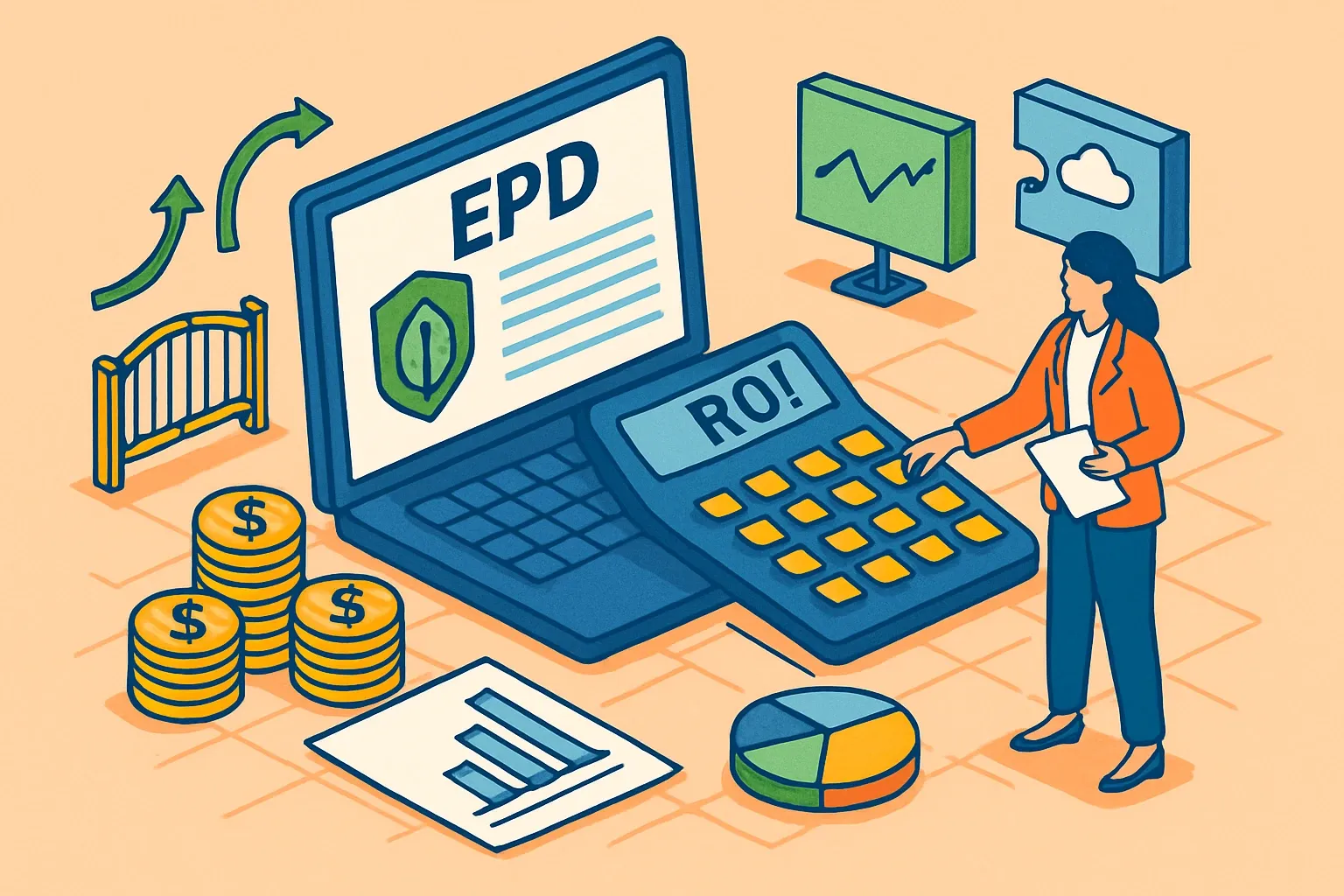
Treat an EPD like a five year commercial asset. A practical model many finance teams accept looks like this: ROI equals [(Projects won because of EPD × Average revenue × Gross margin × Win uplift) plus Avoided internal cost] minus EPD cost, all divided by EPD cost. Run it across the validity window rather than a single quarter so the picture is complete.
Turn assumptions into numbers
Start with a short list of bids where an EPD was requested and your product was comparable on performance. Ask sales to mark whether lack of an EPD blocked pursuit. Pull average deal size and blended margin from finance. For win uplift, use a conservative percentage tied to situations where an EPD removes a penalty in carbon accounting rather than guessing across every deal.
A worked example you can copy
Imagine three additional specs per year become viable because the EPD exists. Average revenue is 600,000 each with a 25 percent margin. You assume a 20 percent uplift attributable to the EPD and you identify 12,000 a year in avoided internal analyst hours. Over five years your incremental margin equals 3 × 600,000 × 0.25 × 0.20 × 5 which is 450,000 and avoided cost totals 60,000. If your quoted EPD cost is C then ROI equals [(450,000 + 60,000) − C] ÷ C. Plug in C from your vendor quote to get the percentage.
Ready to turn EPDs into revenue generators?
Follow us on LinkedIn for insights on how to leverage EPDs for winning tenders and boosting your bottom line.
What counts as cost in the model
Include external LCA modeling and third party verification. Add publication fees with your chosen program operator. Add internal time for data pulls, plant metering, and supplier requests. If software seats or database licenses are required for data collection, count them. Do not forget opportunity cost when senior engineers are pulled off production work.
Validity window and timing really matter
Most EPDs are valid for five years under the major program rules, which is the planning horizon your ROI should use (ISO 14025, 2018) (EPD International GPI, 2023). Some operators allow limited extensions with checks, although details vary by scheme (UL Solutions EPD Program, 2024).
Policy and procurement signals to track
Federal incentives shifted in early 2025, which means teams should confirm current Buy Clean and owner requirements before assuming credits or rebates. Even with national policy noise, many public owners, higher education systems, and private developers continue to request product specific EPDs in solicitations. Treat those requests as direct leading indicators in your pipeline.
Build the spreadsheet in 15 minutes
Create inputs for Projects gained, Average revenue, Gross margin, Win uplift, Avoided internal cost, EPD cost, and Validity years. Add a sensitivity tab that varies margin and win uplift across low, base, high cases. Output three numbers that executives care about: payback period in months, five year ROI percentage, and breakeven number of projects.
Pick the first product with intent
Choose a high volume item with frequent specs in verticals that reference embodied carbon. Favor a product where competitors already publish EPDs so your gap is obvious in prequal reviews. If you have a new product with limited data, consider whether a prospective EPD path is possible, then plan to refresh once a full reference year of production data exists.
Partner selection shapes ROI as much as the math
The fastest returns show up when internal effort is low and verification is clean the first time. Look for a partner that handles white glove data wrangling across plants and suppliers, knows how to select the right PCR for your category, and can publish with the operator your market uses most. The less time your R and D and plant teams spend hunting invoices and utility records, the more the EPD behaves like a true commercial asset.
Bring it home with a simple decision rule
If the five year incremental margin plus avoided cost is at least two times the total EPD cost, greenlight the work. If it falls short, adjust the scope or timing and re run the assumptions. When the input data is uncertain, state it plainly and proceed with the conservative case. The goal is clarity more than optimism.