What the CMF Data Module actually is
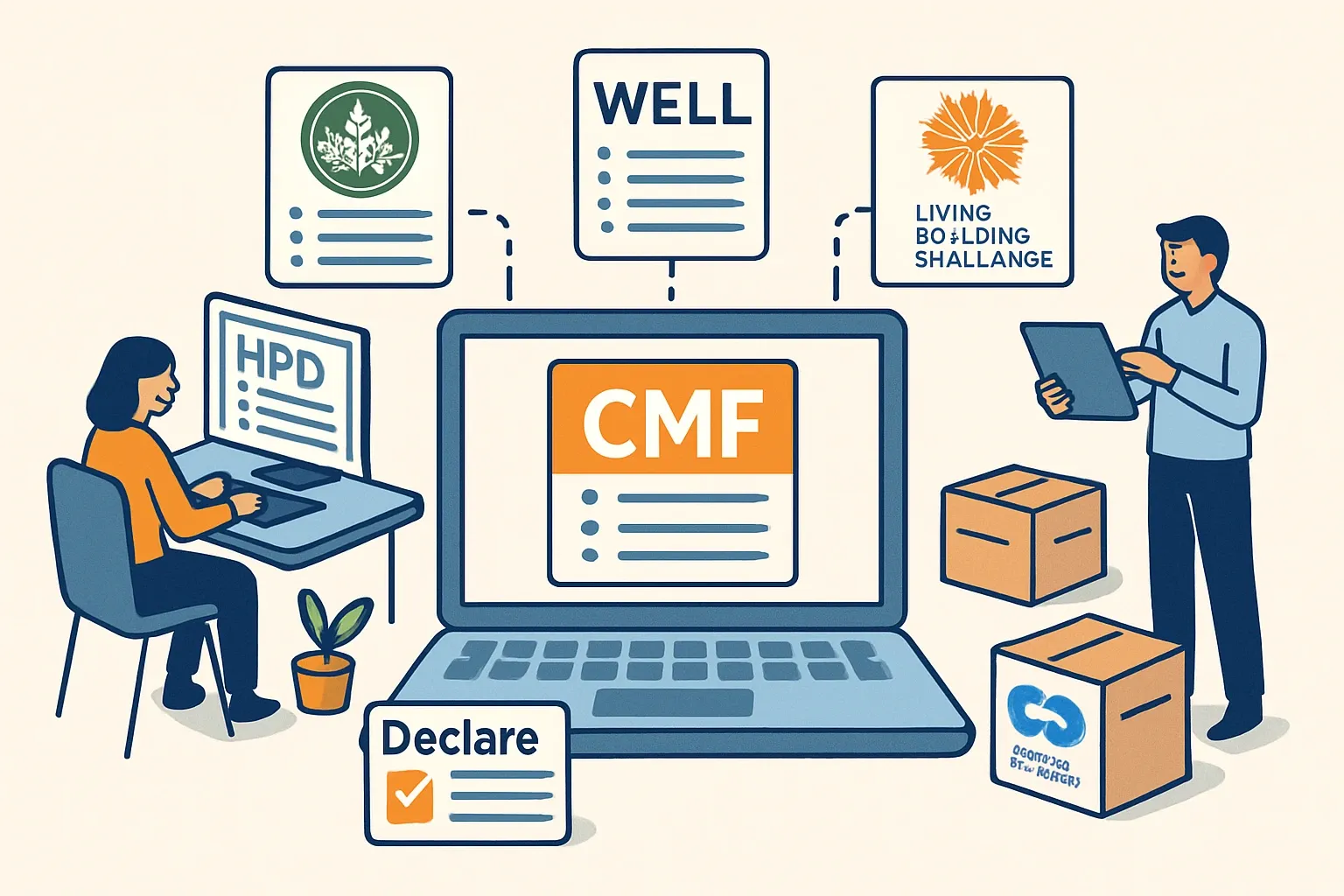
Think of the CMF Data Module as the universal power adapter for material health data. It standardizes the fields inside your HPD into a shared schema that other platforms can read without retyping. When data lives in a common language, it stops getting lost in PDFs and starts moving across rating systems.
Why this matters in LEED v5 and beyond
LEED v5 formally recognizes HPDs that meet specific transparency and repository requirements, which means clean digital HPD data is now directly useful in credits rather than stuck as an attachment (USGBC, 2025). WELL and the Living Building Challenge also accept ingredient and hazard disclosures, so one high quality HPD can do real work across multiple pathways instead of creating parallel paperwork.
The scale is already here
Manufacturers have published more than 14,000 HPDs from almost 1,000 companies, covering over 40,000 products, and more than 6,000 project teams have used material health disclosures to earn LEED credits (HPDC, 2025). The HPD Repository adds about 250 new HPDs each month, so the pipeline of digital‑ready data keeps growing (HPDC Repository, 2025). With this volume, a shared data module is not a nice to have, it is infrastructure.
Goodbye swivel chair work
Before CMF, someone copied ingredient lists from the HPD into a LEED worksheet, then into a Declare form, then again into a C2C submission. The steps were the same, the field names were slightly different, and errors crept in. CMF maps those fields and keeps a single source of truth so updates cascade to each destination.
Join Parq Pulse!
Our weekly newsletter for manufacturers mobilizing product and environmental insights to remain competitive and win more projects.
ROI in plain sight
Every duplicate submittal costs time and introduces risk. When one approved data record powers multiple certifications, teams answer specifier requests faster, reduce rework after reviews, and keep products visible in digital libraries where selection happens. There is no reliable cross industry time study yet, but the direction is obvious because fewer hand‑offs mean fewer chances to stall a bid.
How it connects to Declare and Cradle to Cradle
The same HPD ingredient and hazard data often populates Declare and supports C2C Material Health evidence. CMF creates the crosswalk so those fields transfer cleanly. You organize once, then route to the right questions in each program without rebuilding the packet.
What to prepare now
- Publish a complete HPD to 1,000 ppm in the HPD Repository and use the pre‑check features that align with LEED v5.
- Adopt stable product identifiers and version control so downstream tools can sync instead of creating duplicates.
- Map internal PLM or ERP attributes to CMF fields so future HPDs auto‑populate from your master data.
- Store evidence files in a consistent structure so third party verification steps move quickly across programs.
- Work with a partner that actually collects data from your plants and suppliers, not one that hands you a blank template and a deadline.
Risk controls worth keeping
Automation does not replace review. Keep an internal gate for chemistry changes, supplier substitutions, and site moves. If your EPD team updates electricity or transport datasets, check whether those changes affect any HPD content that flows into other tools. Single source of truth only works if that source stays current.
Early signals to watch
Mindful MATERIALS and HPDC have been laying the groundwork with implementation toolkits and crosswalks so the 2026 data modules land in a ready ecosystem. As LEED v5 guidance continues to roll out and more platforms consume CMF‑aligned fields, expect specifiers to prefer products that sync in seconds over those that arrive as static attachments.
The practical takeaway
Organize HPD data once in the CMF shape, then let the machines do the heavy lifting across LEED v5, WELL, and LBC. Your team spends less time copying rows, more time winning specs. That is the whole point of digital product data.