BNB in a nutshell
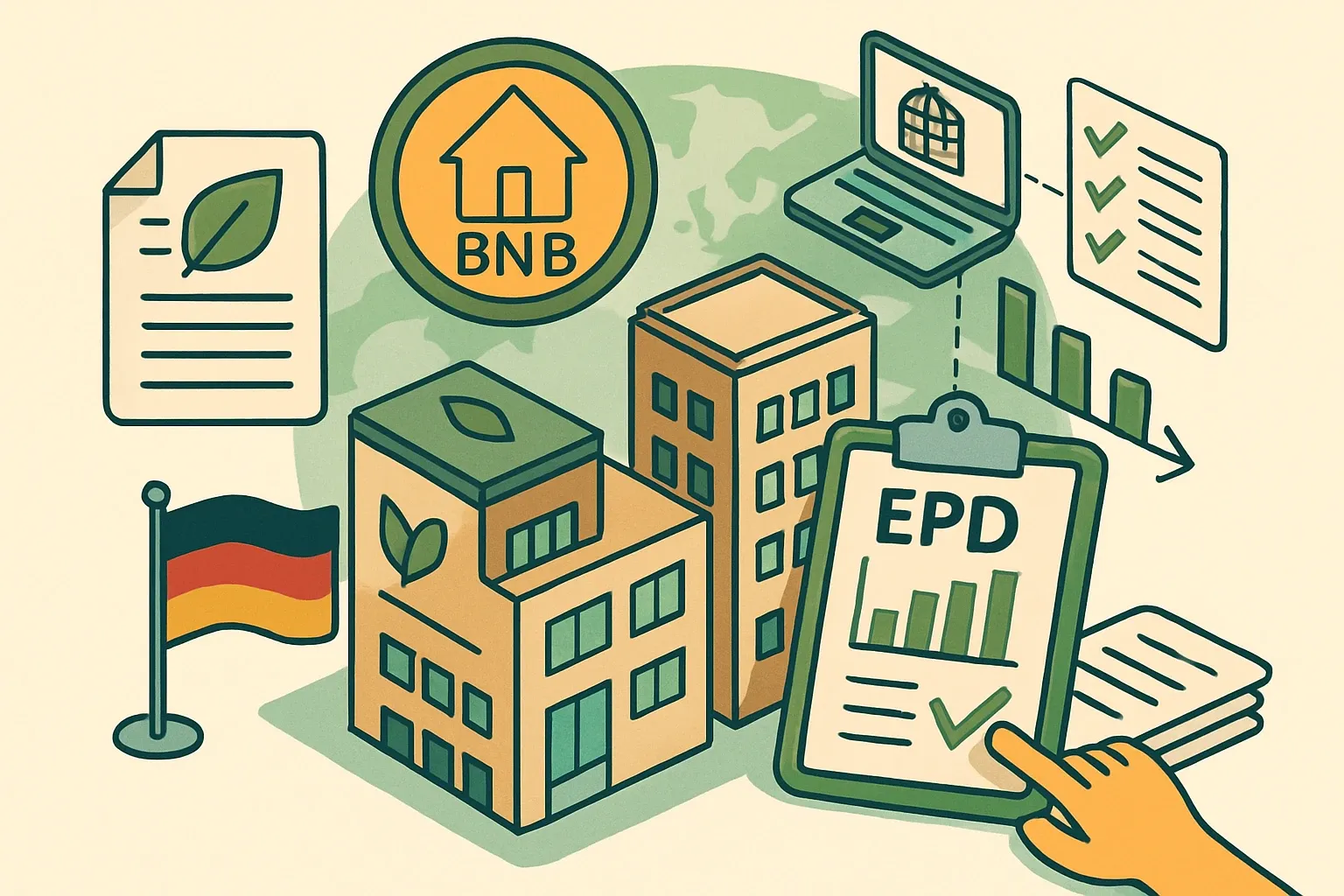
BNB is Germany’s federal sustainability assessment for buildings. It is used most often on public projects and mirrors how engineers think about a building across its whole life. The method groups requirements into ecological, economic, sociocultural, technical, and process quality, with site features reported separately.
The scoring basics you must grasp
BNB evaluates through criteria profiles that each run on a 100 point scale, with a reference level at 50 and a threshold at 10 that must be met. Criteria are weighted by significance factors from 1 to 3, which collectively shape the final result (BNB Methodology and Usage, 2025) (BNB, 2025). The six main criteria groups frame the big picture and guide where product data matters most (DIBt, 2025) (DIBt, 2025).
Where EPDs move the needle
EPDs power the building LCA that feeds BNB’s ecological quality. If your product performs better than the generic benchmark, the overall LCA improves and the project’s score tracks upward. Think of generics as the default soundtrack and product‑specific EPDs as the remastered version that sounds sharper and scores better.
Data that counts in BNB
Project teams calculate the building LCA to EN 15978 using datasets conforming to EN 15804. ÖKOBAUDAT is the binding database for BNB, hosting generic datasets and verified EPD data that meet additional quality gates. When your EPD is present there, it drops straight into eLCA, the federal online tool, with fewer questions and fewer spreadsheets.
Winning German public projects with EPDs?
Follow us on LinkedIn for insights on how to leverage BNB readiness and boost your specifications.
Why this matters commercially
Without a product‑specific EPD in ÖKOBAUDAT, modelers often use conservative defaults. That can create a penalty that makes switching to a competitor with an EPD the lower‑risk choice. An EPD lets sales teams step into BNB‑tracked projects early, keep price out of the only‑decider seat, and stay in the spec when design options are compared.
Build a BNB‑ready EPD play
Start with the PCR your competitors rely on, aligned to EN 15804. Publish through a program operator that supports ÖKOBAUDAT ingestion, then validate formatting so datasets import cleanly into eLCA. The simpler you make this handoff, the faster design teams can prefer your product.
Operational shortcuts that protect your team’s time
Gather one clean reference year of factory data. Map utilities, production volumes, and scrap with clear site boundaries so reviewers don’t bounce it back. For new lines, plan for a prospective EPD that you refresh after a full year of production so specs are never delayed.
A short to‑do list for manufacturers
- Confirm the target PCR and any operator‑specific templates your market expects.
- Prepare an ÖKOBAUDAT‑ready dataset so eLCA users can pull it in seconds.
- Create a one‑page LCA summary that highlights the drivers buyers actually compare.
Bringing it together
BNB rewards credible, building‑level math. EPDs are the data key that unlocks that math and makes your product easy to choose. Do the quiet work up front and your bids read as low‑friction, high‑confidence choices when the LCA and BNB score are on the line.