What Module B actually covers
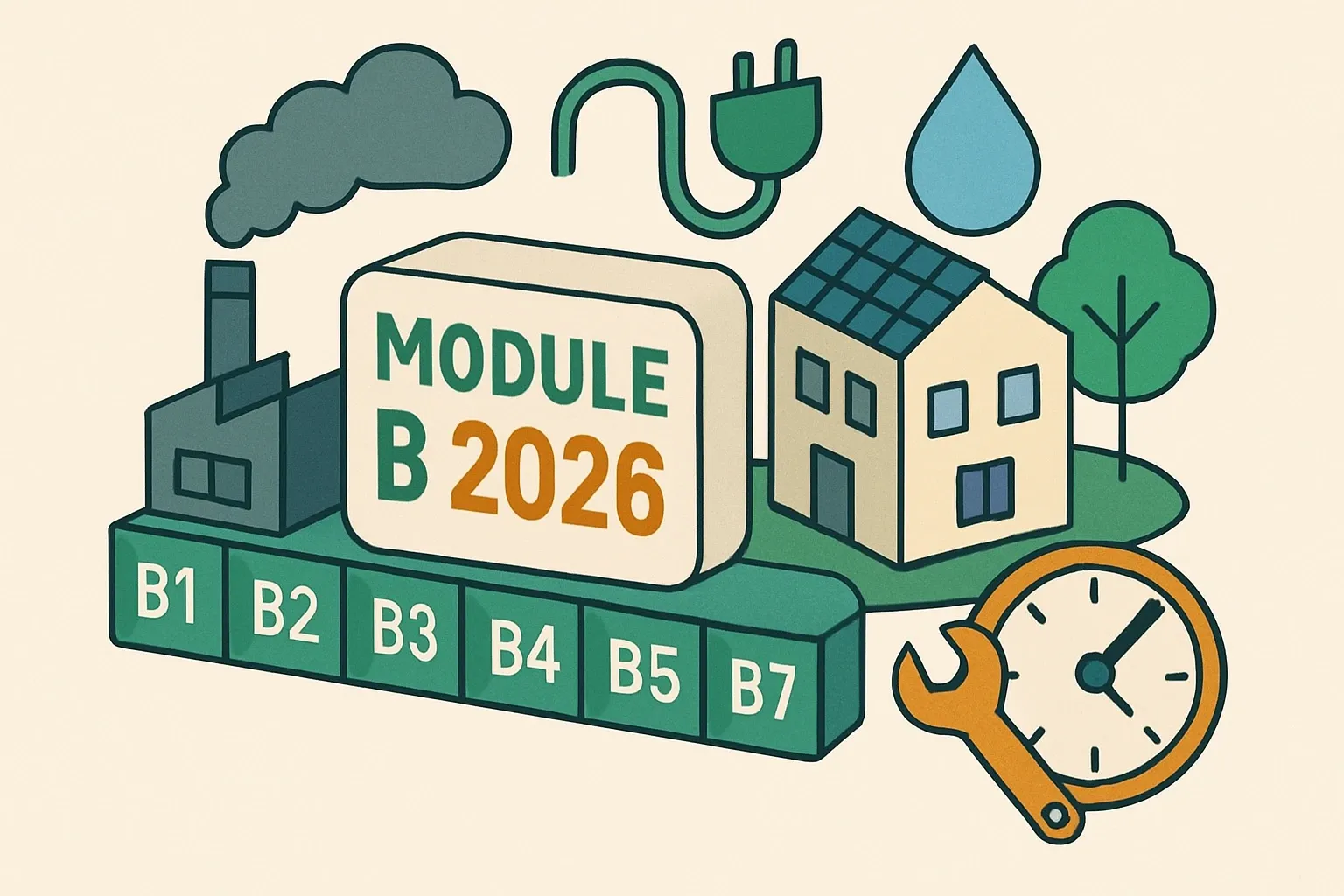
Module B tracks everything that happens after installation. Think of it as the season box score across the product’s working life, not the pre‑game warmup. EN 15804 calls it the use stage and splits it into seven sub‑modules.
The B1 to B7 lineup in plain English
- B1 Use: normal operation and direct emissions, if any.
- B2 Maintenance: cleaning, inspections, consumables, coatings touch‑ups.
- B3 Repair: fixing faults without full replacements.
- B4 Replacement: swapping components or the whole product at end of service life.
- B5 Refurbishment: planned upgrades that reset performance.
- B6 Operational energy use: electricity or fuels consumed by the product in use, or energy saved because of better performance.
- B7 Operational water use: water needed to function, clean, humidify, or cool.
Struggling with LCA Modules in your EPDs?
Follow us on LinkedIn for clear insights that help you win tenders and get specified on projects.
B6 is the quiet heavyweight
For energy‑using products, B6 often dominates total impact across decades. Two numbers matter most. First, how much energy the product actually needs in real service conditions. Second, the carbon intensity of the power that feeds it, which varies by grid and is changing fast. The global average electricity intensity was about 445 g CO2 per kWh in 2024 and is forecast to drop toward 415 g per kWh by 2026 as clean power grows (IEA, 2025).
In the United States, the 2023 national average was roughly 350 g CO2e per kWh based on EPA eGRID total output emission rates for 2023 data released in 2025 (EPA eGRID, 2025). Use your plant’s market‑based factor when available, not a generic global figure.
B7 water often reads zero, but verify
Many structural and passive products have no operational water use. Others do. Cooling coils, adiabatic systems, sanitaryware, and irrigation components can move the needle. WaterSense labeled faucets cap flow at 1.5 gpm, with a draft spec proposing 1.2 gpm in late 2024, and tank‑type toilets are set at 1.28 gpf under the revised specification timeline in 2025 (EPA WaterSense Faucets, 2025; EPA WaterSense Toilets, 2024). If your product influences hot water draw, model the energy tied to heating that water inside B6.
Maintenance and replacements are not afterthoughts
B2 to B5 captures cleaning cycles, filter swaps, wear parts, and full replacements. Treat this like a tune‑up schedule the reviewer can audit. Declare consumables, transport for service crews, waste routes, and any downtime materials. For coatings and membranes, the B4 cadence often steers the whole EPD result, so make the replacement logic crystal clear.
Reference Service Life that specifiers can trust
Declare either a Reference Service Life aligned to ISO 15686 or field‑backed manufacturer data with the assumed conditions. Several European operators and verifiers have tightened expectations around RSL documentation and Module B consistency through 2025, with program updates continuing into 2026 (EPD Hub Rules, 2025; EPD Italy Regulations, 2025). When in doubt, state the uncertainty and give a sensitivity range for B4.
Data you actually need to collect
Start with metered or tested energy at realistic duty cycles. Add standby modes, controls performance, and seasonal effects. Capture water draw at typical line pressures, cleaning consumables per visit, and technician travel. Pull grid factors from authoritative datasets aligned to your markets and publication year. If trustworthy numbers are missing, say so plainly and document why.
2026 reviewer expectations, decoded
Expect sharper questions on five items. Are B6 and B7 truly product‑level, not double‑counted from building models. Is the RSL backed by standards or measurement. Are maintenance materials and transport included. Do you model replacements consistently across variants. Are regional grid factors current to the EPD’s reference year. Small misses here trigger long review loops that slow publication.
Commercial upside you can feel
Clear Module B math makes procurement teams relax. It smooths LEED v5 conversations and prevents last‑minute substitutions when operational targets are tight. More importantly, it shows lifetime value, not just upfront carbon, which protects margin in competitive bids. One accurate standby‑power line item can be the diference between shortlisted and sidelined.
A fast path to a clean Module B
Pick a partner who can pull operational data from the floor and the field without burying your team in spreadsheets. Provide them with maintenance logs, warranty terms, control strategies, and utility bills for a well‑chosen reference year. Ask for sensitivity runs on RSL and grid intensity. That is how Module B stops being a black box and starts being your advantage.