What changed in LEED v5 materials
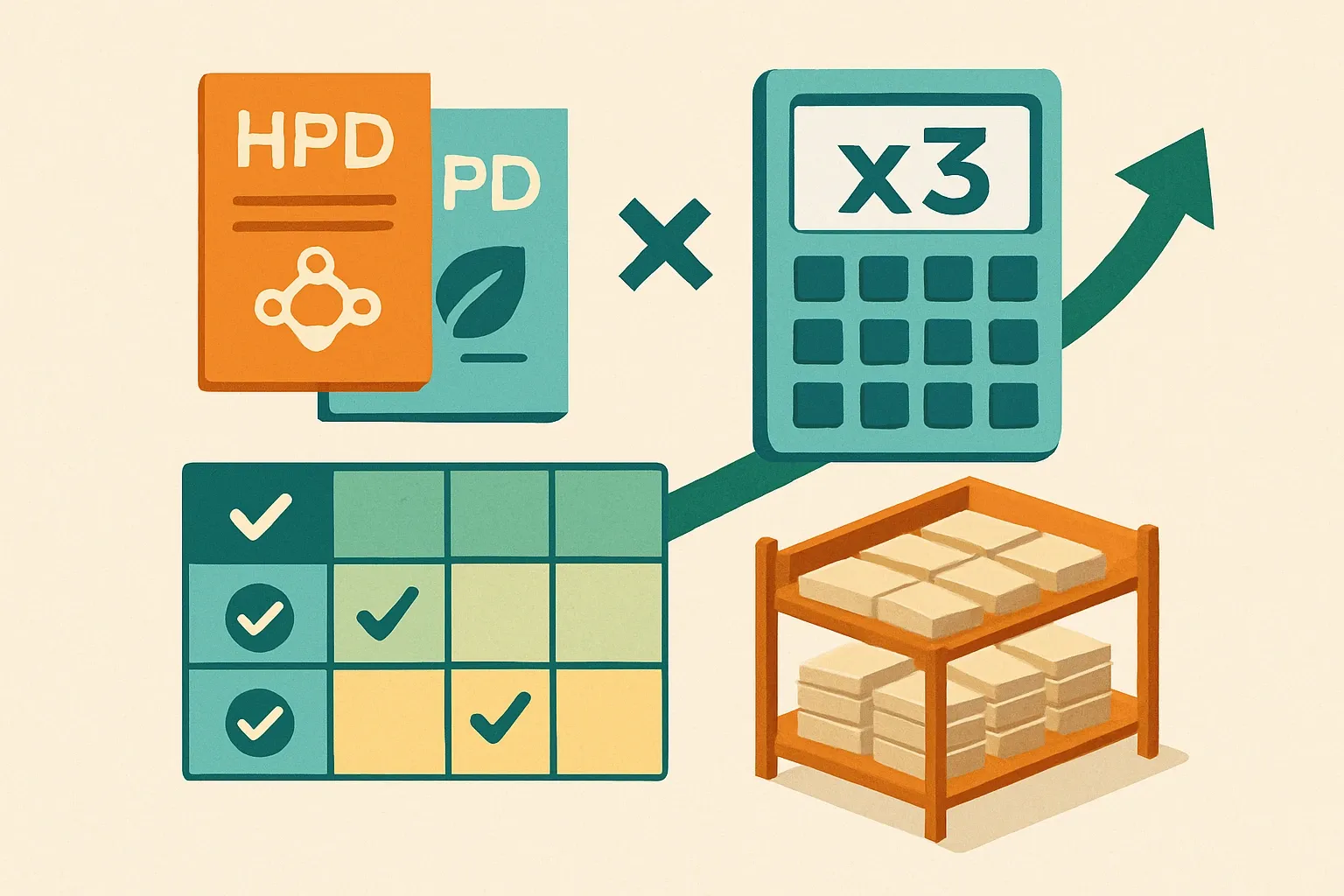
LEED v5 merges the old EPD, material ingredients, and sourcing credits into a single Building Product Selection & Procurement credit that evaluates five criteria areas, including climate health and human health (USGBC, 2025). Products are scored at Level 1, Level 2, or Level 3, and each level applies a 1x, 2x, or 3x multiplier when the project team counts value in the calculator (USGBC, 2025).
Goodbye separate HPD credit, hello multiplier math
Under v5, a product’s “adjusted value” equals the product value multiplied by its multi‑attribute score. Scores from different criteria areas can be added for a single product, up to a maximum of five (USGBC Glossary, 2025). In plain terms, pairing disclosures boosts the weight of that product in the project’s tally.
Show the math on one SKU
Take a product‑specific Type III EPD, which earns a 1 in Climate Health. Add a third‑party verified HPD at the 100 ppm threshold that avoids worst‑in‑class hazards, which earns a 2 in Human Health. The product’s multi‑attribute score becomes 3, so $50,000 of that SKU counts as $150,000 toward the category target in the LEED calculator (USGBC, 2025) (USGBC, 2025).
Why this flips the ROI for HPDs
Teams are rewarded for fewer, better documented products rather than many lightly documented ones. A single product that combines an EPD with a robust HPD now carries two to three times the weight in the spreadsheet that decides points, which directly improves the spec‑win odds per SKU.
Join Parq Pulse!
Stay ahead with weekly insights on material health disclosures and LEED v5 multipliers to win more projects.
What counts as “robust” material health data
LEED recognizes multiple document types, but for HPDs the levels matter. A published, complete HPD to 1,000 ppm is valued at Level 1. Third‑party verified HPDs at 100 ppm that avoid specific hazard lists are Level 2, hence the 2x multiplier in Human Health (USGBC, 2025). If that same product also shows EPD‑documented optimization, the combined score can rise further within the five‑point cap (USGBC, 2025).
Level 3 potential without new SKUs
Level 3 acknowledges elite performance. An optimized EPD with >40% GWP reduction plus improvement in additional impact categories can score at the top of Climate Health. Pair that with a verified HPD and qualifying circularity or social proof, and the multi‑attribute score can approach the 5 cap, which is where category points rack up fast (USGBC, 2025).
Practical sequencing to file EPD and HPD together
- Define scope and reference year, then freeze the bill of materials and suppliers for the products in play.
- Pull ingredient data to 100 ppm early, including CAS RNs and residuals, and run hazard screening. This unlocks a Level 2 HPD path while LCA modeling proceeds.
- Collect utilities, production volumes, transport, and waste for the same reference period, then model the LCA and draft the EPD.
- Book third‑party verification for both documents in parallel to compress elapsed time, and prepare the HPD Repository publication package.
- Publish with the selected program operator for the EPD and publish the HPD in the Repository, then update spec sheets with both links the same week. We recomend a shared internal checklist so marketing and sales do not lag.
Common blockers and fast fixes
Supplier opacity slows HPDs. Ask for SDS plus composition ranges and a letter of access under NDA, then inventory to 100 ppm to avoid rework. Mismatched data windows break the “single cycle” plan, so agree on a common 12‑month period before modeling. Verification queues can bite, therefore hold tentative slots while data collection runs.
How specifiers actually use this
Project teams use a LEED calculator that multiplies each product’s value by its score and sums by category. Products that combine a verified EPD and a strong HPD reduce the number of line items needed to hit the threshold, which simplifies documentation and de‑risks the plan (USGBC Glossary, 2025) (USGBC Glossary, 2025). That is why one better documented product can quietly replace two or three weaker ones in a submittal set.
A smarter disclosure combo for 2026 specs
LEED v5 made HPDs a force‑multiplier, not a side quest. The fastest commercial win is to pair a product‑specific, verified EPD with a third‑party verified HPD at 100 ppm, then keep both current so each SKU consistently pulls a 2x to 3x weight in the calculator (USGBC, 2025). If trustworthy numbers change in addenda, teams should check the current USGBC resource before finalizing bid language.