HPDs & Why They Matter

HPDs are your chemical early warning system

Walker Ryan
Walker RyanChief Executive Officer
March 25, 20265 min read

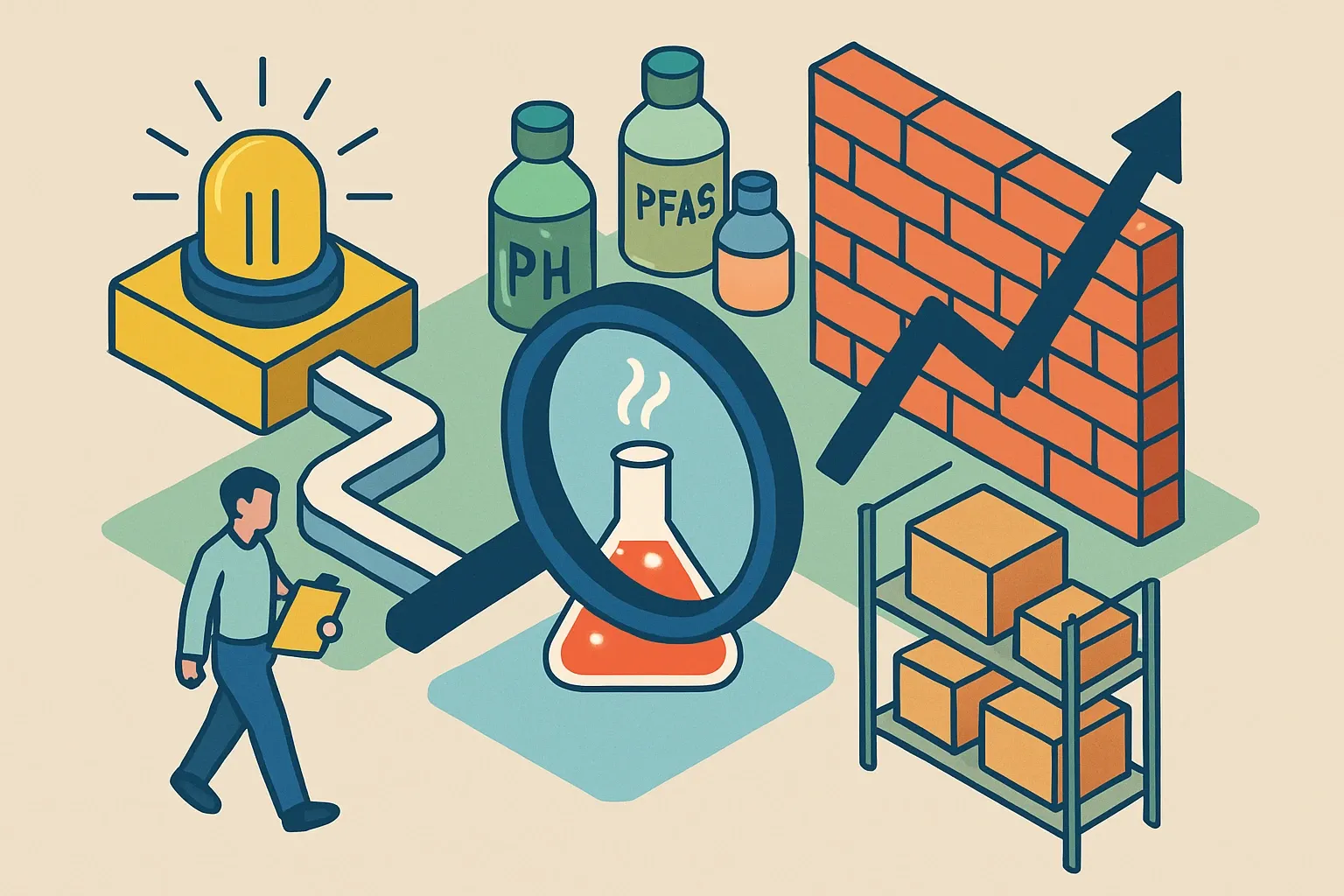
PFAS and certain phthalates are meeting a rising wall of rules and retailer policies. Manufacturers that use HPDs as an internal audit find Red List chemicals early, reformulate on their schedule, and avoid stranded inventory when state bans or no buy lists click into place. The kicker is ROI. Continuous material health work costs less than emergency redesigns and keeps products in spec when projects require ingredient transparency under LEED v5.

Generate an illustration for an article following this concept:

HPDs are your chemical early warning system
PFAS and certain phthalates are meeting a rising wall of rules and retailer policies. Manufacturers that use HPDs as an internal audit find Red List chemicals early, reformulate on their schedule, and avoid stranded inventory when state bans or no buy lists click into place. The kicker is ROI. Continuous material health work costs less than emergency redesigns and keeps products in spec when projects require ingredient transparency under LEED v5.

Ensure that you use no text, as this illustration will be used on international translations of the article..

Use an illustrative style (e.g. isometic) and don't generate in a photorealistic style.

The new risk math for chemicals

PFAS in products now face firm dates in multiple states. Minnesota begins PFAS reporting on July 1, 2026 and has category prohibitions already in effect for eleven product types starting January 1, 2025 (Minnesota Pollution Control Agency, 2026) (MPCA, 2026). Colorado bans intentionally added PFAS in cleaning products, cookware, dental floss, menstruation products, ski wax, textile articles, cosmetics, textile furnishings, and upholstered furniture beginning January 1, 2025, with broader prohibitions in 2032 (Colorado General Assembly, 2024).

Washington’s Safer Products program restricts PFAS in several categories and adds reporting in 2026, with more restrictions starting 2027. It also restricts ortho phthalates in vinyl flooring from 2025, a direct hit to common building materials (Washington State Department of Ecology, 2025).

HPDs: from sell sheet to supply chain audit

An HPD inventories ingredients to at least 1000 ppm and can go to 100 ppm with third party verification. That turns a marketing disclosure into an internal map for R&D and procurement. The HPD Collaborative reports more than 14,000 HPD reports from almost 1,000 manufacturers, covering over 40,000 products, which signals mature infrastructure you can plug into today (HPDC, 2025).

Retailers move faster than legislatures

Big boxes do not wait for every statute. The Home Depot states that as of January 2016 no ortho phthalates are permitted as added plasticizers in vinyl flooring sold in the United States and Canada, a policy still referenced in its chemical strategy materials (The Home Depot, 2023). Lowe’s lists all vinyl flooring as free of ortho phthalates in its safer chemicals policy. Those decisions effectively create private market bans that can strand inventory overnight.

Join Parq Pulse!

Stay ahead on chemical disclosures and environmental insights to keep your products compliant, competitive, and winning projects.

What to do with HPDs so inventory never gets stranded

Use the HPD as an engine for continuous improvement, not a one time PDF.

  • Map every ingredient to Red List, LEED v5 accepted frameworks, and active state chemical lists. Prioritize PFAS and ortho phthalates in product families called out by Minnesota, Washington, and Colorado.
  • Require supplier attestations and test data where disclosure is incomplete. Set a cadence to refresh HPDs in step with supplier changes.
  • Stage reformulations in risk order. Focus first on categories with 2025 to 2028 compliance gates to stay in front of sales friction.
  • Sync document control. When hazards change, OSHA requires SDS updates within three months, and the updated SDS must accompany the first shipment after the change (OSHA, 2026) (OSHA 1910.1200, 2026).

LEED v5 keeps ingredient disclosure on the spec sheet

LEED v5’s Building Product Selection and Procurement credit awards points for HPDs that are pre checked for LEED at 1000 ppm, and higher value for third party verified HPDs at 100 ppm that avoid worst in class hazards (USGBC, 2025) (USGBC, 2025). If your catalog includes verified HPDs, sales teams can defend margin instead of offering discounts to offset missing documentation.

Why HPD work pays back fast

Emergency reformulations chew up engineering time, delay bids, and trigger reprints for labels, data sheets, and marketing collateral. Steady HPD driven tweaks cost less, and they preserve shelf space when a retailer adopts a new chemical policy. HPD Builder version 3.0 even added PFAS focused reporting features to help manufacturers identify and eliminate PFAS before rules bite, which is exactly the kind of early signal R&D needs (HPDC, 2025).

Choose partners for speed, not busywork

Look for experts who take on supplier wrangling, align your ingredients to evolving state lists, and publish with the program operator that fits your market. Make sure they can move from first data pull to verified HPD quickly so R&D and product managers stay focussed on design, not paperwork. It sounds basic, but speed and completeness are what keep products in spec and out of the stranded pile. That is definately the goal.

Sign up for our weekly newsletter

Get the latest on ESPR, EPDs, and sustainability regulations delivered to your inbox every week.

Frequently Asked Questions

Which 2025 to 2027 PFAS dates matter most for building materials sold in the U.S.?

Minnesota prohibits intentionally added PFAS in eleven product categories beginning January 1, 2025 and starts PFAS in products reporting on July 1, 2026. Washington’s Cycle 1 restrictions began January 1, 2025 and Cycle 1.5 adds reporting in 2026 with restrictions in 2027. Colorado bans multiple PFAS product categories starting January 1, 2025, and adopts a broad prohibition from 2032 (MPCA, 2026) ([MPCA, 2026](https://www.pca.state.mn.us/air-water-land-climate/pfas-use-prohibitions-and-reporting)), (Washington Ecology, 2025), (Colorado General Assembly, 2024).

How exactly do HPDs reduce the risk of stranded inventory?

An HPD inventories ingredients to 1000 ppm or 100 ppm and screens them against hazard lists. This lets R&D flag Red List or state targeted chemicals early and plan substitutions before retailer policies or state rules block sales. The result is incremental reformulation instead of last minute changes that risk unsellable finished goods. HPD infrastructure is mature, with 14,000 plus published HPDs and 40,000 plus covered products (HPDC, 2025).

Do HPDs help with LEED v5 requirements for ingredient transparency?

Yes. LEED v5’s Building Product Selection and Procurement credit awards value for HPDs that are pre checked at 1000 ppm and higher value for third party verified HPDs at 100 ppm that avoid worst in class hazards (USGBC, 2025) ([USGBC, 2025](https://www.usgbc.org/sites/default/files/2025-08/LEED-v5-BPSP-Criteria-Areas-and-Levels-Resource_v1.1_updated%207.31.25.pdf)).

How fast must we update SDSs if an ingredient hazard changes during reformulation?

OSHA’s Hazard Communication Standard requires adding significant new hazard information to the SDS within three months. The updated SDS must accompany the first shipment after the change (OSHA 1910.1200, 2026) ([OSHA, 2026](https://www.osha.gov/laws-regs/regulations/standardnumber/1910/1910.1200)).

Are retailers really ahead of regulations on chemicals like phthalates?

Yes. For example, The Home Depot documents that no ortho phthalates are permitted as added plasticizers in vinyl flooring sold in the U.S. and Canada as of January 2016, a policy still referenced in its chemical strategy materials (The Home Depot, 2023). Retail decisions like this create immediate market barriers even when a law is still pending.

Want to win more bids?

Parq helps construction materials manufacturers get spec'd more often with industry-leading EPDs and LCAs.

Get in Touch

About the Author

Photo of Walker Ryan

Walker Ryan

Chief Executive Officer at Parq

Walker Ryan is a climate-tech entrepreneur focused on driving industrial decarbonization through better data. As the founder and CEO of Parq, he helps manufacturers generate high-quality, third-party–verified carbon disclosures at scale—accelerating a traditionally slow and expensive process. Before starting Parq, Walker led over $200 million in sustainability-focused investments as VP of Strategy & Growth at ReStream Solutions, following earlier experience in investment banking at Deutsche Bank. He brings a rare mix of capital markets expertise and hands-on sustainability knowledge to tackling the infrastructure of industrial emissions.

More in HPDs & Why They Matter