What “independent” really means in EPD land
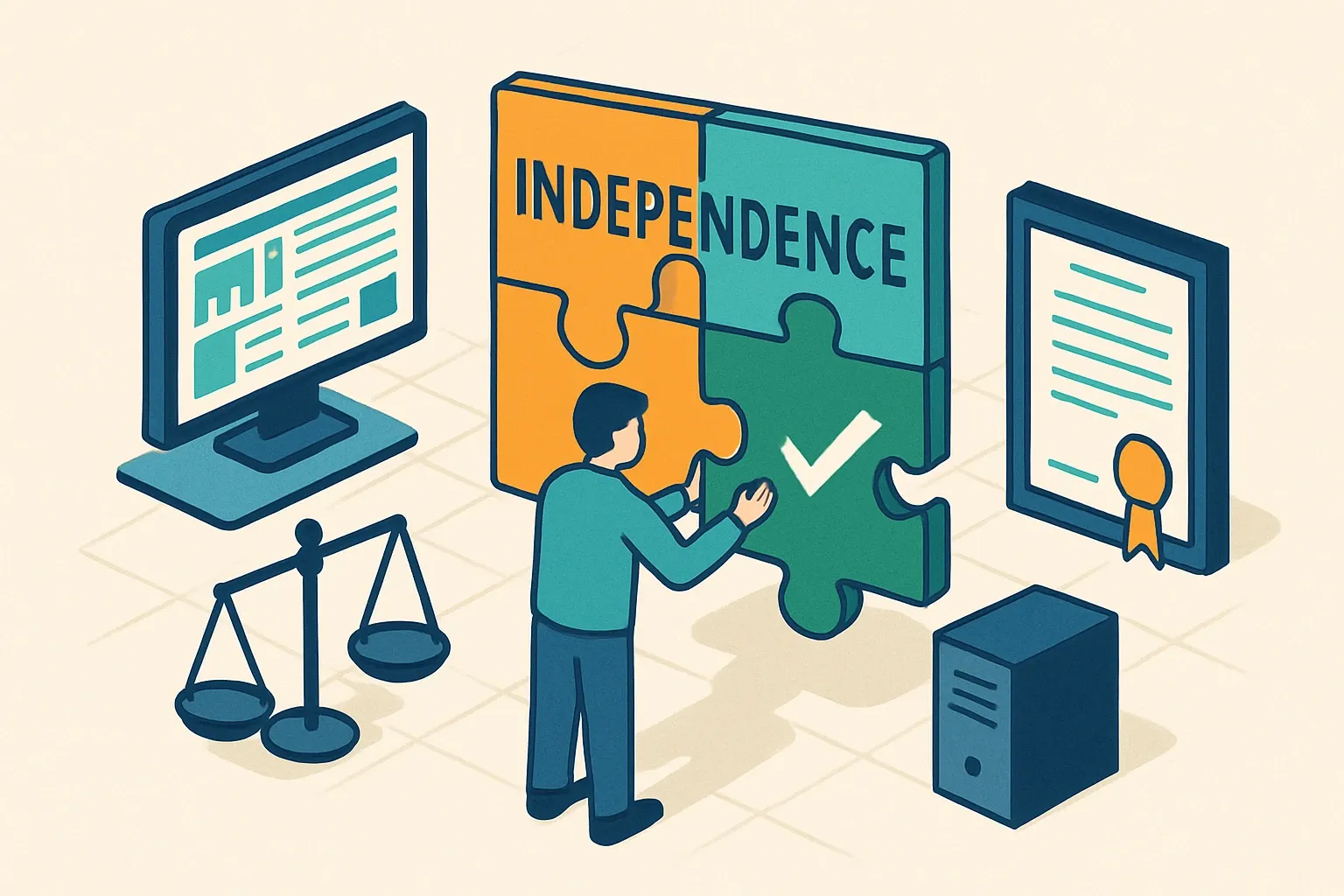
ISO 14025 sets the ground rules. Independence is proven at the verification step, not by who owns a website or a tool. Programs can allow independent verification or require third‑party verification. Many major operators require third‑party verification for business‑to‑business EPDs because buyers expect it (ISO 14025, 2006; ISO/DIS 14025, 2025).
Think of the PCR as the rulebook of Monopoly. Ignore it and the game falls apart.
Vertical models are common, so test them
Across the market you will find EPD programs housed inside research bodies, industry associations, certification companies, and yes, software vendors. This structure is not automatically a problem. The question to ask is whether verifiers are independent of the LCA work and free to reject or require changes.
One quick health check is whether the operator is audited by ECO Platform and how many ECO EPDs they list. As of July 1, 2025, several operators show four‑digit portfolios on ECO’s public leaderboard, for example 12,749 for the International EPD System and 2,565 for IBU (ECO Platform, 2025). Large counts are not quality by themselves, yet the audit gives you a baseline of procedural rigor.
The safeguard that matters most: verification
Verified EPDs must be checked by someone not involved in the LCA work. Many programs require fully third‑party verification and publish lists of approved verifiers you can contact directly to compare scope and lead time (EPD International, Verifiers, 2025).
Validity is normally five years, and there is an expectation to update within that window if any declared indicator worsens by more than 10 percent (EPD International FAQ, 2025). That rule keeps results trustworthy between renewals.
Struggling to navigate EPD program operators?
Follow us on LinkedIn for clear insights that help you publish confidently and win more tenders.
Can you publish without the program’s preferred tool
Usually yes. Even when an operator pre‑verifies specific software, they typically accept submissions from other tools if the LCA and the EPD meet the referenced standards and PCR. Your verifier will focus on method, data quality, and conformance, not on which button generated the tables.
If your portfolio is large, ask whether the operator supports batch workflows and digital EPDs so your team does not drown in PDFs.
Market signals that affect schedules and pricing
Verification capacity is tight. One major European operator reported external verification costs up roughly 40 percent in recent years and raised its own verification fee in September 2025 to sustain independent reviews (IBU, 2025). That aligns with what many manufacturers feel on the calendar.
During the 2019:14 PCR transition in mid‑2025, another operator temporarily extended publication from 1–3 days to up to 10 working days to handle volume (EPD International, 2025). Plan buffers when industry‑wide updates land at the same time as your launch.
ECO Platform status, decoded for buyers and spec teams
ECO Platform audits member programs and groups them by the number of ECO EPDs. Counts are public and updated periodically. The public registry listed, for example, 12,749 ECO EPDs for the International EPD System on July 1, 2025, which signals broad acceptance in European LCA workflows (ECO Platform, 2025). Use this as one input when your sales team needs recognition across multiple EU markets.
Where LEED lands in 2025
LEED still recognizes product‑specific, verified Type III EPDs for materials credits, and LEED v5 was ratified on March 28, 2025. If North America matters, stay aligned to ISO 14025 with EN 15804 or ISO 21930 and make sure verification is clearly documented for reviewers (USGBC, 2025).
Five questions to ask any operator or verifier
- Will this EPD be third‑party verified and who chooses the verifier
- Can we submit from our current tool and what format is required
- What is the current queue and realistic timeline to publication
- How are mid‑cycle updates handled if an indicator shifts more than 10 percent
- Is the program an audited ECO Platform member and where will our EPD be discoverable
The practical play
Pick partners who remove the friction inside your company. The fastest path is usually ruthless data collection, a verifier booked early, and a program that can publish at scale. Whether a tool and a program share a parent company is less important than the independence of verification and the clarity of the paper trail. Do that well and your product stays in the choice set, not sidelined by default penalties, and your team sleeps better because the evidence is solid and easy to recieve.