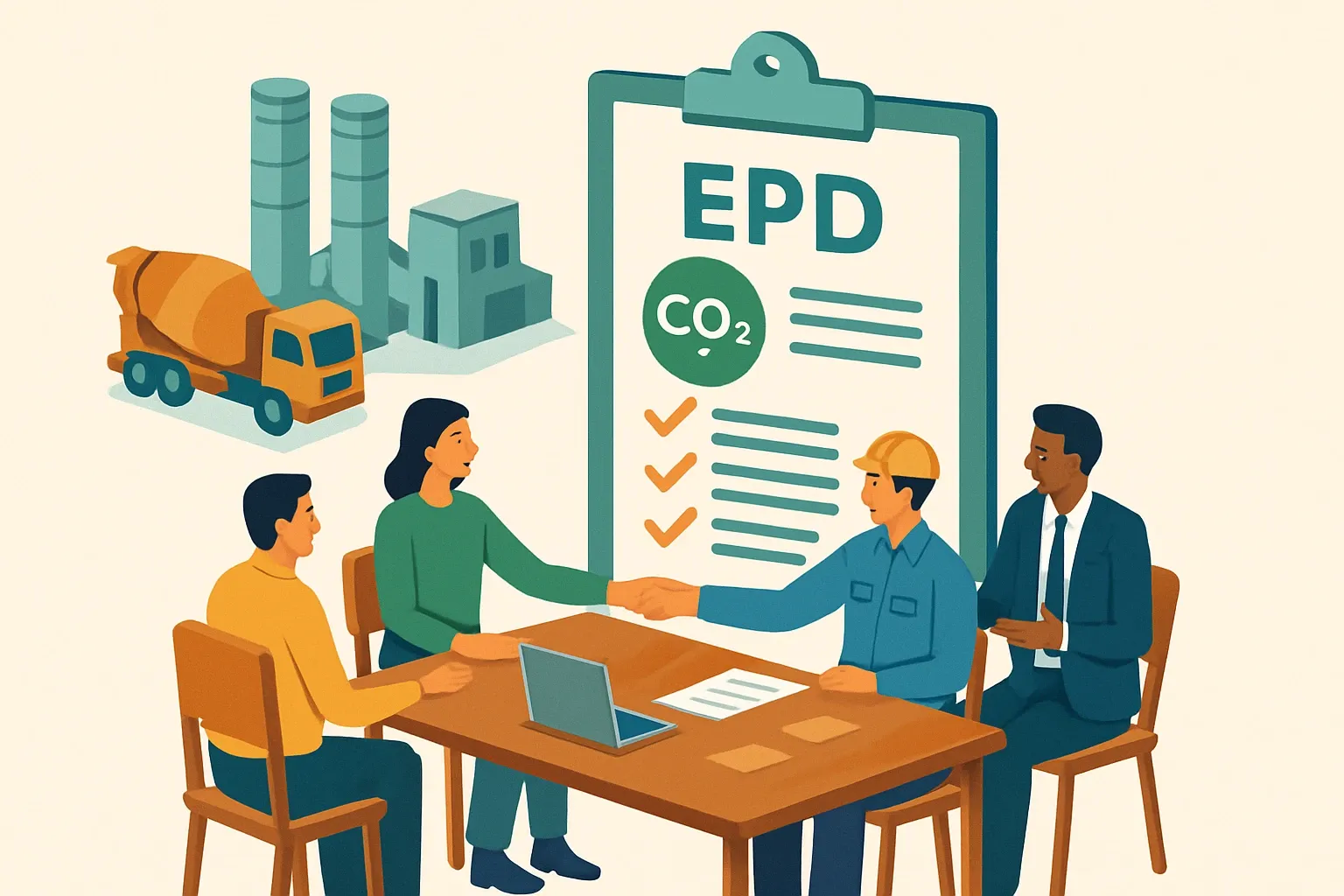
What landed in September 2025
Stoneway Concrete released two first‑ever product EPDs in September 2025. The declarations cover Butyl Rubber Preformed Sealant Products and Concrete Admixture Products. Both are published with The International EPD System, operated by EPD International AB, under the EN 15804 A2 framework. The records read like family‑level declarations rather than a single SKU, which helps cover common use cases across project types. The developer or LCA consultant is not stated on the published records.
Why it matters in specs and bids
Owners and agencies are normalizing EPD submittals for concrete work and adjacent materials. Caltrans requires EPDs for concrete, asphalt, and CMU on projects with bid openings after February 1, 2025, which turns documentation into a go‑no‑go item on many teams’ checklists (Caltrans, 2025) (Caltrans, 2025). In Portland, a 4,000 psi mix must hit 242 kg CO2e per cubic yard to qualify for city work, verified by a current Type III EPD, a clear signal that EPDs influence placement and pricing conversations (City of Portland, 2022) (City of Portland, 2022).
The product scope in plain English
Sealants and admixtures travel with concrete. The new sealant EPD helps spec teams model envelope and joint assemblies with real numbers instead of default penalties. The admixture EPD supports submittals where mix performance and embodied carbon both matter, especially when value engineering pressures surface. Put simply, these two documents help Stoneway show up as a complete, documentation‑ready partner rather than a mix‑only supplier.
Join Parq Pulse!
Stay ahead in construction materials with our weekly insights on product transparency and environmental data to win more bids.
Competitive snapshot in Puget Sound and beyond
Ready‑mix rivals in Stoneway’s backyard already play the EPD game and have active coverage across many mixes. CalPortland, Cadman, and Miles Sand & Gravel appear with broad, current EPD portfolios for cast‑in‑place and paving mixes in public directories. That means the concrete side is a catch‑up race. Where Stoneway’s new declarations could tilt the field is on the companion materials. National brands in these lanes, including Sika, GCP Applied Technologies, Tremco CPG, and Euclid Chemical, publish product EPDs of their own, so Stoneway’s move narrows gaps that used to send buyers elswhere.
Program operator choice that travels with you
Stoneway’s first EPDs are issued with EPD International AB, a globally recognized operator aligned to EN 15804 that many North American teams accept for building products. For readers comparing operator options, here is a quick explainer on standards and program operators that buyers see most often (EPD Guide, 2026). Matching the operator peers use in your exact niche typically smooths reviewer questions.
How to turn the debut into day‑to‑day visibility
Add a prominent EPD page to the corporate site so estimators and specifiers can self‑serve the PDFs fast. At the time of writing, we could not find these EPDs on Stoneway’s website, and visibility is key to capture inbound requests. Make it one click from product pages and from the footer. Link each EPD to the plant or product family it covers so submittals stay tidy.
Timing tip most teams miss
There is often a lag between the program operator’s publication date and the appearance in the global specifier directories that architects and engineers actually use. That delay can be weeks or even months. If shaving that gap to a day or two matters for upcoming bids, reach out. We can outline the checklist that keeps verification and listing in lock‑step so new EPDs start working for sales almost immediately.
The practical takeaway
Stoneway’s September 2025 debut moves them from documentation‑light to documentation‑ready on two products that ride alongside concrete on real jobs. Concrete competitors already publish, so the immediate edge is stronger submittal packages that bundle mixes with verified sealant and admixture data. Keep the momentum by expanding coverage where bids concentrate, refreshing records before renewal pressure hits, and putting the EPDs where buyers actually look. That’s how this first step turns into repeat specs. We’re rooting for it, this is a smart move that pays back fast when bids get tight.