Same ingredients, different scorecards
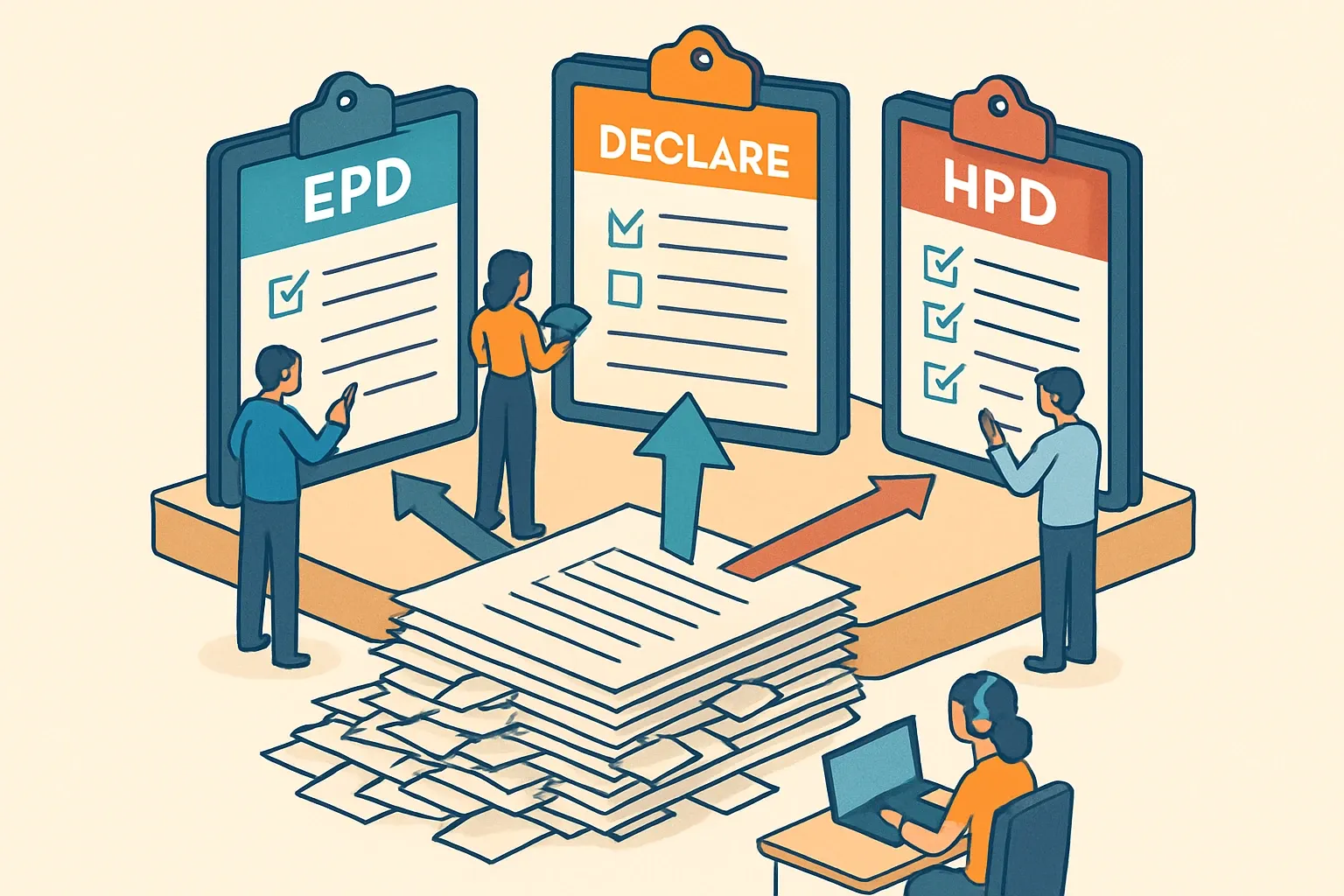
HPDs report what is in a product and the hazards tied to those ingredients. EPDs quantify life cycle impacts across climate, energy, and other categories using a specific PCR rulebook. Declare labels make ingredient and Red List status instantly legible for specifiers.
There is important overlap. Declare requires disclosure of all intentionally added ingredients at or above 100 ppm, including CAS numbers and weight percent (ILFI, 2024) (ILFI, 2024). HPDs commonly disclose to 1000 ppm or 100 ppm depending on the manufacturer’s chosen threshold, both recognized within the HPD Open Standard (HPDC, 2018). EPDs typically carry a five‑year validity window under program rules based on ISO 14025, which matters for planning refresh cycles (EPD International, 2025) (EPD International, 2025).
What truly overlaps
Think of a single master BOM as the spine. The same CAS‑level inventory that powers an HPD also satisfies Declare’s 100 ppm bar with minimal extra lift. Supplier declarations, trade‑name to CAS mapping, and proprietary flagging are reusable across both. For EPDs, mass of inputs, packaging, energy and fuel by site, and transport legs originate from the same suppliers you already contacted for HPD.
No official percentage quantifies the exact overlap, but a large portion of supplier outreach repeats when teams manage these streams separately. Centralize once, reuse often, and the work shrinks alot.
LEED v5 keeps driving multi‑document demand
LEED v5 was ratified by USGBC members on March 28, 2025, and projects can register under v5 in Arc. Materials credits unify disclosure pathways while rewarding better environmental outcomes, so HPDs, EPDs, and sometimes Declare still show up together on submittal checklists (USGBC, 2025) (USGBC, 2025). That means a single data foundation pays off across the whole credit family.
Build the single source of truth
Treat product data like a parts bin, not a PDF. Structure it so fields map to each scheme.
- Ingredients registry: CAS number, substance name, role, weight percent, proprietary indicator, supplier source, and threshold coverage.
- Hazards: list screening results and versioned lists used for HPD and Declare.
- EPD inputs: bill of materials by site, utilities by meter and period, fuels, process yields, scrap and waste, inbound and outbound transport.
- Evidence: attach SDS, supplier attestations, invoices, and meters with date ranges for audit trails.
A pragmatic workflow for paints, coatings, and resinous flooring
Start with the formulation inventory that R&D already maintains. Normalize to CAS and weight percent. Screen against priority lists and record the list version. Publish HPD at the right threshold so ingredient disclosure is usable for LEED and mindful materials libraries. From the same inventory, configure a Declare submission and apply exceptions only where valid at the 100 ppm level (ILFI, 2024). In parallel, request plant‑level energy, packaging, and transport. Those numbers become the backbone for the EPD model.
Reuse rules that make life easier
Carry the same BOM line IDs from HPD into Declare and your LCA dataset. Link suppliers to both hazards and EPD input tables so one update propagates. Keep list versions time‑stamped. When a Red List update lands or a PCR revision goes live, you can pinpoint which SKUs are affected rather than reopening every file.
What to ask a platform partner before you commit
- Can HPD ingredient data at 100 or 1000 ppm flow directly into Declare without retyping fields, including CAS, weight ranges, and proprietary flags.
- Does the system attach one supplier package to both material health screening and EPD evidence so reviewers see the same proof.
- Are program operator exports supported for multiple operators in the US and EU without duplicating records.
- Is there version control and change‑log history granular enough for surveillance updates across a five‑year EPD term.
- Can it schedule renewals across HPD, Declare, and EPD so supplier outreach happens in one consolidated window.
Cadence beats heroics
EPDs usually run on five‑year validity, with annual surveillance common in some programs. HPDs and Declare rely on list versions and may change more frequently. Declare disclosures run at a 100 ppm threshold and labels operate on a defined license cycle, so plan light annual touchpoints and a heavier refresh mid‑term when Red List and PCR changes stack up (ILFI, 2024; EPD International, 2025). With a shared dataset, those touchpoints become review sessions instead of fire drills.
The quiet commercial upside
When HPD and Declare can be produced from the same inventory that fuels EPDs, submittal packages compile faster and land cleaner. Sales teams spend less time chasing paperwork and more time positioning performance. The market signal is clear. HPDs have topped 11,000 published, which shows sustained demand for ingredient transparency alongside EPDs in specs (HPDC, 2025).
Bring the pieces together
Use one structured data foundation for content, hazards, and life‑cycle inputs. Let automation map that core to HPD, EPD, and Declare outputs. The result is fewer supplier pings, fewer review rewrites, and a smoother path to the multi‑program transparency buyers expect.