What “new” means in EPD land
A product can be new to market and still qualify for a verified declaration if the rules are followed. Under current program guidance, there are explicit paths for products recently on the market and even for products not yet on the market, provided they reference a similar product’s verified model and meet verification requirements (EPD International, 2025).
If you are searching for “EPD for brand new products with little data history,” the key is proving representativeness and being transparent about what is measured vs estimated.
Can you publish with only months of data
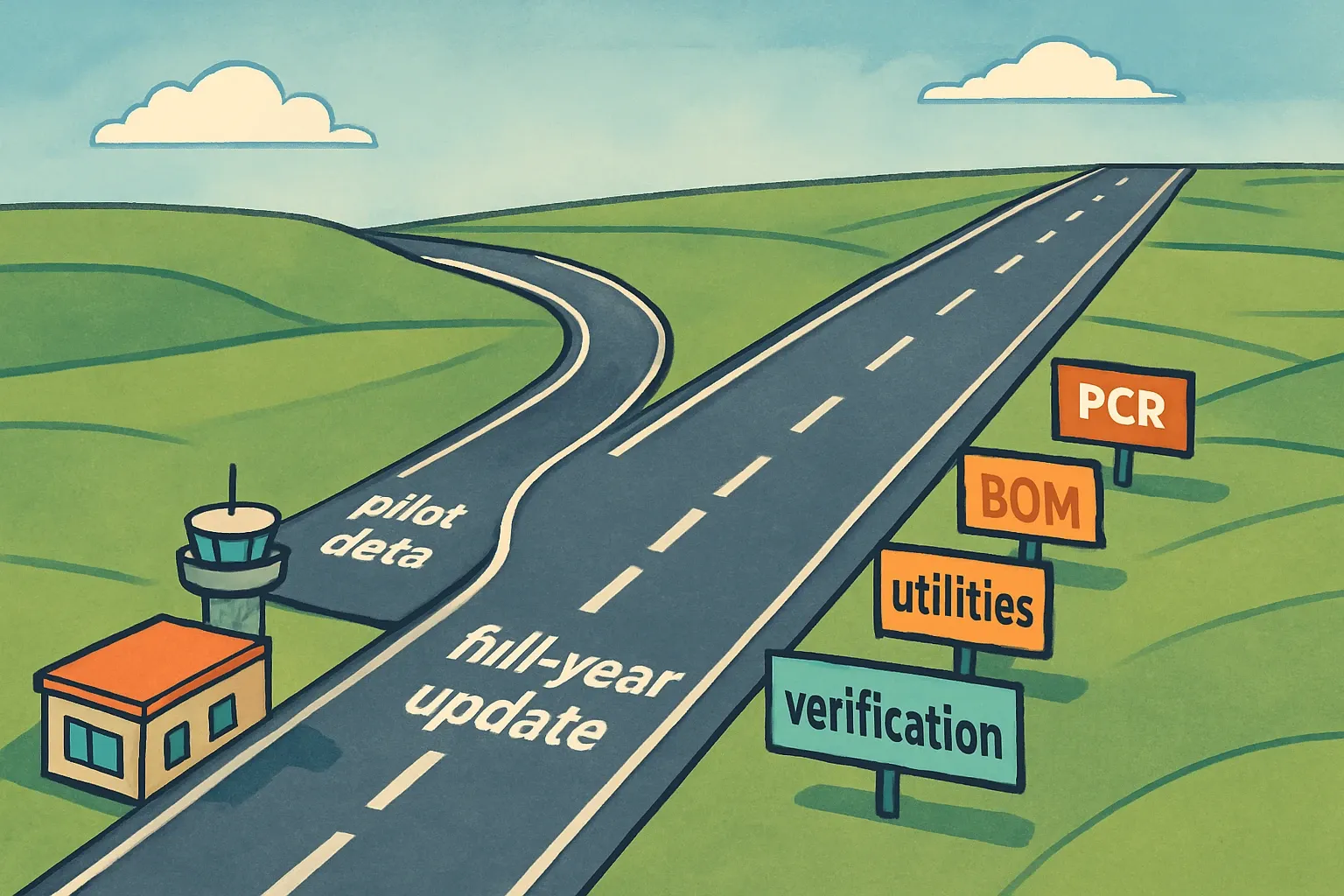
Yes, if production has started and there is a verifiable reference period. Many teams begin with a partial operational window, then commit to refresh once a full year of primary data is available. Your verifier will want to see how partial datasets were scaled and where conservative background data was used. Treat it like a pilot run that graduates to a full season.
The minimum dataset that actually works
Start lean, document hard.
- A complete bill of materials with supplier specifications and any supplier EPDs.
- Utility meters or invoices for the reference period, plus the plant’s metering plan.
- Process flow diagrams that show energy, mass balance, scrap, and rework.
- Transport legs from purchase orders and shipping docs, with distances and modes.
- Packaging details, end‑of‑life assumptions, and maintenance if relevant.
Label every placeholder and its source. Verifiers do not penalize caution. They do question mystery numbers that appear from nowhere.
Want to launch new products without delays?
Follow us on LinkedIn for strategies that help you unlock specifications and drive ROI with quick EPD publishing.
Picking the right PCR when your SKU is new
A PCR is the rulebook of Monopoly. Ignore it and the game falls apart. When several PCRs could fit, look at what competitors used, which program operator you plan to publish under, and how soon each PCR expires or is due for revision. Most PCRs are reviewed or expire on roughly five‑year cycles, which affects how long your study assumptions stay aligned with market rules (UL Solutions, 2025).
Validity windows and what triggers an update
Most programmes set EPD validity at five years from publication. During that window, if any declared indicator changes more than about 10 percent, an update is expected to keep the declaration trustworthy (EPD International, 2025). Plan an annual health check so you do not get ambushed by mid‑cycle process changes that quietly shift results.
Prospective paths when the product is not yet shipping
If launch is imminent but not started, some programmes allow an EPD of a product not yet on the market. The model is anchored to a similar, already verified product, then adjusted for the new formulation or process. There are guardrails on how similarity is shown and how quickly the EPD must be updated once live data arrives (EPD International, 2025).
Data quality without the drama
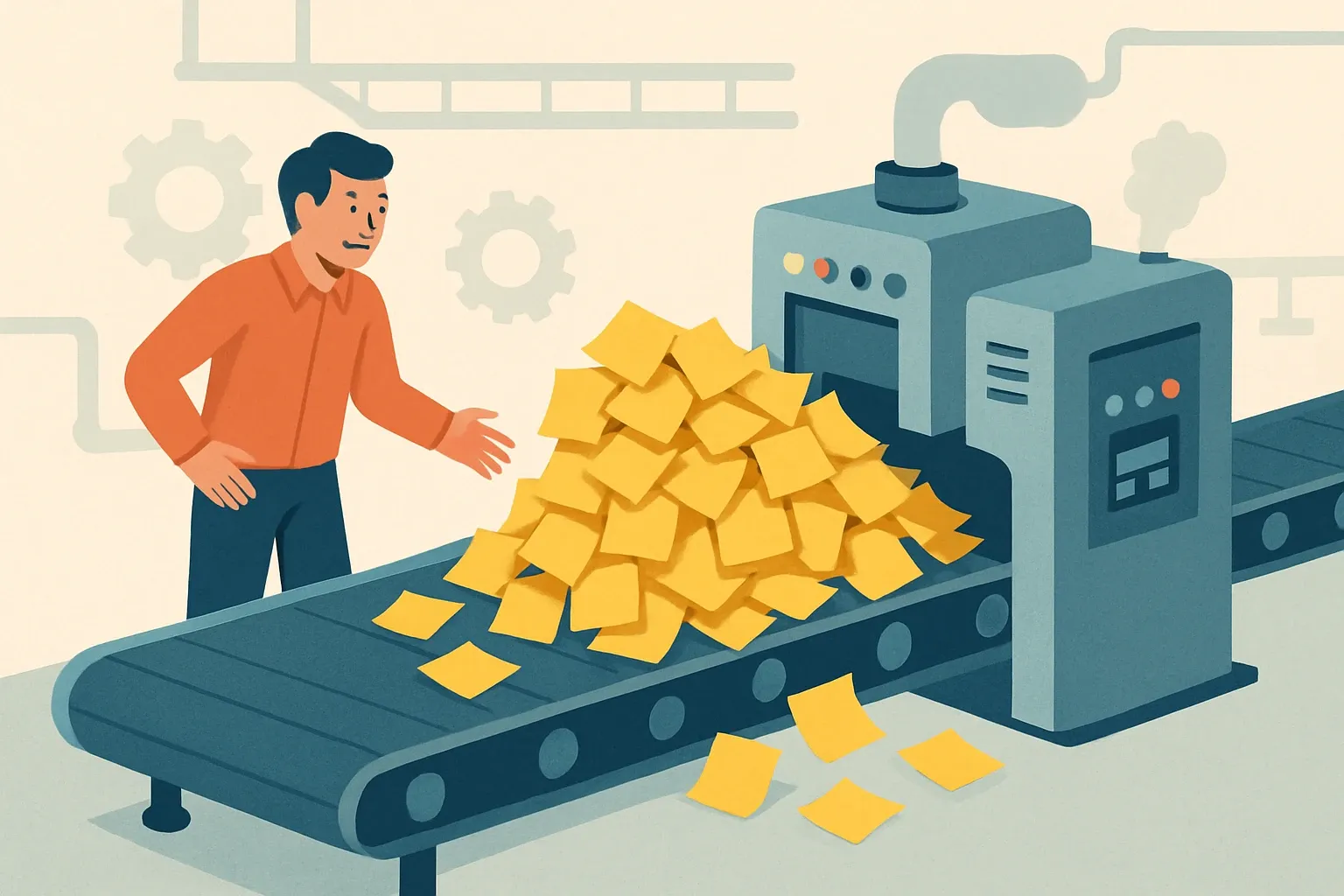
Short windows create noise. Control it. Lock a reference period, freeze BOM versions for the calculation, and store snapshots of supplier data used. Keep a single source of truth for assumptions, not scattered spreadsheets that no one can later reproduce. White‑glove data collection beats email chases every time because it reduces rework and reviewer ping‑pong.
Commercial why now
Project teams face real carbon accounting penalties when they pick products without product‑specific EPDs. An early, verified declaration avoids those penalties and keeps your product in the serious conversation instead of the price‑only bucket. Even a first edition EPD can unlock specs that would otherwise default to competitors with paperwork in hand.
The market pressure is not going away
Buildings and construction still account for 34 percent of energy and process‑related CO2 emissions and about 32 percent of global energy use, which is why buyers keep asking for verifiable product data (UNEP GlobalABC, 2025). The drumbeat is steady, from LEED v5 drafts to owner‑driven carbon targets. Waiting for a “perfect” dataset is a good way to miss this quarter’s pipeline.
Verification tactics that save weeks
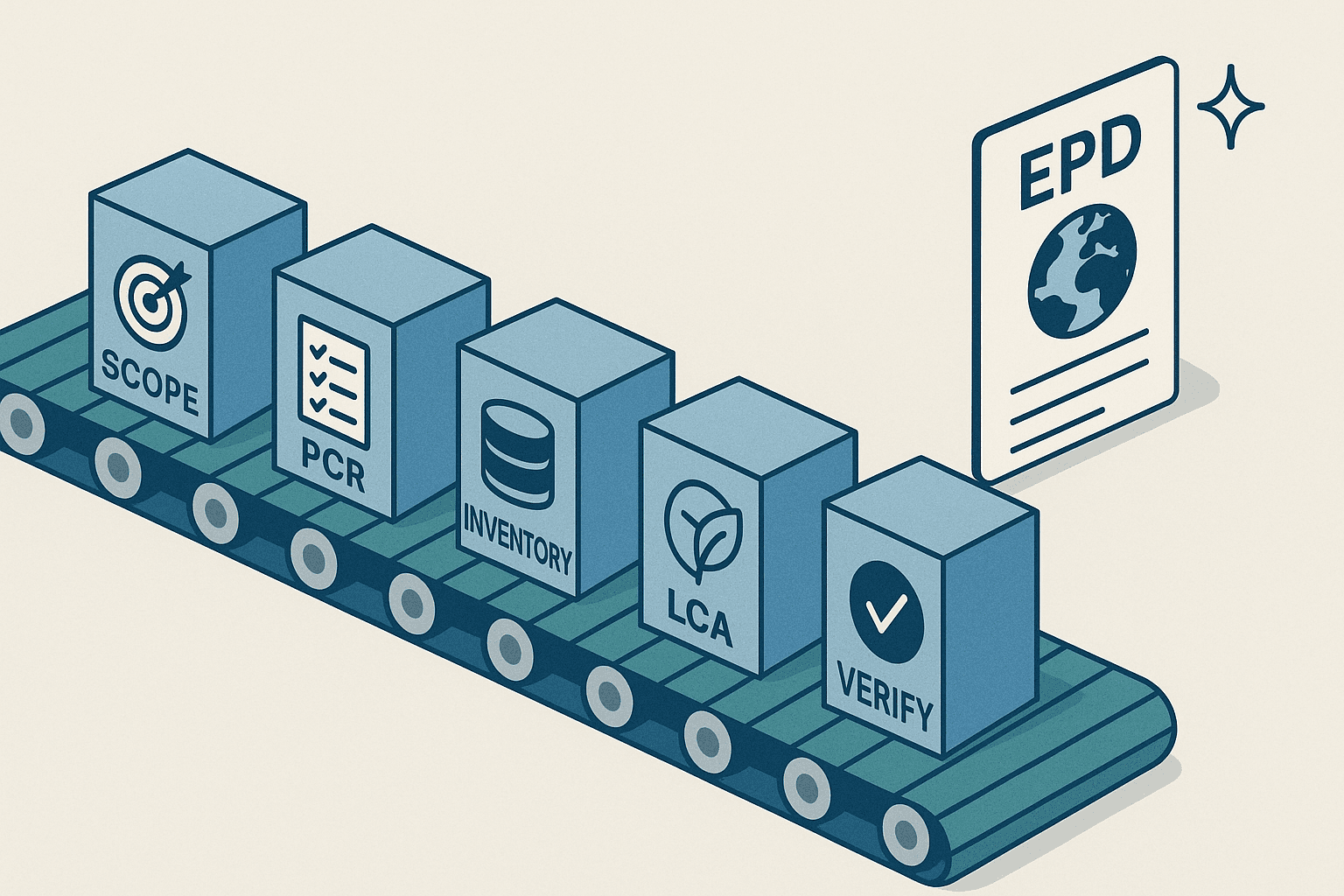
Bundle evidence the way reviewers read. Put the PCR reference, functional or declared unit, and system boundary on page one of your dossier. Include a clear mapping from each foreground process to meters, invoices, or engineered estimates. Flag every conservative assumption so the verifier can approve it in one pass. Small move, big speed‑up. Do not forget to recieve sign‑offs from operations early.
How to choose help without slowing down
Look for a partner that will pull data from your ERP, utility portals, and supplier channels directly, not hand you a questionnaire and wish you luck. Ask for a named verifier and a draft verification plan up front. Request an update roadmap for year one, including triggers and responsibilities. Speed comes from orchestration, not heroics.
If you have truly zero operational data
You still have options. Use a similar product EPD plus engineering changes documented by R&D, conservative grid factors for your geography, and supplier EPDs for high‑mass inputs. Publish under a programme that explicitly supports forthcoming products with clear update rules. Then schedule the first refresh after a fixed production quarter to anchor the model in measured data.
A quick note on PCR and GPI changes in 2024–2025
Programme rules evolved in 2024 and 2025, including clearer definitions for EPDs of products recently on the market and not yet on the market, and continued five‑year validity norms with structured surveillance. When in doubt, check the latest GPI and the specific PCR you plan to use. A one‑hour desk check here can save a month later.
Wrap up
You do not need a full year of history to publish a credible EPD. You need the right PCR, a defendable starting dataset, conservative choices where data is thin, and a firm update plan. Treat the first declaration as your pilot. Treat the first update as your proof of reliability. That is how a search for an “EPD for a brand new product with little data history” turns into a market‑ready credential that wins specs today.