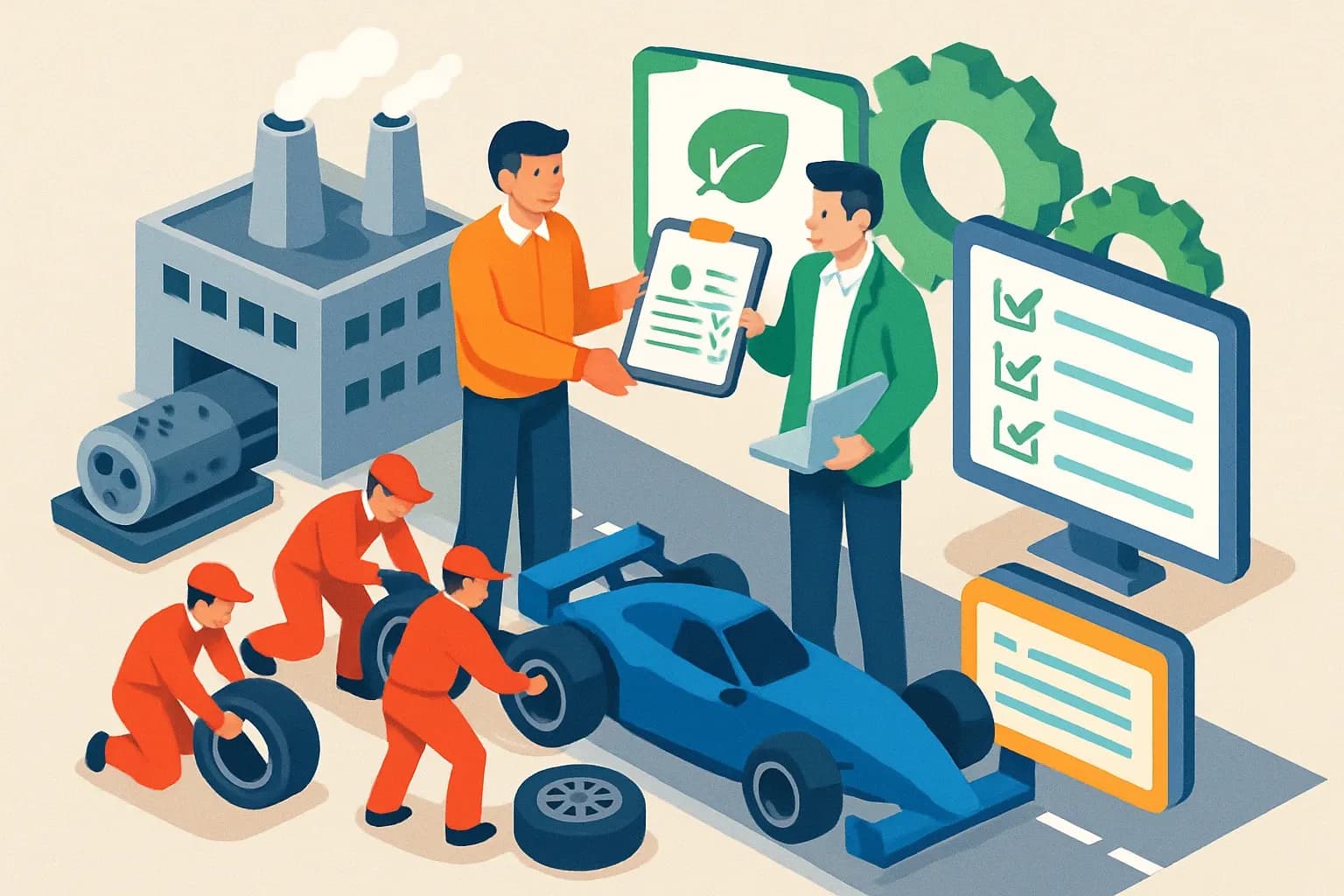
Who RINA is
RINA is a global engineering, testing, inspection, and certification group with headquarters in Genoa and offices across Europe, the Americas, and Asia. Their North America presence includes multiple offices in the United States and Canada, which matters if your plants or data owners sit here.
What RINA appears to offer for manufacturers
RINA provides Life Cycle Assessment consulting and related sustainability services, positioned as life cycle thinking support rather than pure software. Their page on Life Cycle Assessment outlines scoping, inventory, impact assessment, and interpretation aligned with ISO 14040 and 14044, plus use of professional LCA software and databases for studies and eco‑design insights (RINA LCA). They also describe EPD services in two ways. One is advisory toward creating product LCAs that feed Type III declarations. The other is acting as a third‑party verifier of Environmental Product Declarations under recognized schemes (RINA EPD).
EPD verification and program alignment
RINA’s EPD page states they carry out verification of EPDs, which is the independent check required by ISO 14025 and EN 15804 for construction products. Published EPDs are typically valid for five years before renewal is needed, a convention reflected by major program operators like IBU and the International EPD System (IBU, 2025 and EPD International, 2025). If you plan to publish in Italy, note their case studies reference EPDItaly, but you can also expect collaboration under other operators common in construction such as IBU and the International EPD System.
LCA study scope and PCR guidance
Their LCA content emphasizes hotspot analysis and eco‑design recommendations, plus the option to translate LCA results into EPDs or other labels. Expect support in identifying the applicable Product Category Rules, aligning with competitor practice in your category, and planning for PCR transitions. If your product sits in a broad construction PCR, they can help interpret boundaries and modules to keep you compliant for LEED v5 submittals.
Data collection and collaboration style
Based on how traditional consultants structure work, manufacturers should anticipate scoping workshops, structured questionnaires, data templates, and document reviews with several subject matter owners. Expect back‑and‑forth on utility bills, production volumes, waste streams, and transport legs. For brand‑new products, a shorter initial reference period can be acceptable, then updated once a full year of actuals exists. If your team wants low‑friction data intake and faster turnarounds, ask detailed questions about their data onboarding methods, system connectors, and who does the heavy lifting inside the plant.
Timelines, audits, and what “done” looks like
Verification by program operators relies on independent verifiers. One major European operator notes verification typically takes several weeks, with timing driven by product complexity and data quality, plus back‑and‑forth on corrections (IBU, 2025). Program rules now also require an internal follow‑up at least once per year during the five‑year EPD validity period, so plan time for that recurring check and potential interim updates (EPD International, 2025).
Navigating EPD consultants for better ROI?
Follow us on LinkedIn for insights that help you choose the right partners and win more projects.
Tools and software
RINA signals the use of professional LCA software and databases, a standard approach for consultants. If your IT team needs specifics, request their toolchain list, the underlying background databases and versions, allocation choices for multi‑output processes, and how they manage primary data vs. secondary proxies.
Industries and example sectors
The service pages and case snippets point to building materials like cement and concrete, industrial machinery, and space or advanced industry research. For construction manufacturers, their Green Building and infrastructure content adds context on building sustainability services that may intersect with your portfolio (RINA Green Building). Broader “Sustainability for Industry” pages describe life cycle based strategy and labeling support that can accompany product workstreams (RINA Sustainability for Industry).
Geographic footprint and practical access
RINA lists hundreds of offices globally and a North American footprint that includes Boston, Chicago, Houston, and Washington DC, among others. If you prefer on‑site plant walk‑throughs, local presence can shorten scheduling cycles and help with data validation.
What the client experience usually feels like
Manufacturers should budget calendar time for stakeholder interviews, data evidence gathering, and several review cycles on models and EPD drafts. You may recieve spreadsheets for data capture, followed by clarifications on metering boundaries and allocation. Turnaround often depends on how quickly your team can supply clean data and how busy the independent verifier is.
Market dynamics that affect cost and speed
Independent EPD verification capacity has been tight in recent years, with one operator citing roughly 40 percent increases in external verification costs and adjusting fees accordingly in 2025. Fewer available verifiers and more EPD volume can elongate timelines, so booking early matters (IBU, 2025).
Peers and common competitors
In the same size and certification‑heavy segment, manufacturers often compare RINA with TIC majors and sustainability consultancies, for example DNV, Bureau Veritas, TÜV SÜD or TÜV Rheinland, SGS, UL Solutions, ERM, Anthesis, and Accenture’s Quantis. Each brings different mixes of verification capacity, engineering depth, and software posture. Ask for the exact team that will work on your product and their recent construction PCR experience.
Questions to ask before you kick off
- Which program operator will we publish under and why, given our competitors and target markets
- Which PCR version applies now, when does it sunset, and what is the transition plan
- What is the data intake method, who populates templates, and how do you handle missing primary data
- What are the expected verification queues and how are reviewer comments tracked to closure
- How will annual internal follow‑ups be handled to maintain compliance across the 5 year validity period
Bottom line for busy manufacturing teams
RINA combines LCA consulting with EPD verification under established schemes, with global coverage and sector breadth. If you need traditional consulting depth, expect workshops, spreadsheets, and several review passes. If your priority is minimal internal effort and faster turnarounds, probe their data collection approach and verifier scheduling early, since these two levers tend to set the actual timeline and effort curve.