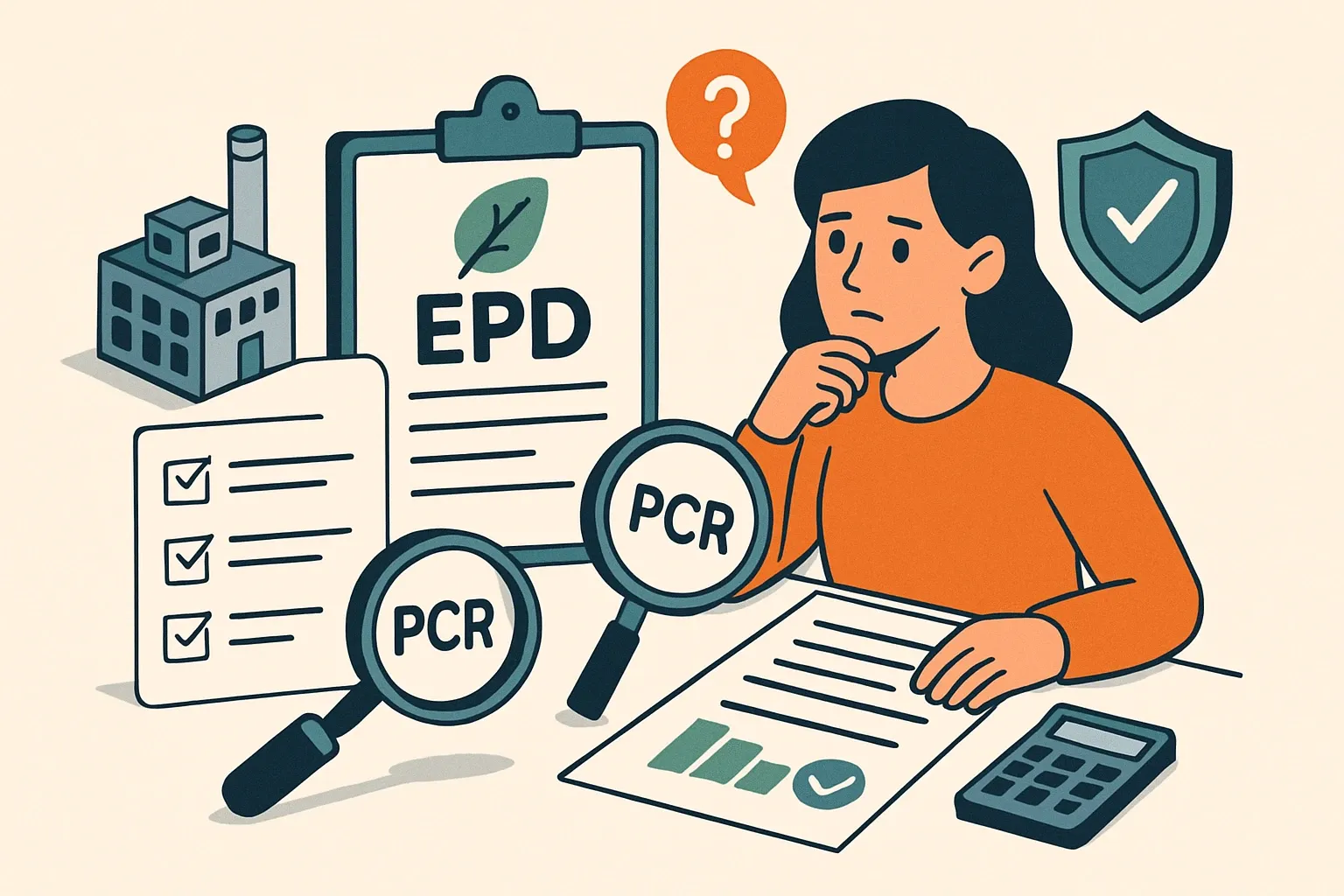
What “EPD consulting services” actually cover
An EPD consultant turns raw plant data into a verified Environmental Product Declaration that follows ISO 14025 and EN 15804. Good teams handle LCA modeling, PCR selection, verifier coordination, and publication with your chosen program operator, not just templates. Think film producer, not camera rental.
Why EPDs change your spec math
Under LEED v4.1, the Environmental Product Declarations credit is worth up to 2 points, and product‑specific Type III EPDs with external verification count as 1.5 products toward the 20‑product threshold from 5 manufacturers (USGBC Credit Library, 2024) (USGBC, 2024). That multiplier can tilt shortlists in crowded categories.
Operator choice, without drama
Most building products publish under Smart EPD in the U.S. or IBU in Europe, yet operator choice should be driven by your buyer’s expectations and project geography. A solid EPD consultant is operator‑agnostic and manages nuances like templates, XML, and portal rules so your declaration lands where specifiers look first.
Data collection, the hidden project risk
The longest delays rarely come from modeling, they come from chasing utility bills, production volumes, transport legs, and waste. White‑glove services do the internal wrangling with your teams, set a reference year, and standardize evidence so verification questions are answered fast. Less email ping‑pong, more progress.
PCRs: the rulebook your LCA must obey
A PCR defines the system boundary, indicators, and comparability rules for your category. Many construction EPDs rely on current EN 15804‑based PCRs. PCRs are reviewed on set cycles, often around four years at major operators, and when a PCR updates your already published EPD usually stays valid until its own expiry, then the renewal must use the new PCR (EPD International FAQ, 2024) (EPD International, 2024).
Want to unlock project opportunities with EPDs?
Follow us on LinkedIn for insights that help you navigate EPD consulting services and enhance your competitive edge.
Timelines you can plan around
Verification at IBU typically takes several weeks depending on complexity and data quality (IBU, 2025) (IBU, 2025). During the 2019:14 PCR transition, EPD International temporarily extended publication from a typical 1–3 days to up to 10 working days due to volume, a reminder that market waves affect calendars (EPD International, 2025) (EPD International, 2025). Build buffers where it matters, especially near PCR sunsets.
Validity, renewals, and your launch window
Most program operators print a five‑year validity on the EPD, tied to verification and publication steps, not when you gathered data (IBU, 2025) (IBU, 2025). Smart teams back‑plan from big bids and product launches so the EPD is fresh, not 30 days from expiry. That avoids frantic extensions and keeps sales moving.
What great EPD consultants actually do differently
They do the heavy lifting inside your organization, collect and clean the data, and keep meetings short. They model to EN 15804 A2 requirements without over‑promising, align to the most common PCR in your competitive set, and propose the operator that matches your market. They also prepare renewal playbooks on day one so version two is easier than version one.
Comparing providers, quickly
Use this fast filter to separate partners from paperwork pushers.
- Will they lead data collection with your plants, not hand you spreadsheets to fill in yourself
- Can they publish with multiple program operators, including Smart EPD and IBU
- Do they show verifiable timelines that factor PCR changes and verifier capacity
- Will they own verifier Q&A to closure, including evidence uploads and corrections
- Do they outline a renewal plan tied to your sales calendar and product roadmap
ROI without hand‑waving
We do not quote averages here because each scope differs, yet the commercial lever is consistent. In LEED‑driven work, the BPDO EPD credit can be the make‑or‑break for a project’s points plan, and product‑specific EPDs act like a multiplier in that count (USGBC, 2024). For many manufacturers, even one mid‑sized project can repay the documentation lift. If numbers are scarce in your segment, say so plainly, then track win rates before and after publication.
Common pitfalls to dodge
Do not delay PCR selection. Do not ignore operator templates. Do not treat Module D or end‑of‑life notes as optional if your category expects them. Above all, do not under‑resource internal data collection, it is the single biggest source of avoidable rework.
Your move
If you need speed, look for EPD consulting that owns the data chase, speaks verifier, and publishes where your buyers live. That is how EPDs, LCAs, and HPDs become a smooth lane into specs instead of a detour. The process is definately manageable once the right crew is in the car.