Who EPD UK is
EPD UK presents itself as a UK‑focused consultancy providing Environmental Product Declarations and supporting Life Cycle Assessments for manufacturers. The site notes EPD UK is a division of ERKE Sustainability Consultancy and lists a London address.
What they appear to offer
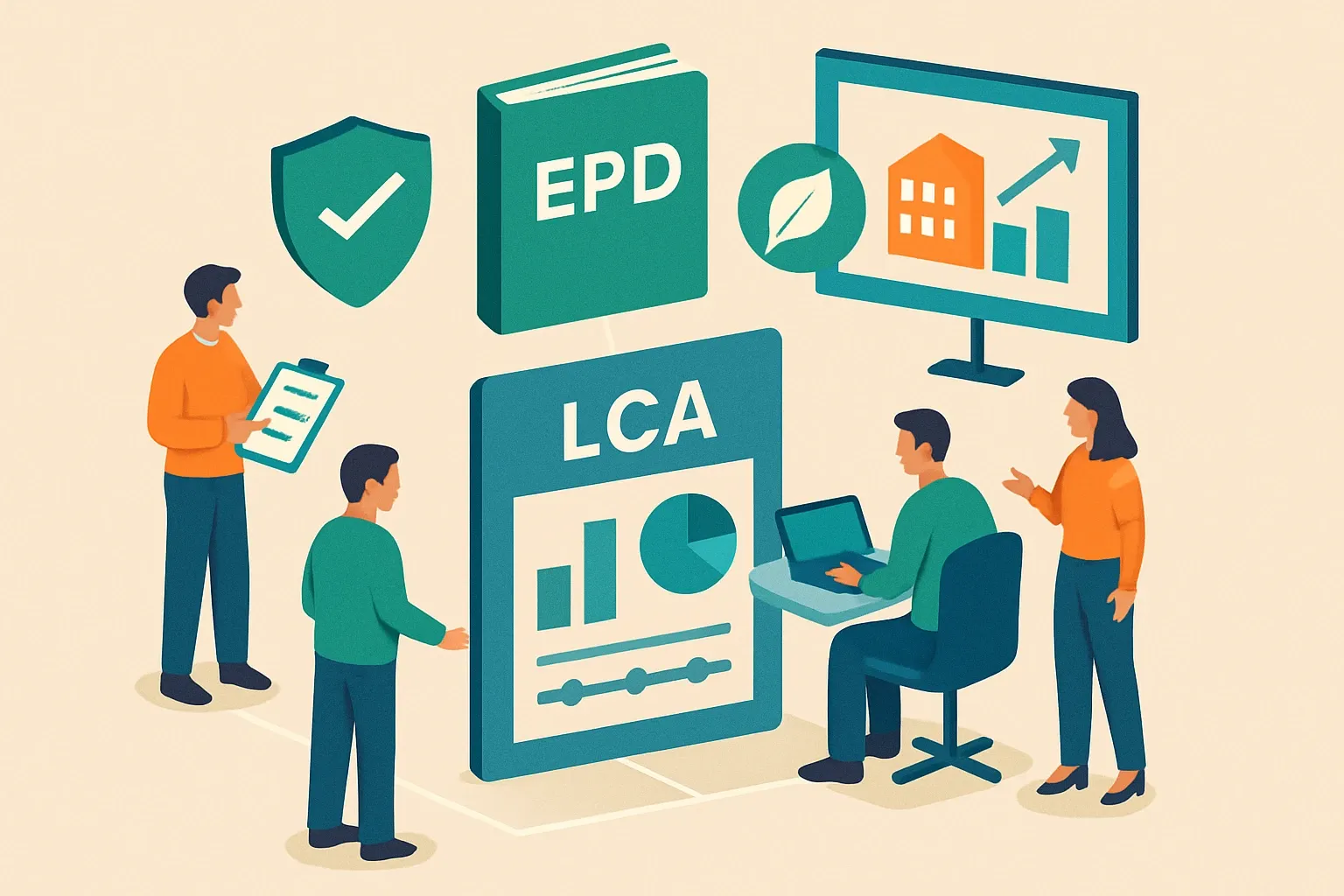
EPD UK describes an end‑to‑end EPD path that starts with data collection, continues with LCA modelling, then documentation, independent third‑party verification coordination, and publication with a recognised program operator. Their pages reference ISO 14025, ISO 14040/44 and EN 15804 as the governing standards, plus common databases and software such as Ecoinvent and SimaPro. See their overview and service descriptions on the homepage and blogs that reference process details and use cases (EPD UK homepage, EPDs and BREEAM in the UK, Are EPDs mandatory in the UK?).
LCA studies and EPD creation
Their content outlines typical LCA scope setting, system boundaries, modelling to EN 15804, and conversion of results into a program‑operator‑ready EPD. EPD UK positions publication via operators such as the International EPD System, BRE and IBU, with third‑party verification carried out by accredited verifiers. That aligns with mainstream practice where the LCA underpins the declaration and verification happens prior to registry publication.
Verification support and PCR guidance
EPD UK indicates they coordinate verification and align work to applicable Product Category Rules. For construction products in the International EPD System, the workhorse PCR today is PCR 2019:14 version 2.0.x, with version 1.3.4 sunset on June 20, 2025, which matters if you are starting a new project in 2025 or updating templates (EPD International, 2025) (EPD International, 2025).
Data collection approach
Manufacturers should expect a classic intake: bill of materials, supplier locations and transport, utilities by process line, yield and scrap, packaging, and distribution to first customer. EPD UK’s content points to spreadsheet‑based collection and follow‑up clarification, which is standard for consulting workflows. Plan for document requests and periodic review calls rather than a one‑click data pull.
Tools and software
The site references industry‑standard LCA tools and datasets, naming Ecoinvent and SimaPro. That suggests file exchanges and version‑controlled models, which typically means a few rounds of iteration as assumptions are confirmed and verifiers ask questions.
Want to navigate EPDs and LCA services more effectively?
Follow us on LinkedIn for insights that help you unlock project specifications and improve your ROI.
Industries and geographic focus
Positioning appears UK‑first, with examples and commentary aimed at construction and building materials, plus language that EPDs can apply to consumer, industrial, and packaging products. The site also cites experience across Europe, the Middle East, and Asia‑Pacific, which can be helpful for multi‑plant footprints and cross‑border publication.
How the client experience usually feels with traditional consultants
Expect an onboarding workshop, a structured questionnaire, spreadsheet templates, and several working sessions to validate boundaries and scenarios. Timelines commonly stretch over multiple weeks, especially if supplier data is incomplete or if the verifier requests additional evidence. Internal effort is not trivial. Teams will spend time on data extracts, meter splits, and answering clarifications. That is normal for a consultant‑led process, and it still gets the job done.
Market context and what to double‑check before issuing a PO
Product declarations live inside a standards framework that shifts on a predictable cadence. Two checkpoints help avoid surprises:
- Validity period and refresh triggers. Most EPDs are valid for five years, with a requirement to update during that window if any published indicator worsens by more than 10 percent, per operator guidance (EPD International, 2025) (EPD International FAQ, 2025).
- Current PCR version. If you plan to publish in the International EPD System for construction products, confirm the active PCR and template at kickoff. Version 1.3.4 reached its final sunset on June 20, 2025, with 2.0.x active to 2030 based on operator announcements (EPD International, 2025) (EPD International, 2025).
Where EPD UK’s content can help your team
If your specs reference BREEAM credits or UK tenders that prefer verified EPDs, EPD UK’s article on BREEAM points to familiar acceptance criteria and the practical need for third‑party verification and EN 15804+A2 alignment. Their “Are EPDs mandatory” piece explains why declarations are often a de facto requirement in public procurement contexts, even when not explicitly mandated in law (BREEAM article, Mandatory article).
Competitor landscape they tend to meet
In the UK and wider Europe, buyers often evaluate alongside other LCA boutiques, generalist sustainability consultancies that added EPD services, and engineering firms with LCA teams. Some program operators also maintain advisory arms. Software‑centric offerings are another route. We see procurement compare these models mostly on speed, ease of intake, verifier familiarity, and how well the team handles multi‑plant complexity.
A quick reality check on timelines and effort
Traditional consulting models can produce high‑quality EPDs. They do, however, rely on client‑provided data, so delays usually come from internal data retrieval and supplier responses. Plan for calendar time devoted to clarifications and to verifier Q&A. If your commercial calendar is tight, ask for a delivery plan that matches bid dates and identifies the critical path tasks early. That avoids last‑minute scramble and protects sales momentum.
Bottom line
EPD UK offers a recognizable consulting pathway for LCAs and program‑operator‑ready EPDs, with verification coordination and publication support. Manufacturers that prefer low‑friction intake and faster turnaround increasingly expect simplified data capture and tighter project management. Whichever path you choose, lock PCR version, verification approach, and publication venue on day one, and confirm the five‑year validity assumptions in writing. It sounds obvious, but it saves real time. And less stress for everyone on the shop floor, too.
Small but useful note for your team: keep all enviromental data sources and assumptions in a single, shared location so handoffs are clean.