Why Sweden counts carbon in roads and rails
Sweden’s transport infrastructure has a climate budget, not just a monetary one. Trafikverket aims for climate‑neutral infrastructure by 2040, with staged reduction targets from a 2015 baseline of 15 percent in 2020, 30 percent in 2025, 60 percent in 2030, and 80 percent in 2035 (Trafikverket, 2025).
Policy tailwinds are mixed. Road‑traffic emissions rose 18 percent in 2024 after biofuel blending rules were eased, which sharpened scrutiny on construction‑stage impacts too (Trafikverket, 2025).
The tool that drives the math: Klimatkalkyl
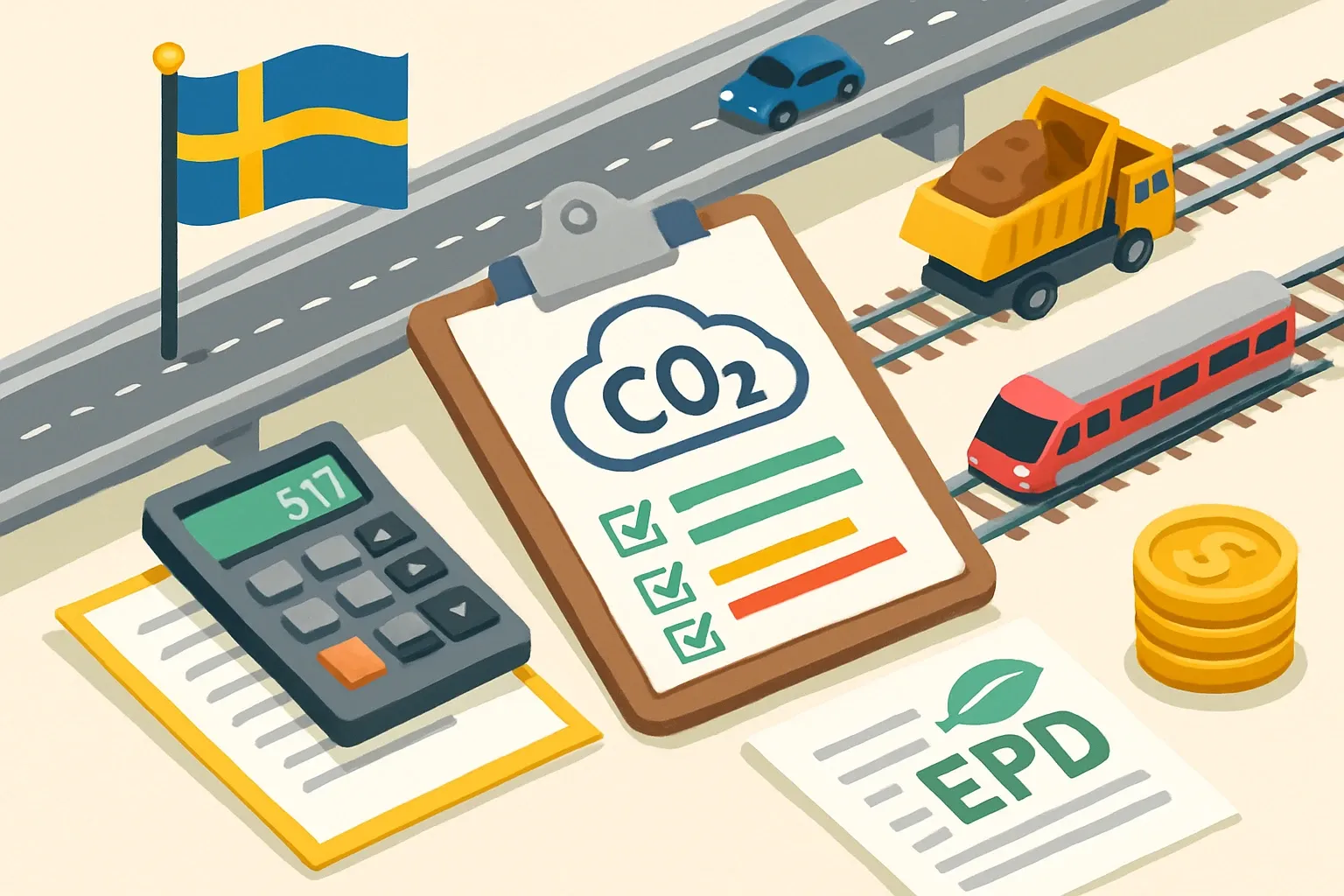
Klimatkalkyl is Trafikverket’s model for calculating energy use and climate impact across construction, operation, and maintenance for roads and railways over the life cycle (Trafikverket, 2025). The tool sets the 2015 baseline and standardizes comparisons between options, so teams can show percentage reductions with shared assumptions.
Project teams can adjust emission factors and transport distances in the model to reflect actual sourcing and logistics, which is where supplier data matters most (Trafikverket, 2025).
What buyers expect from materials data
Trafikverket’s climate requirements increasingly focus on high‑impact materials such as cement, concrete, reinforcement, structural steel, and fuels, with economic bonuses possible for outperforming set limits (Trafikverket, 2025). To replace generic factors in calculations, reviewers look for verified declarations that match the product used on the job.
That is usually a third‑party verified EPD aligned with EN 15804. Without it, conservative defaults tend to stick.
Navigating carbon regulations for winning bids?
Follow us on LinkedIn for insights that help you stay compliant and competitive in your projects.
Where EPDs move the needle
Sweden’s building climate declaration regime shows the logic clearly. When specific EPD data is missing, Boverket’s generic values are set roughly 25 percent above averages to nudge selection toward documented products (Boverket, 2024). While that policy applies to buildings, the same idea plays out in infrastructure tenders when generic factors replace your numbers.
Publishing through a widely used operator also improves discoverability. The International EPD System, headquartered in Sweden, reported passing 10,000 valid EPDs in 2024 and over 18,000 by late 2025 (EPD International, 2024) (EPD International, 2025).
Transport to site carries real weight
Module A4 can swing results on remote projects. In Klimatkalkyl, transport distances and modes can be made project specific, so accurate supplier‑to‑site mileage, payloads, and backhaul assumptions help cut inflated A4 figures (Trafikverket, 2025). Dont leave those fields blank and hope for the best.
If your plant is closer, prove it. If you can shift to rail or higher load factors, document it so the model reflects reality.
Asphalt, concrete, steel: practical accounting tips
- Asphalt: Declare binder content, mixing temperature, and reclaimed asphalt share consistently. Warm‑mix settings can lower fuel use on site, which should be reflected in construction energy inputs.
- Concrete: Align cement type, clinker factor, SCMs, and curing temperature with Swedish specs. Provide mix‑specific EPDs or supplier verifikats that match actual delivery.
- Steel: Distinguish EAF vs BOF routes and document scrap content. Package EPDs with mill test certificates so reviewers can trace lots to the project.
Each point sounds small, but together they often determine whether your data displaces a conservative factor.
How manufacturers prepare, fast
- Match the declared unit and boundaries in your EPD to how the product is bought for Swedish projects, then provide machine‑readable data for easy import.
- Provide site‑specific A4 data: plant address, typical truck type, payload, and one‑way kilometers. Keep a simple, dated log that can be attached to the tender.
- Share change‑ready assumptions. Trafikverket’s model lets engineers test options, so give ranges for feasible SCM rates, recycled content, or lower‑temperature mixes with proof points.
Bringing it together for specs
Sweden’s approach is pragmatic. Set clear targets, use one model, and reward verified improvements. Manufacturers who arrive with EPDs, clean transport data, and traceable evidence make the buyer’s carbon math easier, which makes selection easier. That is the quiet edge in a market where the calculator decides.