What changed on January 1, 2025
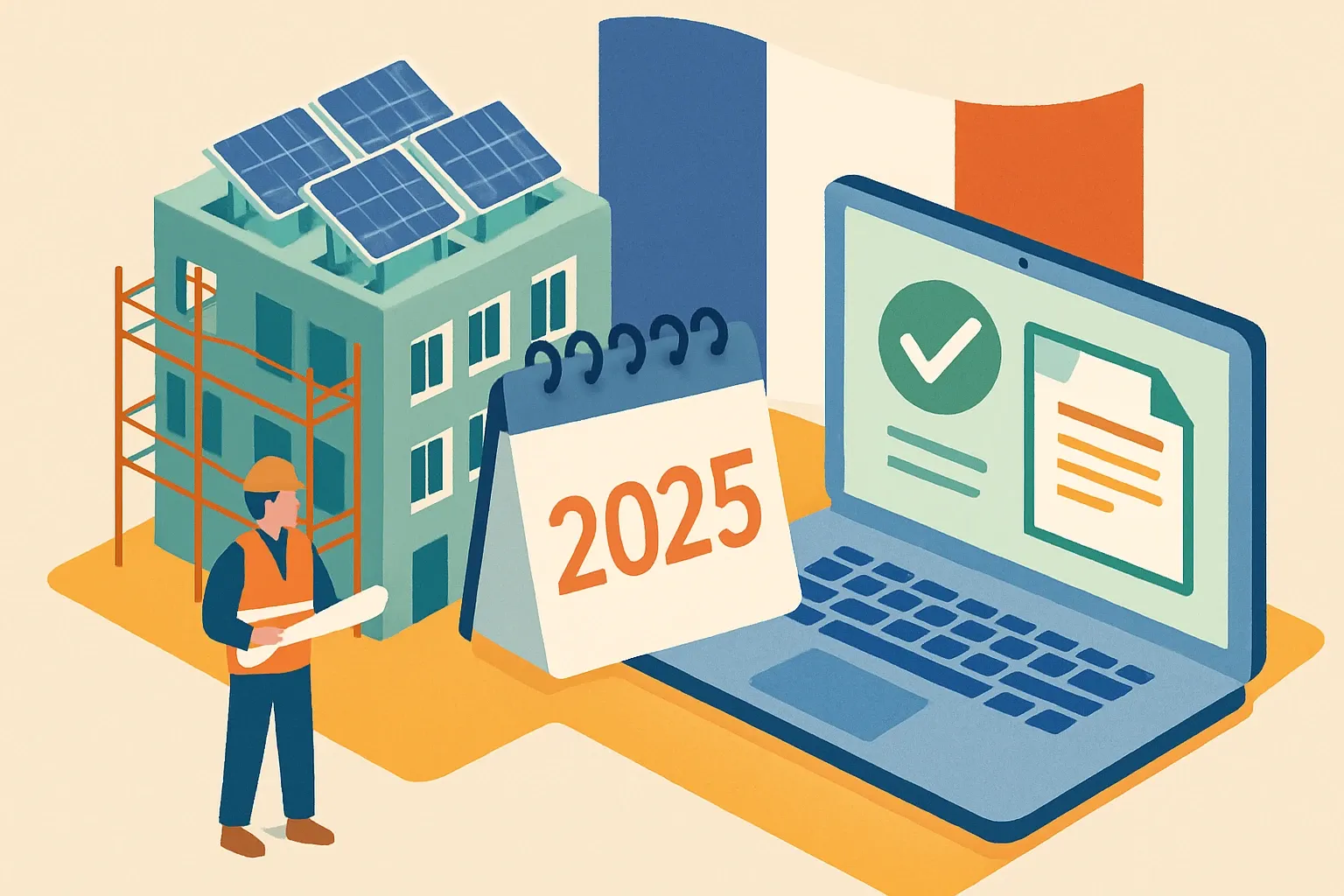
France activated the 2025 RE2020 tightening for new homes, apartments, offices, and primary or secondary schools. The Ic construction caps moved to 530 kg CO2e per m² for single‑family and 650 kg CO2e per m² for multifamily, with related adjustments to Ic énergie and the official modulators that set project‑specific limits, including new surface and PV terms added to the formula. The legal basis is Décret n° 2024‑1258, effective January 1, 2025 (Légifrance, 2024) (Légifrance, 2024).
December move that speeds paperwork
On December 3, 2025 the state introduced “Attestations‑construction”, a free portal that centralizes and digitizes construction attestations. It links to RE2020 permit and completion attestations and lets teams generate other required attestations online, like seismic or accessibility. That trims admin time and reduces errors at permit and DAACT stages (RT‑RE Bâtiment, 2025).
INIES is the gate your product must pass
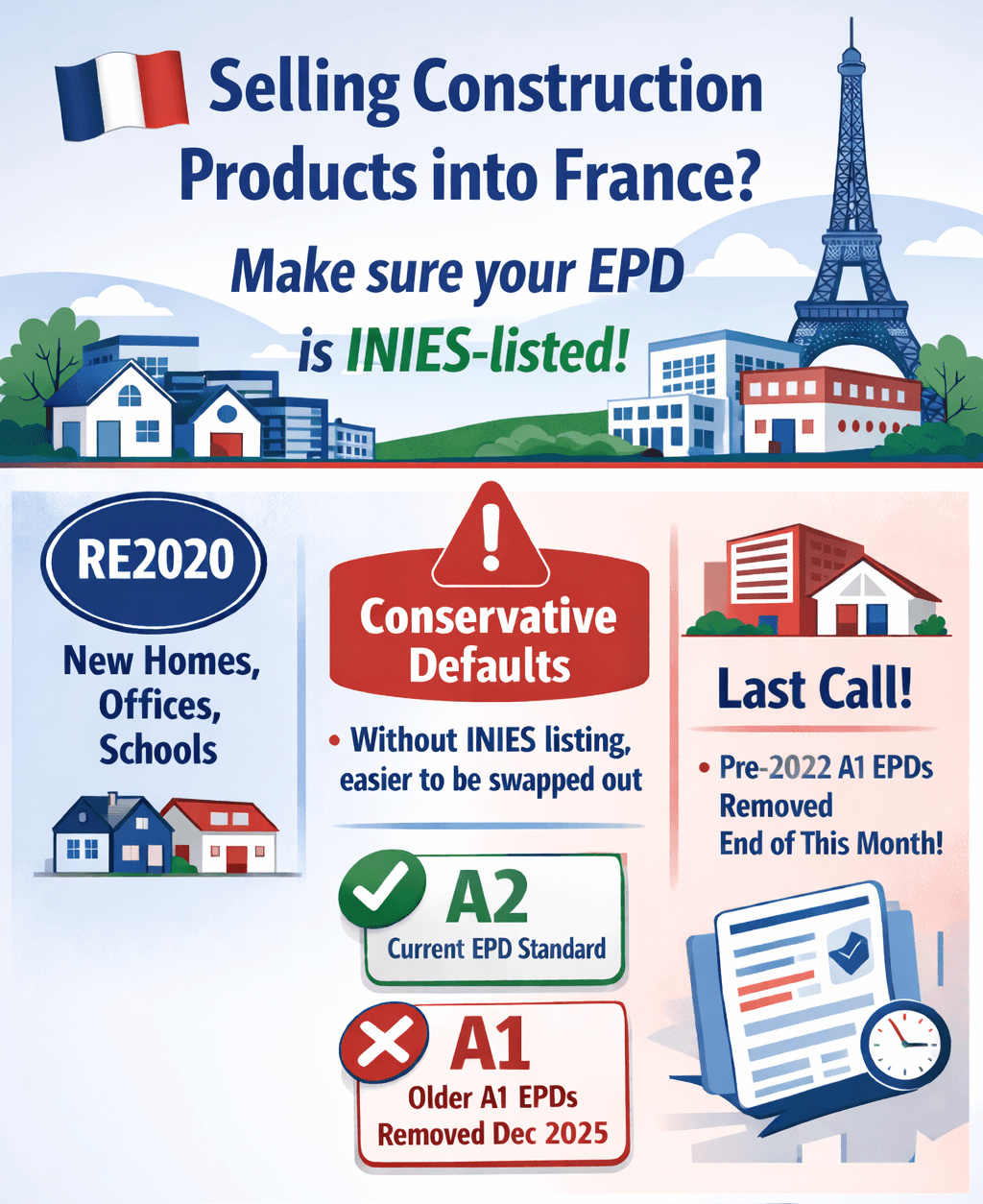
Designers in France pull product data from INIES. As of December 17, 2025, INIES listed 5,485 FDES and 1,784 PEP, representing 320,868 commercial references. If your product lacks a specific declaration, modelers fall back to Default Environmental Data that are intentionally conservative, which can push a tight design over the line. Publish as FDES or PEP so your real process beats a generic estimate (INIES, 2025) (INIES, 2025).
Navigating France's new building code updates?
Follow us on LinkedIn for insights that help you stay compliant and win more projects.
A1 sunsets after December 31, 2025
France is completing the shift to EN 15804+A2. Cerema confirms that FDES verified after November 1, 2022 must be A2 and that, from January 1, 2026, only A2 files remain active in INIES. Older A1 files are archived at year‑end 2025. If your listings are still A1, schedule the update now so customers dont have to substitute a default on January 2 (Cerema, 2024) (Cerema, 2024).
The project pipeline is big, and visible
The government’s RE2020 observatory shows the volume of files moving through the system. As of November 1, 2025 it recorded 495,230 permit‑stage submissions and 106,632 completion‑stage entries, a reminder that your data is tested in live models, not in theory. Expect scrutiny on both Ic construction and Ic énergie as teams aim for 2025 limits with the 2028 step already in sight (OPEE Observatoire RE2020, 2025).
Why this matters for EPD strategy
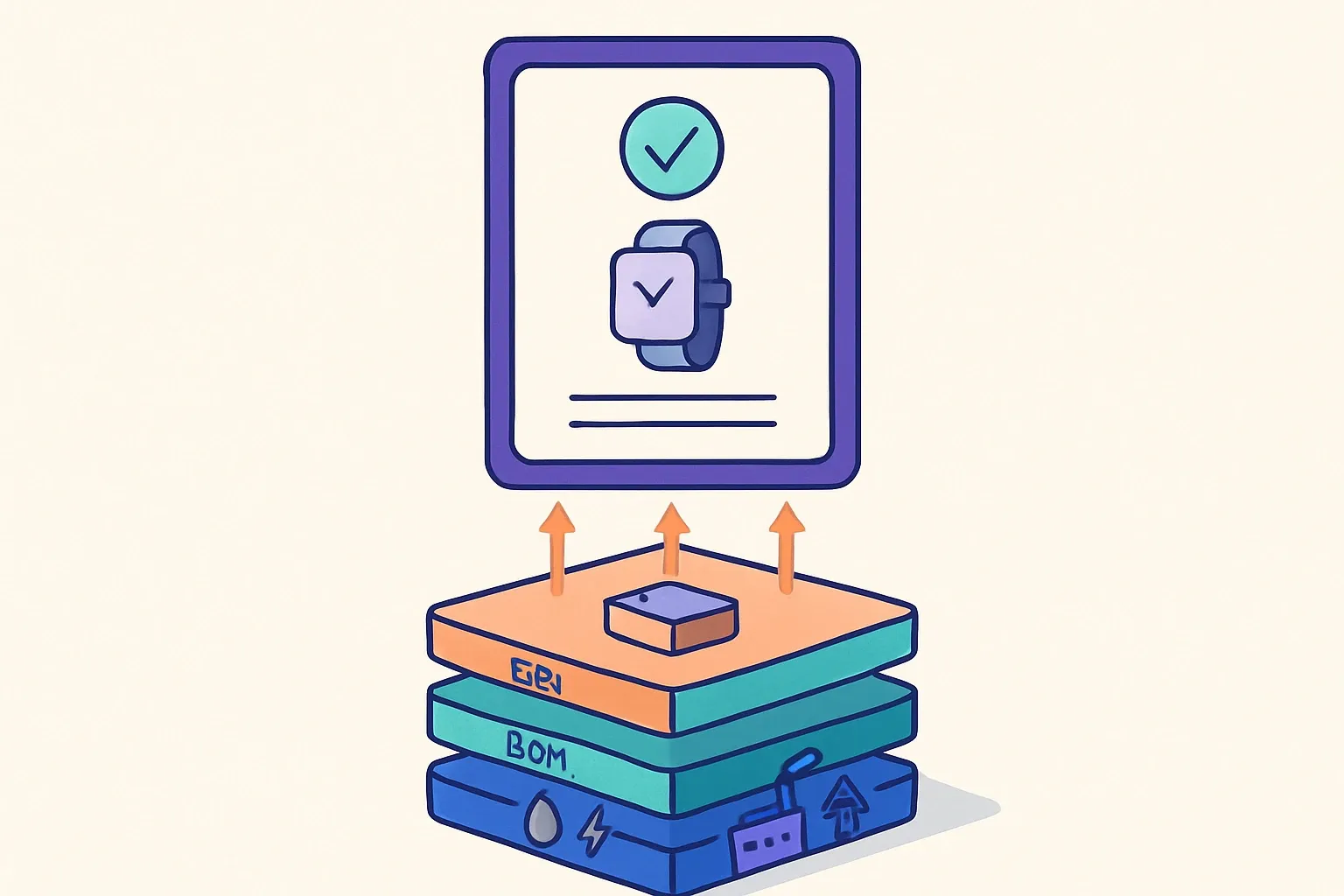
RE2020 turns EPDs from nice‑to‑have into modeling inputs that influence permit outcomes. A product‑specific, third‑party verified declaration in INIES lets your actual mix, plant energy, and transport show up in the building LCA. That keeps your product in play when designers juggle structural choices, heat sources, and summer comfort constraints rather than losing out to a conservative default value.
What to do next without losing weeks
Pick the PCR your French competitors use so modelers compare apples to apples, then gather complete 12‑month plant data for the latest reference year. Confirm A2 alignment and France’s national complement, verify with an accredited program operator, and publish into INIES. Choose a partner who handles the internal data wrangling, coordinates verification, and delivers files ready for INIES so your R&D and plant teams stay focused on production.
One more 2025 thread to watch
INIES notes that the new EU Construction Products Regulation rolls out progressively from 2026 to 2039, which will reshape how declarations are produced and shared. Planning your data model now, with clean references and version control, will save painful rework later (INIES Baromètre, 2025) (INIES, 2025).
Short version
France tightened carbon caps in 2025, digitized attestations in December, and is phasing out A1 EPDs at year‑end. Get your A2 files in INIES, keep your data complete and verifiable, and your product remains specification‑worthy when projects face stricter carbon math. The fastest path is the one that takes the heavy data lifting off your team so the declaration arrives clean, correct, and on time.