What actually changed, and when
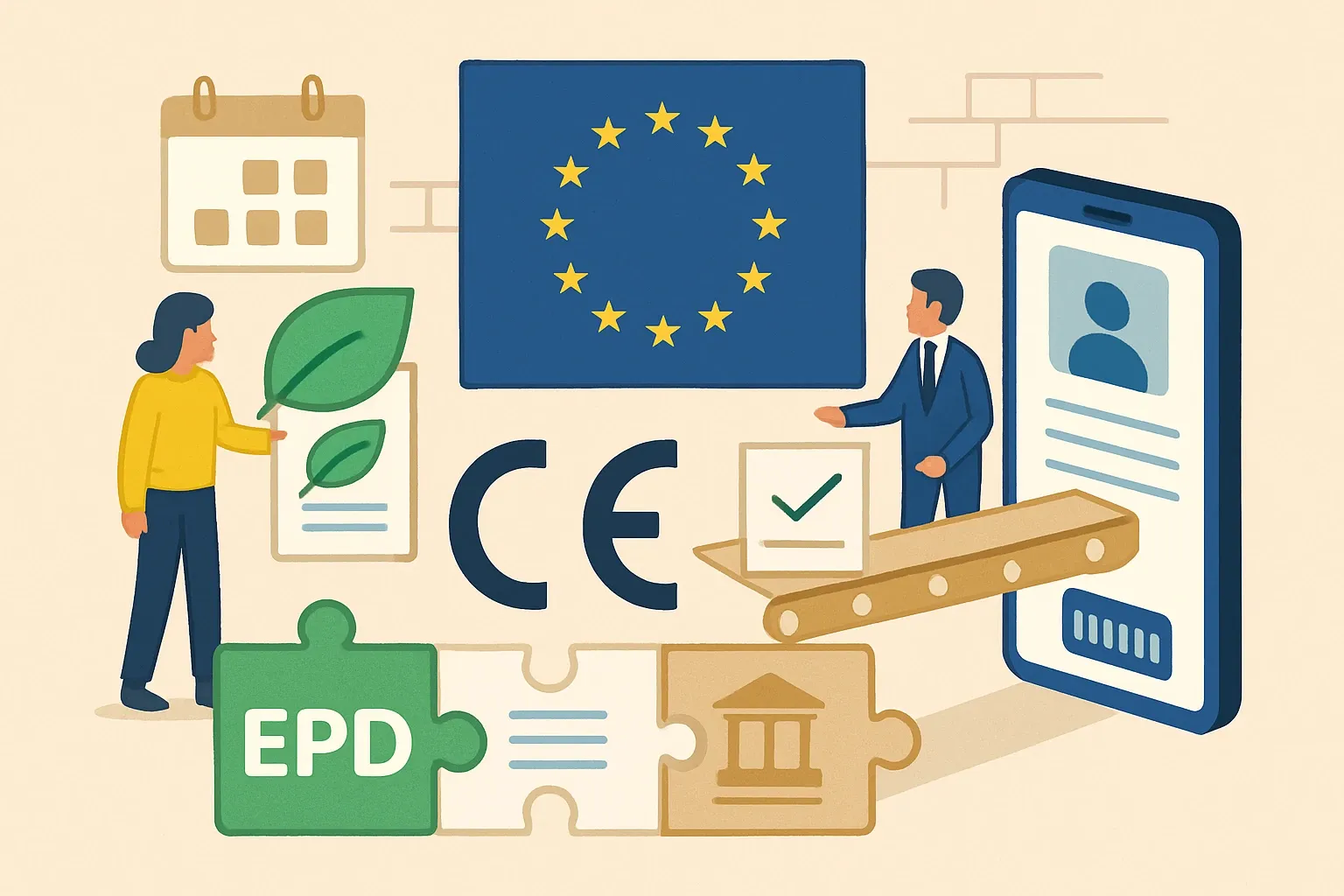
The new Construction Products Regulation was published on 18 December 2024, entered into force on 7 January 2025, and most provisions start to apply from 8 January 2026. Penalties for non‑compliance with environmental declarations begin on 8 January 2027 (FPS Economy, 2025) (EUR‑Lex, 2024).
Until new harmonised specifications land, CE marking workflows continue as today, so use 2025 to prepare the data plumbing rather than pause decisions (Euralarm, 2025).
DoPC becomes the home for environmental performance
The Declaration of Performance and Conformity must include a product’s environmental sustainability performance across its life cycle and follow a staged schedule of essential characteristics. The Annex II sets start dates for groups of characteristics on 8 January 2026, 9 January 2030, and 9 January 2032. The Commission will provide free calculation software that becomes mandatory one year after each update (EUR‑Lex, 2024).
Think of the DoPC as the product’s passport and résumé in one place. If the number goes there, it needs traceable data behind it.
EN 15804 stays the rulebook for construction EPDs
EN 15804 remains the core method for construction product EPDs across European program operators. The major operators completed the switch to the A2 version, and IBU confirms the A1 transition ended in October 2022, so new or adapted EPDs must use A2 in that program (IBU, 2025) (IBU, 2025).
Translation for roadmap planning. If an EPD refresh is due, plan it on A2 and wire its datasets so they can feed your DoPC without double entry.
Digital Product Passports move from idea to infrastructure
The regulation sets up a construction digital product passport system with machine‑readable records that include the DoPC, labels, technical documents, and unique product identifiers. Access must be free based on roles. Passports need to remain available for at least 10 years and be interoperable with open standards (EUR‑Lex, 2024).
This is less a shiny badge and more a reliable API for your product facts.
Want to stay compliant with new EU regulations?
Follow us on LinkedIn for insights that help you navigate EPDs, CE marking, and unlock new business opportunities.
CE beats badges in the new hierarchy
CE marking is the only mark that attests product performance against assessed essential characteristics in this regime. Other marks, including private ones, are allowed only if they do not suggest a different assessment route than the harmonised one, and the DoPC itself may not carry anything but CE. Official Type I ecolabels can help where they meet CPR conditions, yet they sit alongside, not above, CE (EUR‑Lex, 2024).
Standalone sustainability badges will still exist, but their relative weight declines once buyers see harmonised environmental numbers inside CE files.
What to do in the next 6 to 12 months
- Map your portfolio to Annex VII product families and list which Annex II environmental characteristics apply now versus later (EUR‑Lex, 2024).
- Schedule EPD updates on EN 15804+A2 and align indicators with your future DoPC fields. If an EPD is within 18 months of renewal, pull it forward to avoid a split data model.
- Stand up a single dataset for plant utilities, materials, packaging, transport, and end‑of‑life assumptions that can serve both the EPD and the DoPC. Avoid parallel spreadsheets that drift.
- Prepare for the digital product passport by assigning unique product type identifiers and testing machine‑readable outputs.
We recommend choosing a partner who handles data collection across sites and keeps verification moving so engineers are not pulled off critical work.
Budgeting where labels still help
Optional certifications can still be smart when they unlock a buyer list, satisfy a tender template, or fill a country‑specific gap. Use them as a bridge, not as the place you park critical climate numbers that the DoPC will soon require anyway. If numbers are scarce for a given badge, say so plainly and focus spend on EPDs that will feed CE.
Timelines that change behavior
There are three clocks to watch. Application of most CPR provisions from 8 January 2026. Penalties for environmental declaration failures from 8 January 2027. And your own EPD renewal cycles, typically five years, which you can time to land before audits tighten (EPD International, 2024) (FPS Economy, 2025).
Get these clocks in one view and you will avoid rework and re‑verification loops.
How this shifts specs and sales conversations
Specifiers will look first to CE documentation for environmental numbers, then to databases and badges as supporting material. That means clean, comparable EN 15804 results in your DoPC can shorten back‑and‑forth and reduce pessimistic defaulting in whole‑building models. The product with transparent numbers wins attention, the one without gets sidelined.
A simple litmus test for the next brief
If a data point helps you populate the DoPC or the passport, it is a must‑have. If it only decorates a brochure, it can wait. That compass keeps the team moving. It is definately the easiest way to avoid scramble weeks in 2026.
The short close
Treat EPDs, DoPC, and the digital passport as one workflow. Use EN 15804+A2, wire data once, publish where buyers actually look, and keep an eye on the CPR dates. That is how documentation stops being a blocker and starts being a growth lever.