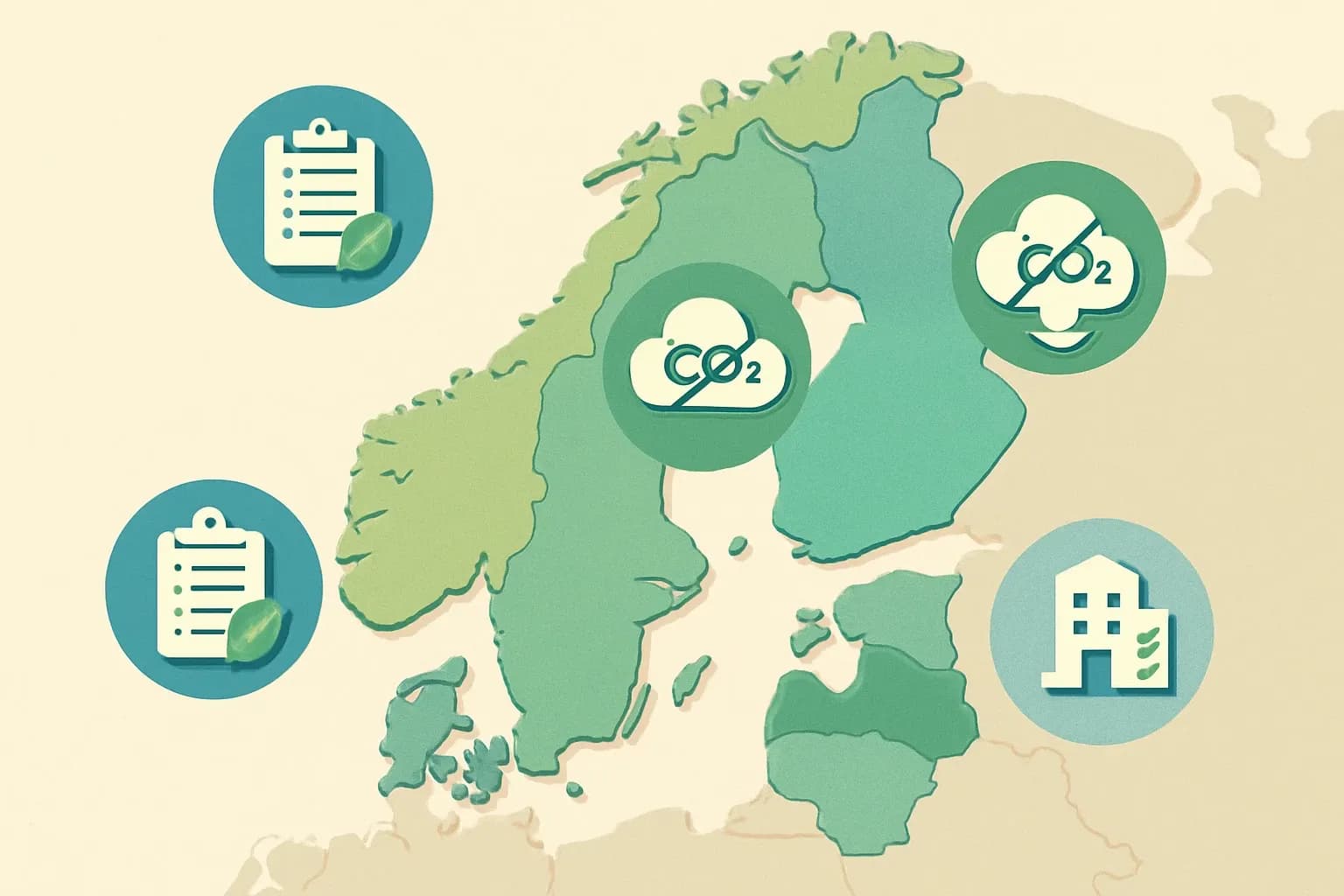
The Nordic EPD landscape in one glance
Across the region, most construction-product EPDs follow EN 15804 A2 and ISO 14025. Common program operators you will encounter include EPD Norge, EPD Danmark, RTS EPD in Finland, and the International EPD System in Sweden. European players like IBU are also widely accepted. Pick the operator that matches your priority market and buyer expectations, not just the cheapest route.
Sweden: climate declarations amplify the value of product EPDs
Sweden requires a climate declaration at completion for new buildings that need permits, in force since January 1, 2022 (Boverket, 2024). Boverket’s open climate database sets generic product data approximately 25 percent above average, so product‑specific EPDs can materially improve a project’s numbers (Boverket climate database, 2024). During 2022–2024, 1,765 climate declarations were registered, signaling steady uptake (Boverket, 2025).
Analogy time. Think of the database as the base score in a video game. Specific EPDs are the power‑ups. You can finish the level with generics, but you will not top the leaderboard.
Denmark: BR18 thresholds now bite
As of July 1, 2025, Denmark tightened BR18. CO2e limits now apply to all new buildings, with differentiated caps such as 7.5 kg CO2e/m²/yr for multi‑storey housing and offices, 6.7 for detached and row houses, and 8.0 for institutions. A separate construction‑process cap of 1.5 kg CO2e/m²/yr covers A4–A5 (Social‑ og Boligstyrelsen, 2025; BR18, 2025). Practical tables used by the industry confirm these numeric thresholds across building types (DI Byggeri, 2025).
For manufacturers, this means EPDs that model realistic A1–A3 and enable credible A4 scenarios can be the difference between a project passing or re‑designing late in the game.
Norway: TEK17 greenhouse‑gas accounting changes what gets specified
Norway requires a greenhouse‑gas account for apartment blocks and non‑residential buildings under TEK17 §17‑1. It includes A1–A4 plus B2 and B4, along with site waste, and uses NS 3720 as the method (DiBK, 2025). Public clients and larger private developers routinely ask for product‑specific, third‑party verified EPDs to de‑risk documentation. EPD Norge remains the default reference for local acceptance.
Navigating EPD regulations in the Nordics?
Follow us on LinkedIn for insights that help you meet compliance and unlock new market opportunities.
Finland: RTS EPDs and national limits from 2026
Finland’s new Building Act framework ushers in national carbon‑footprint limit values for new buildings starting in 2026, with a planned tightening in 2028. Draft levels communicated by public bodies indicate values such as 16 kg CO2e/m²/yr for apartment buildings in 2026–2027, tightening to 14 in 2028, and 20 to 18 for offices (Motiva, 2025; TRIS, 2025). Cities like Helsinki already run a local limit for multi‑storey housing at 14.0 after an energy‑factor update in October 2024 (City of Helsinki, 2024).
The headline for suppliers is simple. RTS‑published A2 EPDs with clear scenarios will plug directly into municipal tools and client LCAs.
Iceland: LCA now mandatory for many permits
From September 1, 2025, life‑cycle assessments are required for a substantial share of new building permits in Iceland, with a 50‑year reporting period. Benchmarks and national limit values are expected after experience builds, tentatively from 2027 (Nordic Sustainable Construction, 2025). Manufacturers serving Reykjavik‑area projects should expect designers to favor products with machine‑readable EPDs to streamline submissions.
Program operators you will meet most often
EPD Norge is the anchor for Norwegian projects, aligned with ECO Platform norms and A2. EPD Danmark publishes to EN 15804 A2 and communicates clearly about verification and data‑quality expectations. Finland’s RTS EPD program is widely used in domestic procurement and design workflows. Sweden’s International EPD System remains a global heavyweight many Nordic teams publish through when they want cross‑border visibility.
None is intrinsically “best.” Match program, PCR and language to the market that buys your product.
PCR choice in the Nordics: follow the competitive fingerprint
A PCR is the rulebook of Monopoly. Ignore it and the game falls apart. In practice, Nordic specifiers read across competitor EPDs. If peers use a specific cPCR under EN 15804 A2, publishing to a different rule can make your results look odd, even if technically valid. Smart teams compare expiry dates, operator instructions and common scenarios before locking the PCR.
Data tactics that pay off
Use plant‑specific utilities, on‑site fuels and waste, not corporate averages. Shipments matter up here. Capture realistic A4 modes and distances for Nordic corridors. In Sweden, relying on conservative generic data can mean a built‑in 25 percent uplift, so specific EPDs grant immediate headroom (Boverket climate database, 2024). In Denmark’s BR18 world, check whether your clients evaluate B4 and energy consistently with their whole‑building model before you promise deltas.
What winning manufacturers do differently
They plan EPDs around target markets, not around internal convenience. They choose operators that clear local compliance debates. They front‑load data collection with a white‑glove approach so verifiers move fast. And they maintain renewal calendars so declarations never expire during a bid window. Sounds simple, but it’s definately where deals are won.
Bottom line for teams searching “EPD Nordics”
The regulatory arc is tightening. Sweden’s climate declarations already favor product‑specific data. Denmark enforces numeric whole‑building limits with a separate process cap. Norway compels GHG accounting that rewards transparent, verifier‑ready EPDs. Finland’s national limits begin in 2026, and Iceland has switched LCAs on for permits in 2025. If you publish clean A2 EPDs with Nordic‑ready scenarios, you shorten sales cycles and protect margin when projects get carbon‑budgeted.
Citations used for numeric claims: Boverket 25 percent uplift and 1,765 declarations 2022–2024 (Boverket, 2024; Boverket, 2025). BR18 differentiated limits and 1.5 kg process cap (Social‑ og Boligstyrelsen, 2025; DI Byggeri, 2025). Finland 2026 and 2028 limit values with example numbers 16→14 and 20→18 (Motiva, 2025; TRIS, 2025). Iceland LCA permit requirement starting September 1, 2025 (Nordic Sustainable Construction, 2025).