EPDs in Spain, in a nutshell
Spain aligns with the European core rules for construction products, so product‑specific EPDs follow ISO 14025 and EN 15804. In Spain, the adopted standard is UNE‑EN 15804+A2, published on 25 March 2020 and corrected in October 2021 (DIN Media, 2020; 2021). That means familiar impact indicators, modules, and comparability across EU markets.
Who operates EPD programs in Spain
Two names show up on submittals most often. AENOR’s GlobalEPD and the DAPconstrucción program administered by Cateb. Both issue EN 15804 EPDs and participate in ECO Platform recognition. As of 1 July 2025, ECO Platform lists about 421 EPDs under GlobalEPD and 190 under DAPconstrucción, each carrying the ECO EPD quality mark when applicable (ECO Platform, 2025). Spanish manufacturers also publish through international operators like the International EPD System or IBU when projects span multiple countries.
Why EPDs help in Spanish tenders
Public buyers in Spain are steadily adding environmental criteria to contracting. The state’s Green Public Procurement Plan covers twenty priority groups including buildings and roads and is in force for the central administration through 2018–2025, with updated guidance issued in 2024 to help ministries apply it (MITECO, 2024; MITECO, 2025). BIM is another accelerator. The national BIM Plan for Public Procurement estimates BIM appeared in 25.2% of 2023 tenders by count, representing roughly €12.5 billion in investment, which raises the bar for structured, verifiable product data like EPDs (Public Buyers Community, 2024).
Standards that govern your file
For construction products, specify to UNE‑EN 15804+A2. It harmonizes with EN 15804, so your Spanish EPD remains comparable across the EU. The latest EU building policy context keeps pressure on embodied and operational carbon. Around 40% of EU energy is used in buildings, and member states are implementing a revised Energy Performance of Buildings Directive adopted in 2024 to push deeper renovations and cleaner materials (European Commission, 2025). When teams ask for “EN 15804 A2 Spain,” they are asking for this exact alignment.
Selling into Spain or exporting from a Spanish plant?
Follow us on LinkedIn for insights that help you win projects by understanding EPD requirements and compliance in the Spanish market.
Picking a program operator for Spain
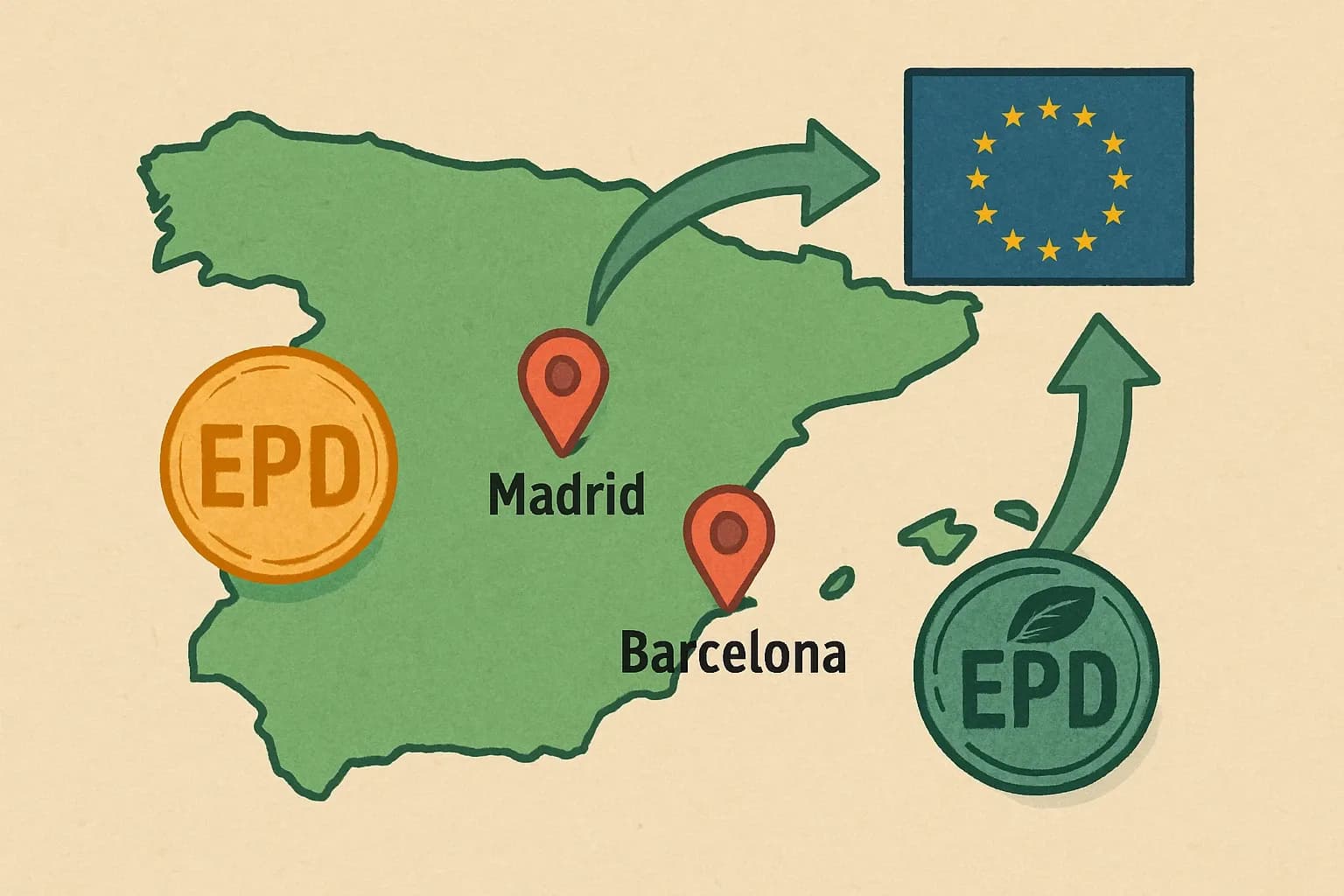
Choose based on where your projects land and how recognition travels. GlobalEPD and DAPconstrucción are well understood by Spanish public owners and private certifiers. ECO Platform recognition improves cross‑border acceptance in Italy, Germany, Nordics, and beyond, which matters for Iberian manufacturers with EU export routes. If your project mix is heavy outside Spain, consider an operator with the strongest footprint in those target countries. The labels on the PDF are not just logos. They signal verification depth and ease of acceptance.
PCR choices without the guesswork
A PCR is the rulebook of Monopoly. Ignore it and the game falls apart. In Spain, many categories defer to EN 15804 with product‑specific European PCRs for tiles, windows, and more. The fastest path is to benchmark the PCRs your direct competitors already use in Spanish and EU submittals, then confirm expiry timing so a renewal does not collide with your bid window. If a perfect PCR does not exist, an experienced LCA partner will recommend the closest fit and explain any tradeoffs.
Timelines, language, and verification
Typical Spanish projects want bilingual files. Plan for Spanish and English in one PDF to avoid parallel document control. Program operators in Spain are accustomed to plant‑level data from ceramics, cement, ready‑mix, metals, and finishes, which helps keep review cycles brisk when data arrives organized. We advise teams to lock a clean reference year of utilities, volumes, and waste at the start to avoid back‑and‑forth. One messy spreadsheet can waste a whole week, no kidding.
How EPDs feed rating systems and owner requirements
Spanish building clients use a mix of tools. LEED v5 is rolling out globally, VERDE remains common locally, and many owners ask for whole‑building LCA against EN 15978. In each case, product‑specific EPDs reduce default penalties and keep your product in the running when carbon caps tighten. The macro policy trend is clear. Buildings drive about a third of energy‑related EU emissions and that share must fall further this decade (EEA, 2025).
Common pitfalls to dodge
Do not publish to A1 when a competitor has already moved to A2. Do not skip biogenic carbon for wood products. Do not split one factory across several EPDs unless the PCR requires it, because buyers expect simple, traceable SKUs. And please avoid last‑minute translations that change category names or units. It sounds small, but it breaks trust during submittal reviews.
Spain‑specific proof points you can cite in bids
- State that your EPD follows UNE‑EN 15804+A2 with the 2021 corrigendum visible in the methodology section. Buyers know these dates matter for comparability (DIN Media, 2020; 2021).
- If your EPD carries the ECO Platform mark, call it out. It shortens questions from reviewers outside Spain (ECO Platform, 2025).
- Mention that public buyers are scaling environmental criteria and that BIM adoption in tenders has surpassed a quarter of procedures by count, which rewards structured enviromental data like EPDs (Public Buyers Community, 2024).
Practical next steps
Map where you will be specified during the next twelve months. Pick the operator that travels best across those geographies. Confirm the live PCR and its expiry. Lock your reference year data now, including energy mixes and inbound transport. Keep the bilingual template tight and consistent. That is how manufacturers win specs in Spain with EPDs that move as fast as the bid calendar.