The Alps, at a glance
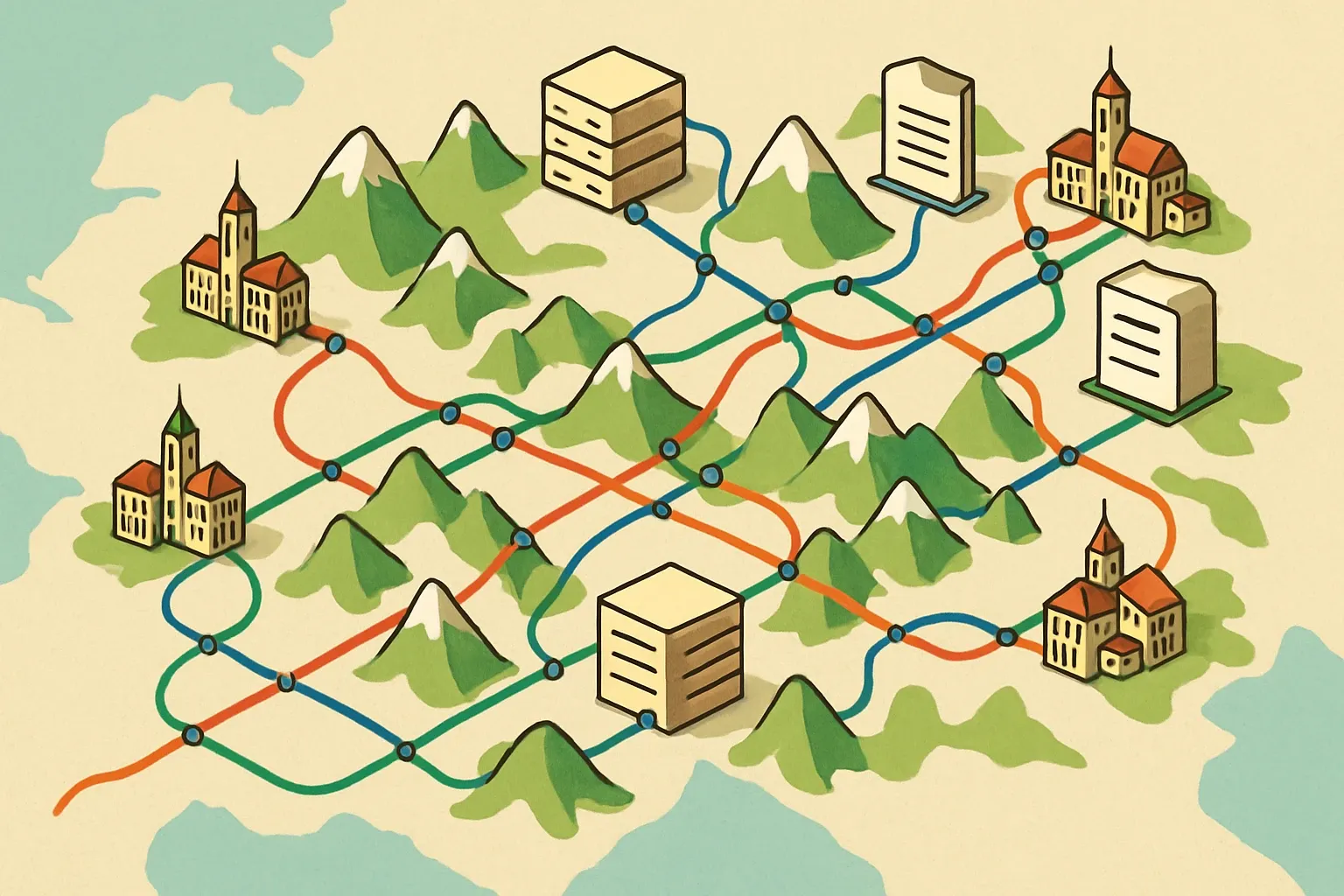
The Alpine arc spans eight countries, which explains why publishing in one place rarely covers every tender you care about (Alpine Convention, 2025). Treat the region as a federation. Same core standard, different gatekeepers.
The common language: EN 15804
Across the Alps, construction EPDs rely on EN 15804, now in its A2 format. That means more impact categories, clearer biogenic carbon reporting, and alignment with building LCA workflows used from Munich to Milan. If an older A1 EPD still sits in your portfolio, plan your next renewal to A2 before competitors turn that into a talking point.
Where your EPD actually “lives” by country
You do not need to publish everywhere, you need to publish where specifiers look.
- Germany and Liechtenstein often lean on IBU and data flows into ÖKOBAUDAT. IBU reported 533 individual EPDs published in 2024, plus 300+ tool‑generated ones, for 840+ total that year (IBU, 2025).
- Italy uses EPDItaly for national recognition. ECO Platform lists EPDItaly among its very large operators, with counts updated mid‑2025 (ECO Platform, 2025).
- Austria’s Bau EPD is the local program, recognized via ECO Platform.
- Switzerland’s market still references KBOB datasets alongside EN 15804 deliverables. A Swiss parliamentary brief flagged the need to harmonize national UBP factors with EN 15804+A2 to avoid trade barriers and double work (Swiss Parliament, 2025).
- France sits on its own rails. Building products use FDES in the INIES database and equipment uses PEP ecopassport. INIES reported passing 6,000 total environmental data entries by April 2025, including 4,560 FDES at 2024 year‑end (INIES, 2025).
- Slovenia’s ZAG program participates in ECO Platform. Monaco aligns with the French path.
Numbers shift fast. Check the program operator you plan to use against the ECO Platform roster if cross‑border acceptance is key (ECO Platform, 2025).
Database gravity you cannot ignore
- France RE2020 workflows pull directly from INIES. Teams model with what is inside that database. INIES logged 6,324 data items at 2024 year‑end and noted continued growth into 2025, including 4,560 FDES representing 265,318 commercial references (INIES, 2025). If you sell into Lyon or Annecy, publishing as an FDES is not optional in practice.INIES, 2025
- Germany’s building LCA tools typically ingest ÖKOBAUDAT. That makes IBU a practical home for many building products.
- ECO Platform’s catalog gives a snapshot of operator scale in mid‑2025, including IBU, EPDItaly, Bau EPD, ZAG and others, which helps when you need mutual recognition across borders (ECO Platform, 2025).
Navigating EPDs in the Alps for success?
Follow us on LinkedIn for insights that help you meet regional regulations and win more tenders.
Procurement signals that move specs
Italy’s Criteri Ambientali Minimi for construction took effect on December 4, 2022. CAM makes environmental criteria mandatory in public works and recognizes Type III EPDs as proof points in bids (SNPA, 2022). France’s RE2020 keeps tightening building‑level carbon thresholds, which is why FDES publication volumes keep rising year by year (INIES, 2025). Switzerland is evaluating closer alignment of methods with EN 15804 to avoid dual accounting across KBOB and EPD use in practice (Swiss Parliament, 2025).
Program operators by the numbers in mid‑2025
Operator scale hints at where specifiers search first. ECO Platform listed, as of July 1, 2025, very large programs such as the International EPD System at 12,749 valid EPDs, PEP at 4,740, EPD‑Global powered by EPD Norway at 3,716, IBU at 2,565, and EPDItaly at 1,906, while medium programs included Austria’s Bau EPD at 88 and Slovenia’s ZAG at 51. Switzerland’s SÜGB program showed 23 EPDs at that date (ECO Platform, 2025).
The A2 transition in France
INIES confirmed the shift from A1 to A2 formatting. This is not academic. Teams using RE2020 software need A2‑compliant FDES for current projects, which explains the rapid climb in verified declarations and the archiving of legacy A1 documents in 2023 and 2024 (INIES, 2025). If your EPD is continental but not an FDES, budget time for the national complement.
Digital EPDs are arriving
The International EPD System reported 62 fully digital EPDs published by May 20, 2025, including first movers in Italy and Switzerland. Digital means cleaner data pipelines into tools and fewer manual entry errors, which accelerates project use (EPD International, 2025).
Choosing where to publish when you sell across borders
Aim for one primary home and one targeted duplication where it changes commercial outcomes. Example, an EPD at IBU plus an FDES in INIES covers most of the DACH‑FR footprint. Keep language in mind, because the fastest‑moving bids still prefer native‑language PDFs even when data is machine‑readable. If your product is specified in Trentino, Ticino, Salzburg and Bavaria, ensure the A2 indicators and modules match how those markets do building LCAs, then publish where those LCAs pull.
Picking the right PCR in a crowded field
In the Alps region, several operators share PCRs or mutually recognize them through ECO Platform. The pragmatic move is to match the PCR competitors use for your product type, check its A2 status and expiry, and verify it maps to the target database’s naming. A great LCA partner will do that scan for you and steer you away from dead‑end rulebooks that slow verification.
What to do next without spinning wheels
- Confirm target projects and their database. If France shows up, plan an FDES.
- Map the operator. If Germany or Liechtenstein dominate, IBU is usually the shortest path.
- Lock the PCR. Use the one already winning specs for your category.
- Gather one clean reference year of plant data. If the product is new, a prospective EPD can start with a shorter window then be updated.
- Translate once. Publish the translation through the operator so the content stays identical. It looks small, it saves weeks.
Bottom line for Alps‑region manufacturers
EPDs arent just paperwork here, they are the passport that gets your product modeled inside the tools teams use daily. Publish to EN 15804 A2, land your declaration where the local databases actually pull, and keep an eye on the few national twists that still exist. Do that and bids in Zurich, Bolzano, Innsbruck, and Grenoble stop feeling like four different planets.