The Dutch EPD landscape in one glance
The Netherlands is highly standardized. Most design teams calculate a building’s material footprint with the National Environmental Database (NMD), which references EPDs aligned to EN 15804 and the local Bepalingsmethode. Program operators matter because their outputs feed the tools Dutch engineers actually use.
Where your EPD should live: NMD and MRPI
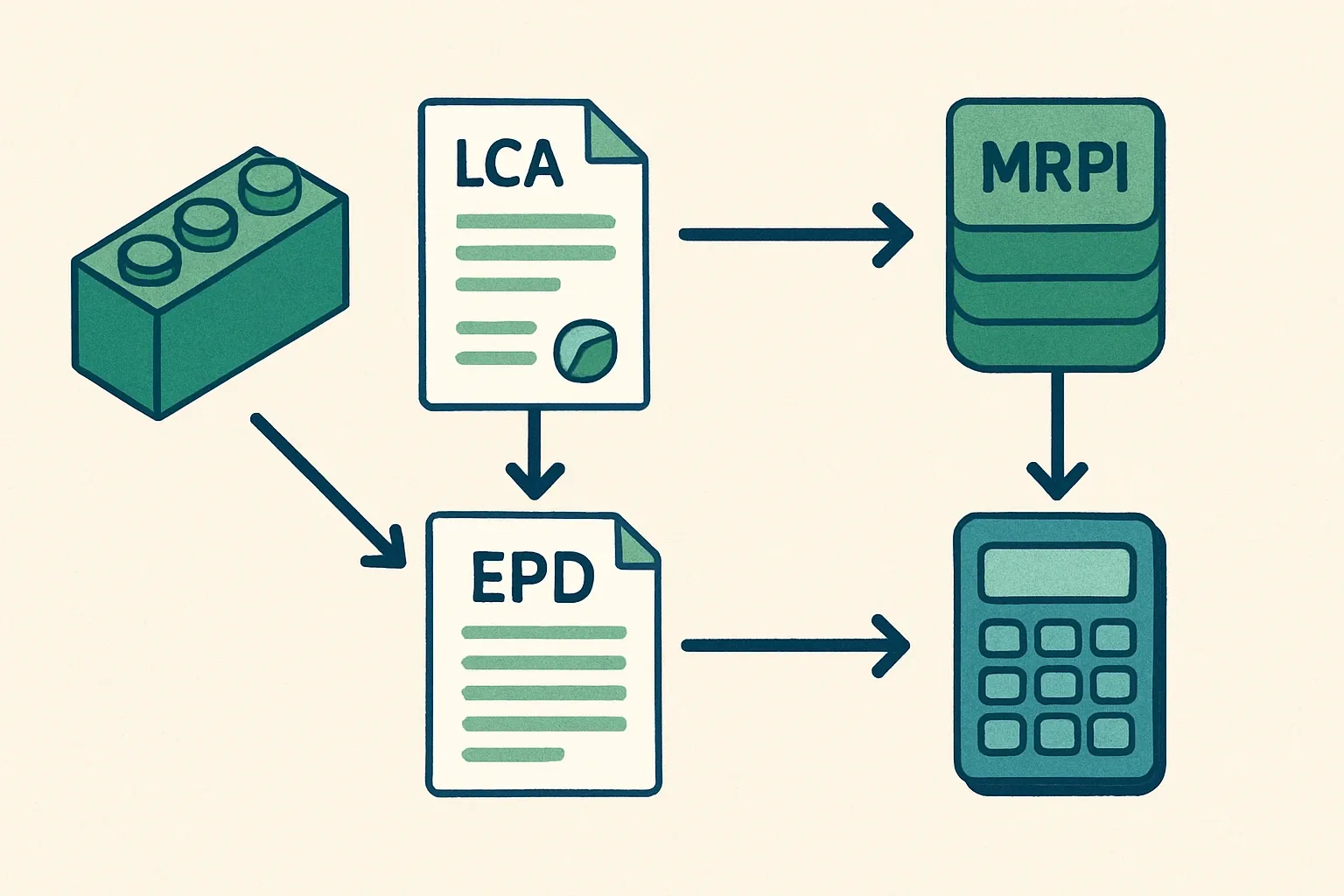
The NMD is the central hub for product data used in MPG and MKI calculations. Stichting MRPI is the Dutch EPD program operator that publishes third‑party‑verified, EN 15804‑compliant declarations many teams expect to see when working in the Netherlands. MRPI reported its 1,000th MRPI‑EPD in November 2025, a useful signal of market traction (MRPI, 2025) (MRPI, 2025).
Permits and the MPG requirement
An MPG calculation is mandatory for building permit applications covering new housing and offices larger than 100 m². Current practice still references a maximum MPG of 0.8 for new homes and 1.0 for offices while the government finalizes a broader update to the method and thresholds (RVO, 2025) (RVO, 2025). The same RVO update notes that the revised rules will be published together with the A2‑based method changes, with the publication process targeted for 2026, so teams should watch timing closely (RVO, 2025).
Infrastructure bids and the MKI scoreboard
Public works buyers have long used MKI, the monetary environmental cost indicator, in tenders. Rijkswaterstaat shifted to an updated MKI valuation approach in May 2024, where environmental costs are monetized and added to the bid total so lower MKI can win real points (Rijkswaterstaat, 2024). The government opened consultation in July 2025 to make MKI‑based performance requirements and award criteria mandatory for large GWW projects, which signals more uniform use of MKI across public clients (PIANOo, 2025). A legislative tracker shows the same package moving through the process in late 2025 (Overheid.nl Wetgevingskalender, 2025).
Standards under the hood: EN 15804 A2 and the Bepalingsmethode
Dutch rules reference the Bepalingsmethode Milieuprestatie Bouwwerken, administered by the NMD. Version 1.2 took effect in January 2025 and continues to anchor how MPG and MKI are calculated in practice (NMD, 2025) (NMD Bepalingsmethode, 2025). The government has signaled a shift to the A2 indicator set in the MPG context, expanding from 11 to 19 impact indicators for the single‑score calculation. RVO confirms that as of 2025 the method moves to 19 indicators, which changes how products compare in Dutch tools (RVO, 2025). For reference, DuboCalc’s public weighting table prices fossil and biogenic CO₂ at €0.116 per kg within the new set, illustrating how carbon carries more weight financially in Dutch single scores (DuboCalc Portal, 2023).
Entering the Dutch market with EPDs?
Follow us on LinkedIn for essential insights that help you meet regulations and win more tenders.
Getting listed: NMD categories 1, 2 and 3
Manufacturers aiming for accurate project calculations should target Category 1 entries in the NMD. These are product and brand specific, verified by an independent reviewer, and refreshed on a five‑year cycle (NMD, 2025). Category 2 is sector average data that is also verified. Category 3 is generic, not verified under the NMD protocol, and carries a 30% uplift factor that usually makes your product look worse than it is (NMD, 2025).
Program operator choices and Dutch acceptance
Teams commonly publish with MRPI for a direct route into the NMD as Category 1 data. Other European operators issue strong EPDs, yet Dutch permit and tender workflows still expect data to be present in the NMD viewer, so plan for that registration step regardless of where the PDF is hosted. Check that your LCA aligns with EN 15804 A2 and the NMD’s Bepalingsmethode to avoid rework.
What this means for commercial ROI
In Dutch permitting, designers must fill gaps with generic category 3 data when no product specific EPD exists, and that 30% uplift can push MPG and MKI the wrong way. A product‑specific, verified entry removes that penalty and helps your spec stay in as designs iterate. For GWW, MKI is increasingly a priced item. If a bidder can cut MKI and the evaluator monetizes that score, your enviromental data turns into real award points and faster decisions (Rijkswaterstaat, 2024) (PIANOo, 2025).
How to prepare so the NL path is fast, not frustrating
The Dutch process rewards clean, complete datasets. Line up one reference year of site utilities, material inputs, transport, yields and scrap, plus packaging and end‑of‑life assumptions consistent with NMD defaults. Agree early on the PCR and program operator so your LCA scope, scenarios, and cut‑offs match the Bepalingsmethode. Then budget the extra step of NMD registration if you publish outside MRPI.
A short checklist for manufacturers eyeing the Netherlands
- Confirm your EPD will be EN 15804 A2 compliant and aligned with the NMD Bepalingsmethode 1.2 language to avoid rework (NMD, 2025).
- Target an NMD Category 1 listing, since Category 3 triggers a 30% uplift in Dutch calculations (NMD, 2025).
- If you sell into public works, model MKI explicitly with the latest valuation rules used by Rijkswaterstaat and watch the mandatory MKI legislation timeline (Rijkswaterstaat, 2024) (PIANOo, 2025).
The bottom line for “EPD Netherlands” decisions
If the Netherlands is on your roadmap, build for the NMD first. That means A2‑aligned LCA work, a verified EPD that maps cleanly to Dutch scenarios, and a Category 1 record in the database. Do that, and MPG and MKI calculations start working for you rather than against you.