Who EPD Danmark is
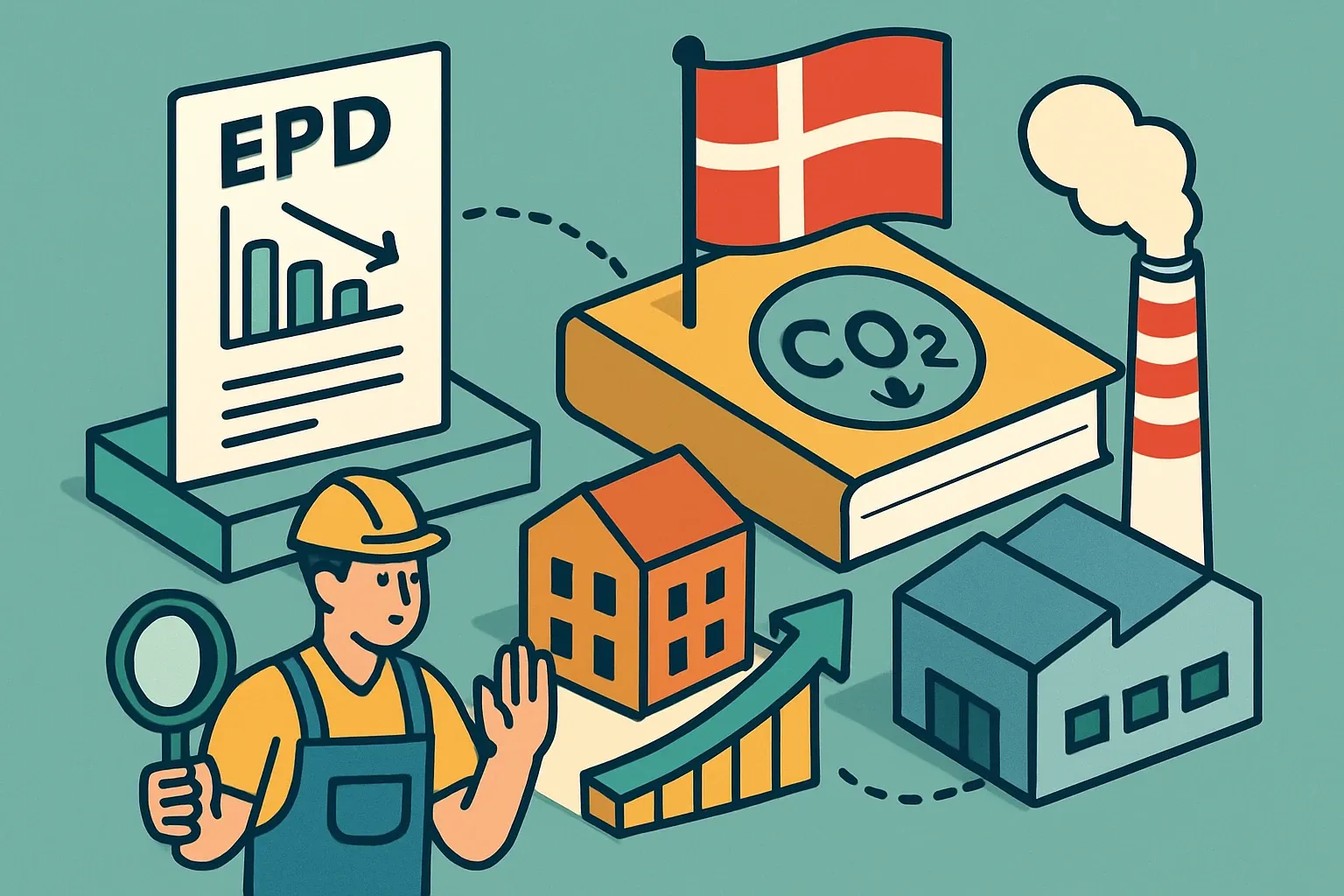
EPD Danmark is Denmark’s construction‑focused EPD program operator. They coordinate verification and publication and keep program rules aligned with European standards. Think of them as the referee ensuring everyone plays by the same LCA rulebook. citeturn1search5
Standards they follow
The program requires EN 15804 (current A2 framework) and ISO 14025, plus ISO 14040 and ISO 14044 for the LCA itself. Third‑party verification is mandatory to publish. That is the guardrail that keeps comparisons fair. citeturn0search0turn1search9
Validity and when to refresh
EPDs published via EPD Danmark are typically valid for 5 years, with an earlier update expected if a relevant indicator changes by about 10 percent compared to the declared values. Plan your refresh to land before large bids, not after them. (EPD Danmark, 2025) (EPD Danmark, 2025). citeturn1search7
Navigating EPDs to win in Denmark?
Follow us on LinkedIn for insights that help you meet CO2e limits and secure more projects.
Digital outputs and discoverability
Publications include a PDF plus a machine‑readable ILCD+EPD file. Entries appear in EPD Danmark’s database and the ECO Portal, which helps specifiers find your product without chasing email attachments. citeturn1search6
Why this matters in Denmark right now
From July 1, 2025, Denmark’s BR18 climate rules introduce differentiated CO2e limits, for example 7.5 kg CO2e/m²/yr for apartments and offices, 6.7 for single‑family and row houses, and 8.0 for institutions. The construction process must also meet a separate 1.5 kg CO2e/m²/yr cap for A4–A5. Average limits tighten over time, with a 7.1 kg CO2e/m²/yr reference in 2025. Product‑specific EPDs make meeting these numbers more achievable. (Social‑ og Boligstyrelsen, 2025) (Social‑ og Boligstyrelsen, 2025) (OECD, 2024) (OECD, 2024). citeturn2search0turn0search4
The process in short
Producer supplies data, an LCA consultant models and drafts the EPD, an independent verifier reviews it, and EPD Danmark administers and publishes. Picture a relay race where clean handoffs (data, model, review, publish) prevent time‑killing reruns. citeturn1search5
Practical tips when choosing a program operator
Pick the operator your specifiers already trust in the bid geography. Confirm alignment with EN 15804 A2 and a robust third‑party verification pool. Ask about digital data delivery to public portals, since many design teams now plug EPDs straight into LCA tools. Finally, map the 5‑year clock to your product roadmap so an update does not collide with your launch window.
Commercial angle, minus the stress
Denmark’s caps mean generic data can push a project over the line in the wrong direction, while a product‑specific EPD can pull it back under the limit. If collecting plant data feels messy, look for partners who take on the heavy lifting inside your org so engineers do not lose weeks. Dont wait for a bid team to escalate a blocker that a finished EPD would have cleared.