What the program is and why it matters
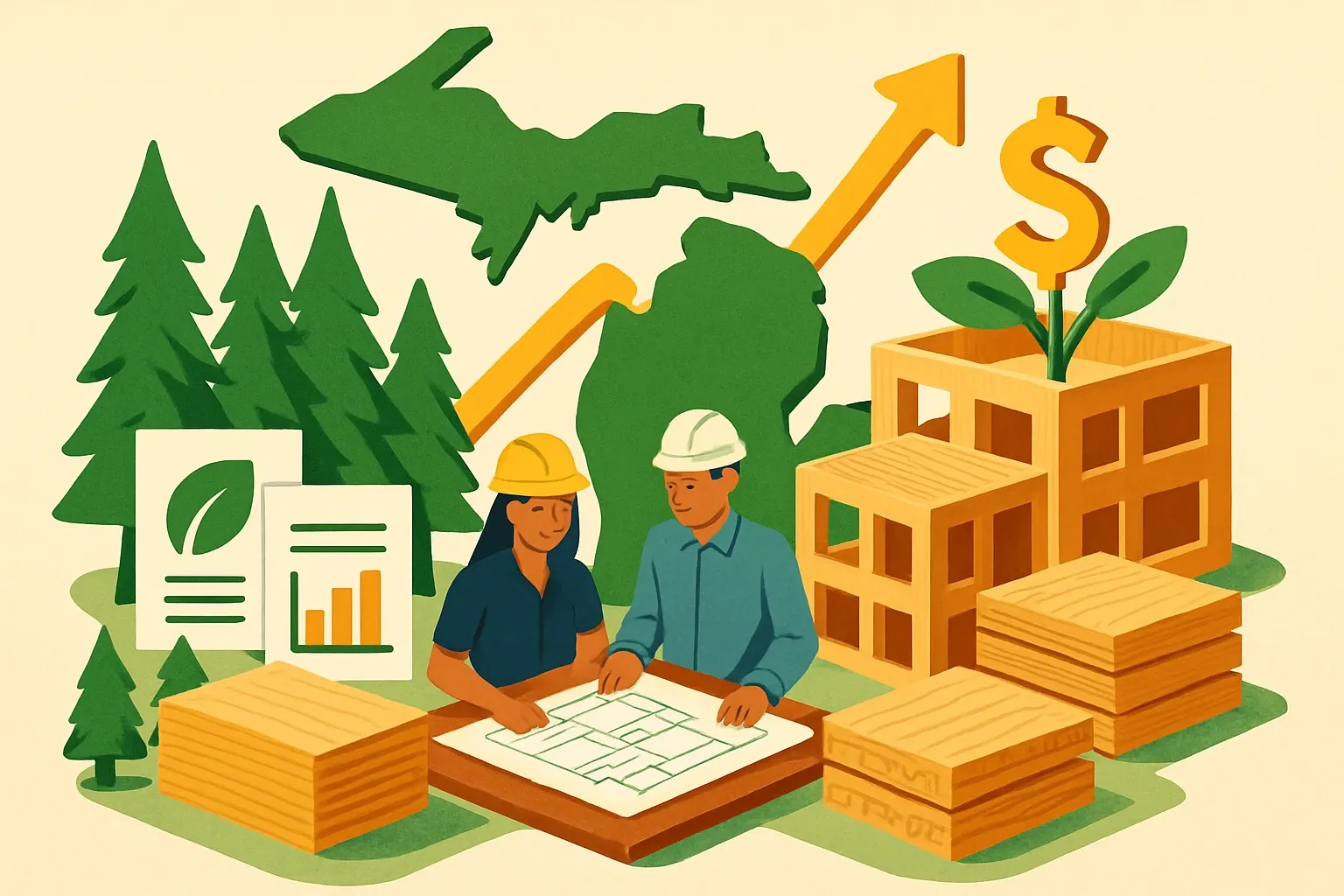
Michigan launched the Mass Timber Catalyst Program to accelerate real projects that use engineered wood in primary structural systems. The state’s forestry and forest products sector generates $26.5 billion annually, and the program is designed to grow that pie while supporting housing and rural economies (Michigan Mass Timber Catalyst Program, 2025).
What gets funded and when
Selected project teams receive cash awards between $25,000 and $75,000 and a year of technical support, with the initial statewide round closing December 22, 2025 (Michigan Mass Timber Catalyst Program, 2025). A supplemental Upper Peninsula call offered $25,000 to $50,000, closed March 2, 2026, and placed awardees in a cohort that meets at least six times starting early 2026 (Michigan Mass Timber Catalyst Program U.P. RFP, 2026).
The hidden gift for manufacturers: LCA signals
Program materials spell out guidance on conducting a life cycle assessment plus a request for carbon accounting results in final reports. That means project teams will be primed to ask for product‑specific EPDs and HPDs, not brochures. Arrive with third‑party verified EPDs aligned to the most relevant PCR and your product avoids default penalties in carbon accounting under owner and LEED v5 workflows.
Sourcing preferences you can turn into wins
The scoring framework rewards commitment to North American mass timber and offers credit for investigating Great Lakes‑sourced wood. Manufacturers who can document regional sourcing, chain‑of‑custody, and transport impacts clearly inside their EPDs make the spec decision easier. Think of it like giving the engineer a well‑labeled toolbox instead of a mystery box.
Join Parq Pulse!
Stay ahead with weekly insights on EPD trends and regional opportunities to win more projects.
Your readiness checklist for Michigan pursuits
Aim to be “EPD‑ready” before design charrettes begin. That keeps your team out of scramble mode when a developer or GC asks for numbers.
- Lock a reference year and gather plant data for A1–A3 with real utility, resin, and yield records.
- Pick the PCR your competitors use, unless a better‑fit PCR improves comparability for your subcategory.
- Choose a program operator familiar to Michigan buyers, then plan HPDs in parallel for health transparency.
Timing and sales math
Most specs shaped in feasibility and early design never circle back for late documentation. If your EPD is live when Catalyst teams evaluate options, you remove friction and shorten decision cycles. Even a single mid‑sized project can repay the cost of disclosure many times, which is why delaying an EPD often costs more than doing it.
Reduce lift for your internal experts
A white‑glove LCA partner that handles data wrangling, supplier follow‑ups, and project management keeps R&D and ops on core priorities. That is how schedules hold and how quality does not slip. We see this play out across manufacturers who dont want to turn their engineers into part‑time archivists.
Watch‑outs
Code approvals still run through local authorities, though the program brings in Michigan’s Bureau of Construction Codes and Fire Services to smooth reviews. Treat that as help, not a guarantee. Also watch PCR expirations and renewal timing so your declarations stay trusted throughout long Michigan development timelines.
The practical takeaway
Catalyst projects are being steered to quantify carbon and compare systems on verified data. Manufacturers who show up with clean, comparable EPDs and crisp HPDs make selection easy and keep price from being the only tiebreaker. Get your documentation ready now so Michigan’s momentum becomes thier momentum too.
(Program data cited: Michigan Mass Timber Catalyst Program, 2025; Michigan Mass Timber Catalyst Program U.P. RFP, 2026.)