What counts as “membrane roofing” here
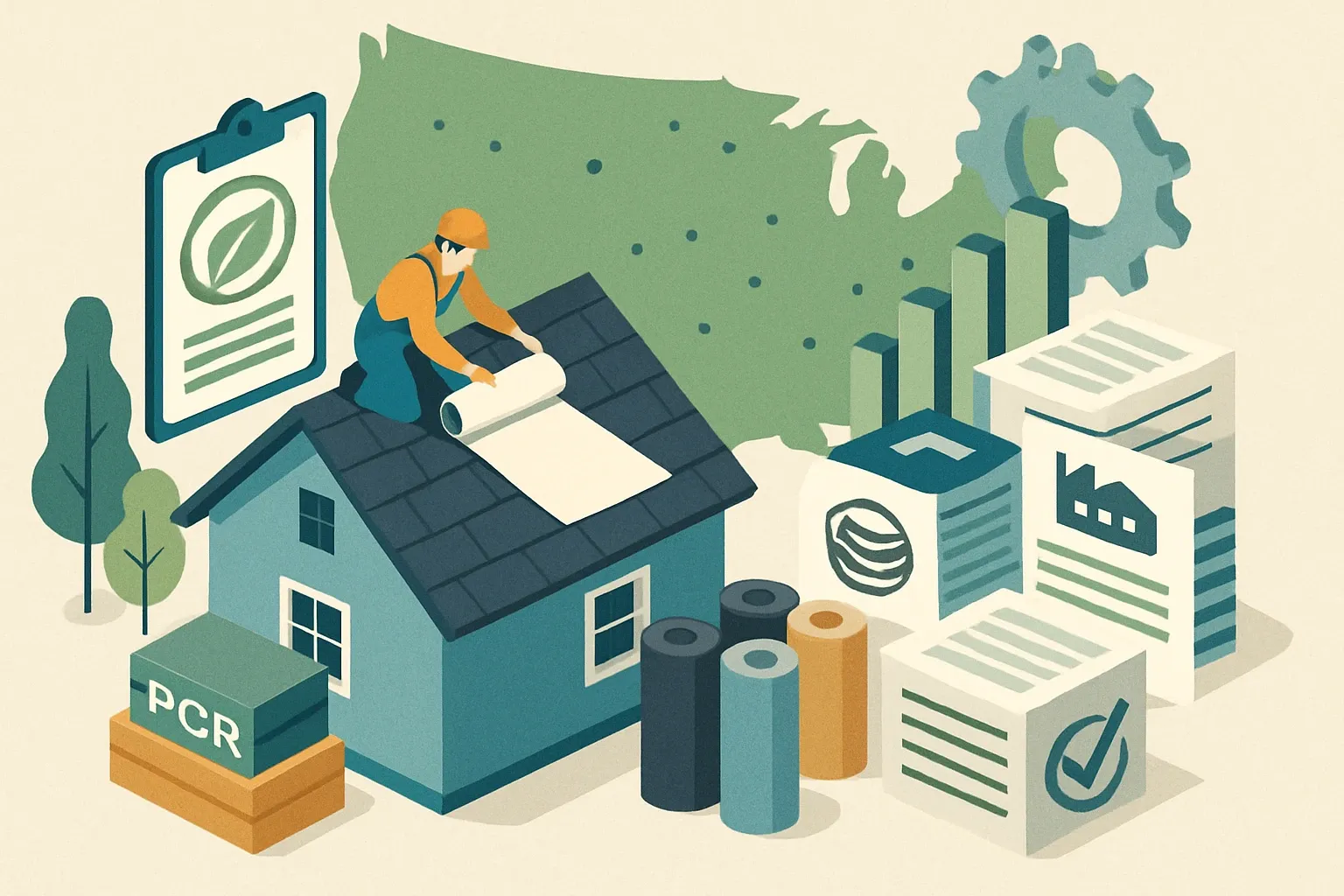
Membrane roofing covers single‑ply systems like TPO, PVC, and EPDM as well as modified bitumen multi‑ply systems. Adjacent products that live in the same specs also appear in this data set, such as seam tapes and water‑resistive barriers when they are published against a roofing or envelope PCR. Think of the roof as a system of layers. If it sits above the deck and keeps water out, it likely shows up here.
2026 market snapshot at a glance
Across the United States there are 24 current EPDs from 9 manufacturers supported by 4 program operators and 5 PCRs. Momentum peaked in 2022 and 2023, then cooled through 2024 and 2025 as teams regrouped around upcoming PCR renewals and portfolio changes.
Latest entry spotted is LP WeatherLogic Seam & Flashing Tape issued Oct 1, 2025 under Smart EPD LLC with the Smart EPD Part B PCR for Plastic and Elastomer Roofing and Sealing Sheet Systems. It is valid to Oct 1, 2030. Accessories matter and this one proves it.
Issuance trend by year
A steady drumbeat early. Then a slowdown as renewals come into view. Here is the five year issuance curve.
| Year | EPDs |
|---|---|
| 2021 | 5 |
| 2022 | 8 |
| 2023 | 7 |
| 2024 | 3 |
| 2025 | 1 |
If your next launch is scheduled for late 2026, expect more competition for verifier time as peers refresh in the same window.
Who published the most EPDs
The leaderboard is tight at the top and diverse below. Carlisle Construction Materials leads with 7 current EPDs. Duro‑Last follows with 5. Malarkey Roofing contributes 4. Siplast adds 3. The long tail includes 3M, GCP Applied Technologies, LP Corporation, Sika USA, and Versico Roofing Systems with one each. Versico is part of the Carlisle family, yet specifiers often search it separately, so keeping both names visible is useful.
What stands out is breadth. Nine distinct manufacturers are active, which signals that buyers can actually compare like for like rather than defaults to generic data. That reduces the “penalty” risk teams face when a product lacks a product‑specific EPD and gets modeled with conservative factors in carbon accounting.
Are you in the membrane roofing industry?
Follow us on LinkedIn for insights that help you win tenders and navigate EPD requirements effectively.
Program operators used most often
Four program operators carry all current declarations in this category.
NSF International is the workhorse with 15 EPDs across 5 manufacturers. That spread indicates NSF is a common lane for single‑ply membranes, not just a single‑client channel.
UL hosts 5 EPDs across 2 manufacturers. It remains a recognizable mark for many submittal packages, especially where internal teams already run UL listings.
ASTM International appears with 3 EPDs across 2 manufacturers. These are concentrated in modified bitumen and related systems.
Smart EPD LLC appears once and it happens to be the newest issue in the set on Oct 1, 2025. Watch this lane if you want shorter schedules and modern digital records tied to North American practice.
Practical takeaway. Your program operator choice should mirror competitors in your exact niche whenever possible. It simplifies apples‑to‑apples comparisons and removes reviewer friction.
The PCRs that actually get used
Five PCRs are in play. One drives most of the action.
Single‑Ply Roofing Membranes accounts for 14 EPDs. Its latest expiries reach May 10, 2029. If you do TPO, PVC, or EPDM and need comparability, starting here is usually the shortest path.
Asphalt Shingles, Built‑up Asphalt and Modified Bituminous Membrane Roofing accounts for 8 EPDs. Latest expiries land July 26, 2027. If your portfolio includes SBS, APP, or BUR, this is the mainstream reference.
Two niche appearances round out the set. Water‑Resistive and Air Barriers carries 1 EPD that still touches roofing scope for some assemblies with an expiry on Sep 26, 2027. Smart EPD Part B for Plastic and Elastomer Roofing and Sealing Sheet Systems appears once with a long runway to Oct 1, 2030.
If your product straddles categories, you still pick a single rulebook. Picture a Monopoly game where everyone must use the same edition or the trade gets messy. That is the role of a PCR.
Renewal stormwatch and timing windows
Expiries cluster in predictable waves. Planning against these dates keeps sales from hitting a pothole.
Five EPDs expire in 2026 and they all sit on the Asphalt Shingles and Modified Bituminous PCR with the same date of Dec 23, 2026. Eight more roll off in 2027 across three PCRs. Earliest is Jan 4, 2027 on a Single‑Ply declaration. Latest is Sep 26, 2027 on Water‑Resistive and Air Barriers. Seven Single‑Ply EPDs reach end of term between May 16, 2028 and Sep 29, 2028. Three more Single‑Ply EPDs expire on May 10, 2029. One Smart EPD Part B declaration runs through Oct 1, 2030.
Two moves help. First, start data collection at least one quarter ahead of your expiry window. Second, check whether peers have moved to a newer PCR and align if comparability is a must in your bids.
What this means for go‑to‑market
Having any current, third‑party verified EPD keeps your product in play when project teams must hit carbon targets. Without it, models often apply conservative estimates that make price the only lever. That is not where you want to be late in a bid cycle.
The 2026 cluster for bituminous systems is an opportunity. Publish a refreshed declaration with clean plant data and you can set the comparison frame for the next five years while peers scramble.
Policy context matters. Federal incentives shifted in early 2025, so the pull today is more owner and rating system driven than it was in 2023. LEED v5 workstreams continue to favor product‑specific transparency, and large private owners are keeping EPDs in specs even when public procurement softens.
Everyone used an EPD service provider
All 24 EPDs were published with support from an external EPD consultant or service provider. That is one hundred percent of the set. The message is simple. Manufacturers that win on speed and quality do not push LCA and data wrangling onto already stretched plant or R&D teams. A white‑glove partner handles collection, modeling, and publication while internal experts focus on production and product.
If you want a benchmark for that model, see how a specialized partner such as Parq approaches data collection and program‑operator publishing. Faster in, faster out, and fewer internal meetings. It is definately the cleaner route when deadlines are tight.
A quick example worth copying
LP’s WeatherLogic Seam & Flashing Tape arrived on Oct 1, 2025 through Smart EPD with validity to Oct 1, 2030. It shows how membrane accessories can and should be published. If you make tapes, cover boards, or edge metals, you can still win specs with a product‑specific EPD even if your main membranes are queued for a later release.
How to pick your lane in 30 minutes
Start with the product that drives the most revenue in low‑slope. Identify the two or three closest competitors. Note their program operator and PCR. If they match, mirror that combination. If they split across PCRs, weigh which one gives you the fairest comparison today and the best renewal runway through 2029. Bring a year of plant data to the table or plan a prospective EPD if the line is brand new.
If you want to sanity‑check the choice, connect with me on LinkedIn and send a short note. I am happy to share the full background dataset behind this article and jump on a short call to help you pick the best fit PCR for your next EPD.
One last note on the data you just read
This analysis reflects the global public registry most architects and specifiers rely on. New records can lag a bit as they propagate, so some entries from late 2025 may not have appeared at the time of writing. If you suspect a fresh release is missing, reach out and we will validate it against the latest feed.