What counts as “Electric Power” here
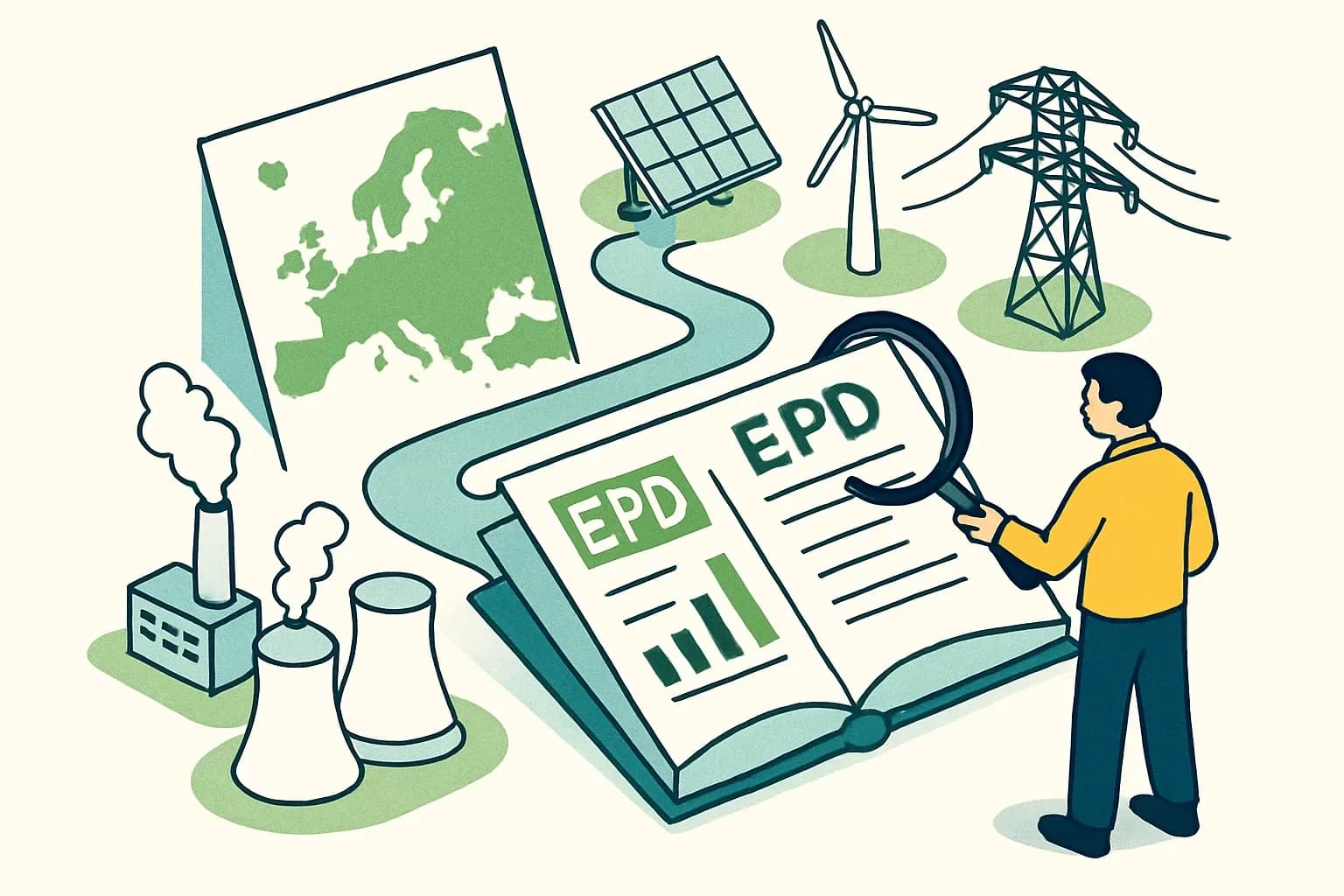
The landscape spans electricity generation, steam and hot or cold water, district heating, and combined heat and power. It also touches adjacent equipment where manufacturers publish EPDs under electrical product PCRs, such as cables and wires. If your team calls itself a utility, power producer, or a district heating company, you are in the right place.
The five‑year snapshot, at a glance
Across Europe, 14 EPDs were issued in this category in the last five years, from 10 manufacturers and 3 program operators, across 5 distinct PCRs. Momentum climbed through 2023, then slowed in 2024, which we often see when a major PCR is being revised or teams shift to new data years.
EPDs issued per year
| Year | EPDs issued |
|---|---|
| 2021 | 2 |
| 2022 | 5 |
| 2023 | 6 |
| 2024 | 1 |
| 2025 | 0 |
The most recent EPD on record was issued on May 14, 2024. It covers EPC Solaire’s iNovaPV Lite photovoltaic integration system under INIES and expires on May 14, 2029.
Program operators utilities actually use
Three operators surface in Europe for this category. EPD International AB accounts for 10 EPDs across 6 manufacturers, which signals cross‑border acceptance. EPD Norway records 2 EPDs across 2 manufacturers, and INIES carries 2 EPDs across 2 manufacturers. That spread suggests teams choose operators that match their primary market and language, while still leaning on a pan‑European option when they target multiple countries.
The mix also matters competitively. High counts concentrated in one manufacturer can be misleading. Here, the EPD International total is split across several companies, so specifiers are used to seeing its format for electricity and heat.
At a utility or competing in electric power EPDs?
Follow us on LinkedIn for insights on EPD gaps, PCR positioning, and competitive analysis to boost your bids.
Manufacturers on the board
Activity clusters in Northern Europe. Names include Kraftringen Energi AB and Tekniska verken i Linköping AB with three EPDs each, plus single‑EPD entries from Vattenfall AB, Stockholm Exergi, EPC SOLAIRE, Hässleholm Miljö AB, SAS International Ltd., Global Special Steel Products SAU, Nordland Betong, and Ølen Betong. For teams selling outside Scandinavia, that is a chance to stand out with enviromental transparency where the field is still thin.
The PCRs that set the rules
Nine of the 14 EPDs use EPD International’s electricity generation and distribution rule set, which makes it the reference point for many specifiers. Cables and wires also appear via a Norwegian PCR, and one declaration sits under a broad electronics and HVAC‑R rule set. France’s national addition to EN 15804 shows up for a photovoltaic mounting system. These choices shape modeling boundaries, datasets, and comparability.
PCR usage and expiries
| PCR | EPDs | Latest expiry |
|---|---|---|
| PCR 2007:08 Electricity, steam and hot or cold water generation and distribution, ver. 4.2 | 9 | Dec 14, 2028 |
| NPCR 027 Part B for electrical cables and wires | 2 | Feb 20, 2028 |
| PCR 2015:03 Basic iron or steel products and special steels, except construction products, ver. 2.0 | 1 | Sep 28, 2027 |
| Product Category Rules for Electrical, Electronic and HVAC‑R Products | 1 | Jun 10, 2028 |
| EN 15804+A2 national addition, France, construction products | 1 | May 14, 2029 |
Upcoming expiries can shape bid timing and renewal workload. The current book shows 2 expiries in 2026, 5 in 2027, 6 in 2028, and 1 in 2029. If your renewal or first release falls near a heavy year, plan verification queues early, pick your data year now, and lock a reviewer.
Why many teams partner with an EPD consultant
Thirteen of the 14 EPDs were produced with help from a third‑party EPD service provider. That tells us electricity and heat declarations benefit from specialized LCA modeling, data wrangling across plants and districts, and tight project management. If you prefer to keep internal bandwidth for trading, balancing and asset operations, consider an EPD consultant or service provider like Parq. We focus on fast data collection across complex orgs and deliver high quality work without dumping spreadsheets on your engineers.
Picking your path in 2026
Start with the competitive lens. If your peers publish under EPD International for electricity and heat, matching that PCR and operator usually speeds acceptance in specs and databases. Decide scope next, for example generated megawatt hours, district heating boundaries, or technology split. Set your reference data year and list any fuel switch or grid factor changes that will land in 2026, since those can materially move the results. Finally, verify whether a national addition like the French EN 15804 variant better fits your primary market.
Notably absent manufacturers in the public registry
As of Jan 20, 2026, we do not see current electricity or heat EPDs in the public registry for several large European utilities. That includes EDF, Enel, RWE, E.ON, Iberdrola, Engie, Statkraft, and Ørsted. Fortum Sverige AB appears with an expired record and no current EPDs. Two caveats apply. Some companies may publish under country specific categories, or classify assets under adjacent PCRs that are not tagged to electricity keywords. If you represent one of these firms and want a quick gap analysis, ping me and I will check again.
What this means for commercial teams
In public tenders that request project specific carbon accounting, offering a verified product specific EPD for your electricity or heat product removes the penalty of generic or conservative default factors. Sales cycles get cleaner, bids become simpler to score, and you avoid late stage product swaps when a competitor has a declaration and you do not. That is the quiet advantage an EPD delivers in power markets where margins are tight.
Bring the data home
All figures above come from the global public registry of EPDs most specifiers use. Due to loading lags, some late 2025 releases may not yet appear. If you want the full dataset behind this piece, or a quick read on the best fit PCR for your next declaration, connect with me on LinkedIn and send a message. I am happy to share the raw tables, answer questions, or hop on a short call. You will recieve a clear path to publish fast, with fewer surprises.