What is expiring and when
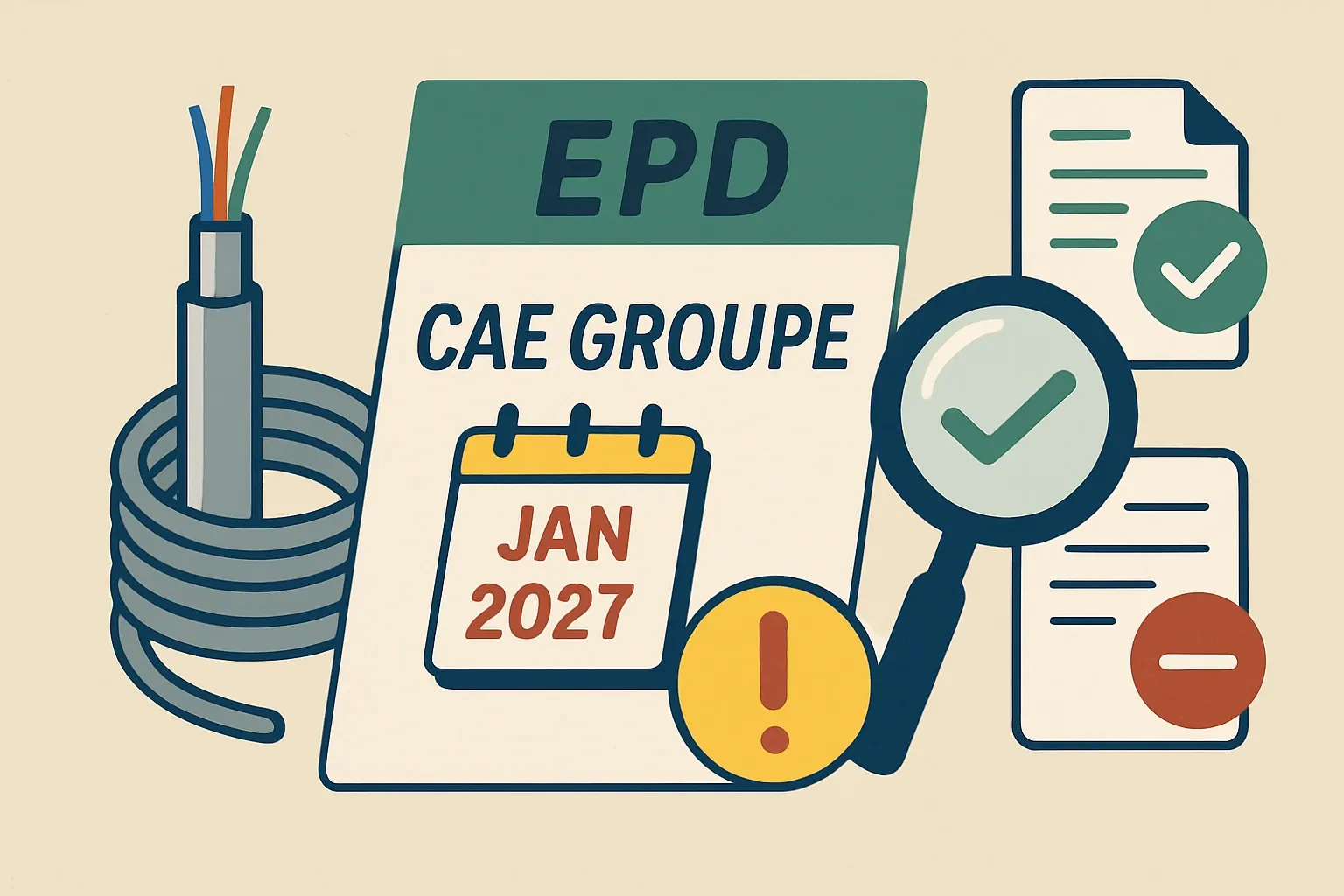
The at‑risk declaration is a CAE GROUPE PEP for “Câbles téléphoniques” under MasterFormat 27 10 00 Structured Cabling. It was registered through INIES and lists a validity window from 2022‑01‑01 to 2027‑01‑01. Scope aligns with low‑voltage voice and intercom telephone cabling used in buildings.
For product context, CAE markets SYT telephone cables alongside broader structured cabling on its site, for example the SYT and interphony range and the telephone cable overview (CAE GROUPE product listings, 2026) (SYT & Interphonie, Telephone cables).
Do replacements exist today
As of May 20, 2026, we do not see a newer CAE GROUPE PEP/EPD published for this telephone cable family. Other CAE declarations in structured cabling and fiber remain active later into 2027, yet they do not replace the telephone cable scope.
Why this matters commercially
When a required EPD lapses, models default to conservative generic factors in many procurement and rating workflows. That pushes specifiers toward products with current, product‑specific declarations. Keeping telephone cabling covered preserves spec eligibility in education, healthcare and public projects where documentation is checked line by line.
Join Parq Pulse!
Stay ahead with weekly insights on EPD expiries and product competitiveness to win more projects.
Likely alternatives specifiers will consider
Where a project requires a current EPD for communications cabling, specifiers will often step to a LAN cable with an active declaration if the telephone cable PEP is missing. Examples include:
- CommScope Category 6A Plenum LAN Cable, EPD issued 2021‑11‑15 with a five‑year validity shown on the declaration (CommScope, 2025) (EPD PDF).
- CommScope Category 6A LSZH LAN Cable, same product family covered with the same issue date and validity window, suitable for international projects outside North American plenum practice (CommScope, 2025) (EPD PDF).
- Nexans publishes a large library of PEP EcoPassport declarations across building and communications cables. Their public PEP register presence gives specifiers current options in the same 27 10 00 space when telephone cabling is out of coverage (PEP Ecopassport, 2026) (PEP register, Nexans example, Nexans PEP landing).
These examples are not one‑for‑one telephone cable swaps in every spec. They are credible, active communications cabling EPDs that keep projects moving when a voice cable PEP lapses. If a project insists on a like‑for‑like telephone cable with a current PEP and none is available, teams often escalate to structured copper or fiber that still meets performance and documentation needs.
PCRs to watch during renewal
Wires and cables rely on category rules that evolve. The International EPD System’s c‑PCR for wires and cables outside EN 15804 construction scope is registered as 2024:06‑c‑PCR‑004 and is valid until 2027‑11‑16. Teams renewing after that date will align to the then‑current rule set, which can shift modules and indicators used in the LCA (EPD International, 2024) (EPD International PCR, 2024:06‑c‑PCR‑004). Separately, the PEP EcoPassport PSR for wires, cables and accessories defines a five‑year period of validity that shows up on many cable EPDs, which is visible on the CommScope declaration cited above (CommScope, 2025).
What specifiers will lose if the PEP lapses
Without a current PEP for CAE’s telephone cables, project teams lose product‑specific impact data tied to that scope. That can mean fewer points toward owner sustainability targets in systems like LEED v5, slower submittal cycles, and extra analyst time reconciling substitutions. In a crowded bid room, missing paperwork is like showing up to a final with no calculator.
Renewal playbook that avoids last‑minute stress
The safe window is now. Plan the data pull, factory contacts, and verification path so the updated PEP is drafted in Q4 2026. A partner that streamlines internal data collection and manages the program operator workflow can cut weeks off the calendar. The goal is simple, keep the telephone cable line item continuously spec‑eligible while marketing builds campaigns around the refreshed declaration. This saves alot of back‑and‑forth with GCs when submittals start.
Keep an eye on peers
If you monitor competitor timing to protect pipeline, this snapshot on a major peer is useful reading: Nexans EPDs set to expire in December 2026. It shows how fast windows close and why renewal discipline pays off.
Bottom line for CAE GROUPE watchers
One CAE GROUPE PEP for telephone cables is due 2027‑01‑01. No replacement is visible yet. If that gap opens, specifiers have live options from brands like CommScope and Nexans that keep their models clean and their schedules intact. Finishing the renewal on time prevents avoidable substitutions and keeps the CAE line on the shortlist.