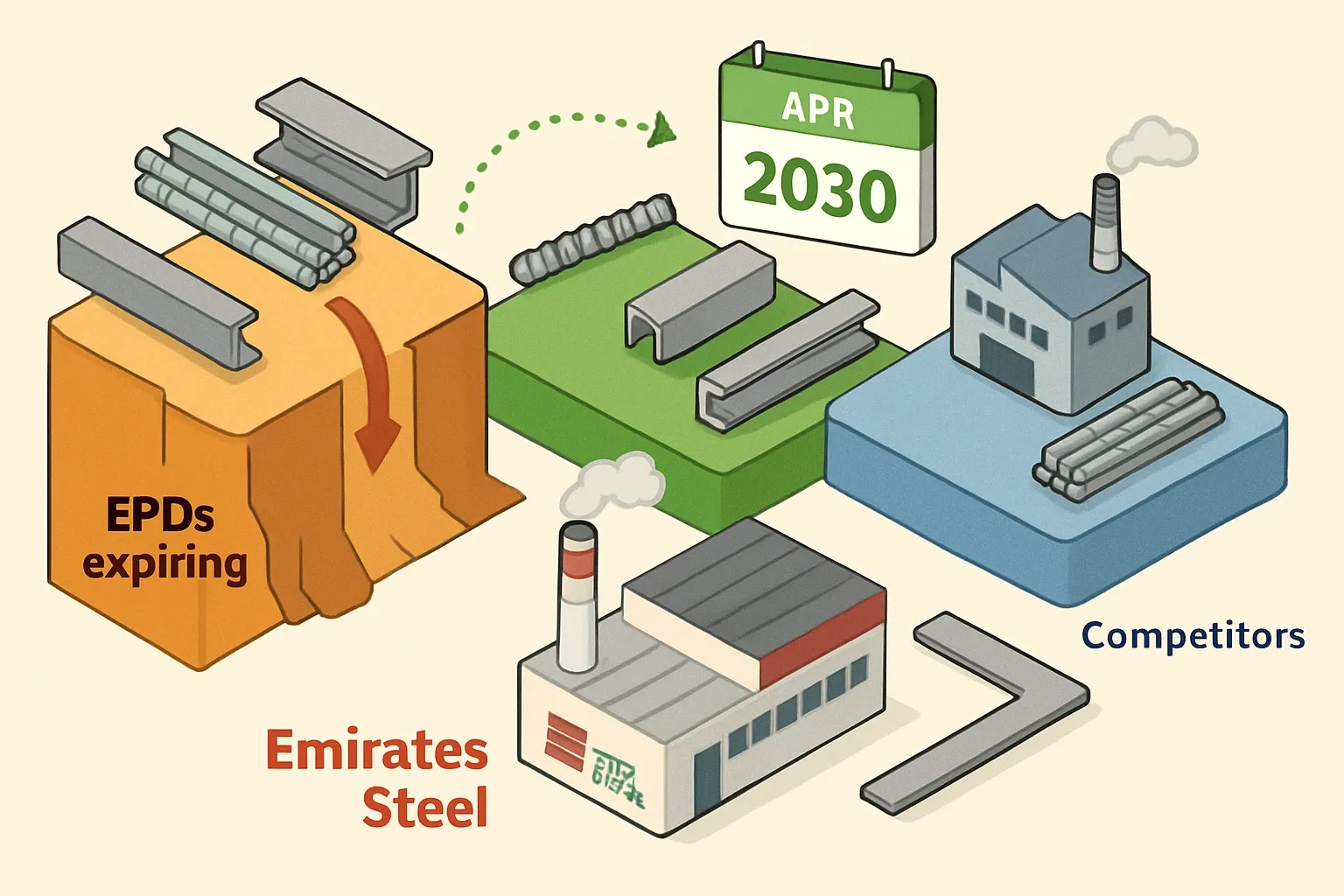


Amiblu Technology, the Norwegian-registered maker behind the Flowtite and Hobas glass-reinforced polyester (GRP) pipe brands, has one of the deepest EPD libraries in the pipe sector. As of November 2026 it lists 62 current declarations. Two of them, both covering large-diameter Hobas pressure pipes, run out on the same day in July 2027.
The two Hobas declarations on the clock
Both expiring EPDs were published with EPD Norway on 20 July 2022, developed with LCA.no, and written under NPCR 019 (the Norwegian Part B rules for sewage and storm water piping systems). Both expire on 20 July 2027:
- Hobas Pressure Pipe, Filled (VO), Spigot coupling, DN700-3600, PN6, SN20000: centrifugally cast pipe with sand filler, 6 m lengths, E-glass and ortho resin, supplied with an FWC coupling.
- Hobas Pressure Pipe, Unfilled (RO), Spigot-Coupling, DN1800-3600, PN6, SN12500-30000: the unfilled version for very large bores and high stiffness classes, also in 6 m lengths with FWC couplings.
These pipes go into trunk mains, large transfer lines, cooling water intakes and similar jobs, where a single project can call for kilometres of pipe. On infrastructure work at that scale, losing a product-specific EPD can cost more than a single line item.
Has Amiblu already published replacements?
Amiblu has clearly been busy. Its Flowtite range picked up a wave of new EPDs in 2025 and 2026, including pressure pipes from DN300 to DN3200 and new biaxial pipe declarations valid until 2031. Several Hobas sewer and jacking pipe EPDs were renewed in 2025, and a few more are listed with validity to January 2031.
We found no direct successor for either expiring Hobas PN6 pressure declaration. No current Hobas EPD covers a filled VO pressure pipe at PN6 and SN20000, and none covers an unfilled RO pressure pipe from DN1800 upward. A related Hobas pressure declaration (Spigot-Coupling DN500-3600, PN6, SN10000) expires even sooner, in May 2027. Most of the Hobas pressure line therefore comes up for renewal in the same window.
Book a free 30-min. consultation
Discuss ideas to mobilize your EPDs, review your portfolio, and generate strategies to make LCA insights impactful across your organization.
Where the overlap is real and where it is cosmetic
Some Amiblu EPDs do sit nearby. The Hobas Sewer Pipe VO with FWC coupling, DN1535-3600, SN10000 to SN20000, is valid until January 2030 and shares the filled wall build and the diameter range. It is rated PN1, though, which makes it a gravity product. The Hobas Sewer Pipe RO covers PN6, but only from DN250 to DN800.
The Flowtite family fills part of the gap. Flowtite FP2.1 pressure pipes at PN6 (DN600-2000, SN2500 and SN5000) and at PN10 (DN600-2400, SN10000) all hold EPDs valid to 2030. A specifier who can accept a filament-wound pipe in place of a centrifugally cast one can stay inside the Amiblu catalogue. Above DN2400 at PN6, or wherever the Hobas wall structure is written into the spec, that fallback no longer covers the job.
Competitors with valid declarations in the same lane
GRP pipe EPDs are scarcer than you might expect. Future Pipe Industries and Superlit each show only expired declarations in EC3. The most direct alternative is Turkish producer Subor, which published two large-bore GRP EPDs with EPD International in June 2026: DN1500-2400 Glassfiber Reinforced Plastic (GRP) Pipes and DN2500-4000 GRP Pipes. Both cover pressure and non-pressure systems and run until June 2031. Together they span almost the entire diameter range of the expiring Hobas pressure pipes.
On the ductile iron side, Saint-Gobain PAM holds product-specific EPDs for its Natural pipe system at DN1500 and DN1600 under PCR 2019:14. Those expire in September 2027, so PAM faces its own renewal deadline around the same time. For smaller pressure mains, polyethylene suppliers such as Pipelife (Robust PE100RC, valid to 2031) also have current declarations, though large GRP bores and PE pipe rarely compete head to head.
For broader context on the brands, see our profiles of Amiblu's GRP pipe EPD coverage and the HOBAS pipe portfolio.
Why eight months is shorter than it looks
In Norway, contracting authorities must, as a general rule, weight climate and environmental criteria at 30% or more when awarding public contracts (Norwegian Procurement Regulation §7-9, 2024). Water utilities across Europe follow similar logic (OECD, 2024). When a pipe has no valid product-specific EPD, the bidder usually has to fall back on conservative generic data, often with a safety margin added. That can sink the climate score before price is even considered.
Tender timelines make it tighter. A trunk main specified in spring 2027 may be evaluated after 20 July, and an EPD that expires mid-tender is like a passport running out at the boarding gate. Getting a renewal through data collection, LCA modelling, third-party verification and publication usually takes several months. That process works best when the reference-year production data is already pulled together and ready.
What this case teaches other pipe manufacturers
Amiblu's portfolio shows the pattern clearly: the products that sell most get refreshed first, and niche high-spec lines can slip down the list. Those niche lines often win the largest single contracts, though. A renewal also has to follow the current PCR version, so teams should check early whether NPCR 019 still fits pressure products or whether a construction-products core PCR is a better match.
The bigger risk is the deals nobody hears about. A sales team that knows an EPD is lapsing tends to stop bidding on carbon-scored tenders rather than flag the problem. Those lost bids never appear in a pipeline report. Plan renewals around the tender calendar rather than the expiry date, and the problem never comes up.
Pipes last a century, EPDs last five years
Hobas pipes are designed to stay in the ground for generations, but the EPDs behind them only last five years. Amiblu has shown it can renew at pace across Flowtite and much of Hobas, and its sustainability hub points to a continued focus on transparent environmental data. The open question is whether the large-bore PN6 pressure declarations get the same treatment before July 2027. Until then, specifiers who need verified data for DN1800-plus pressure lines have a clear alternative in Subor's newly published GRP EPDs.