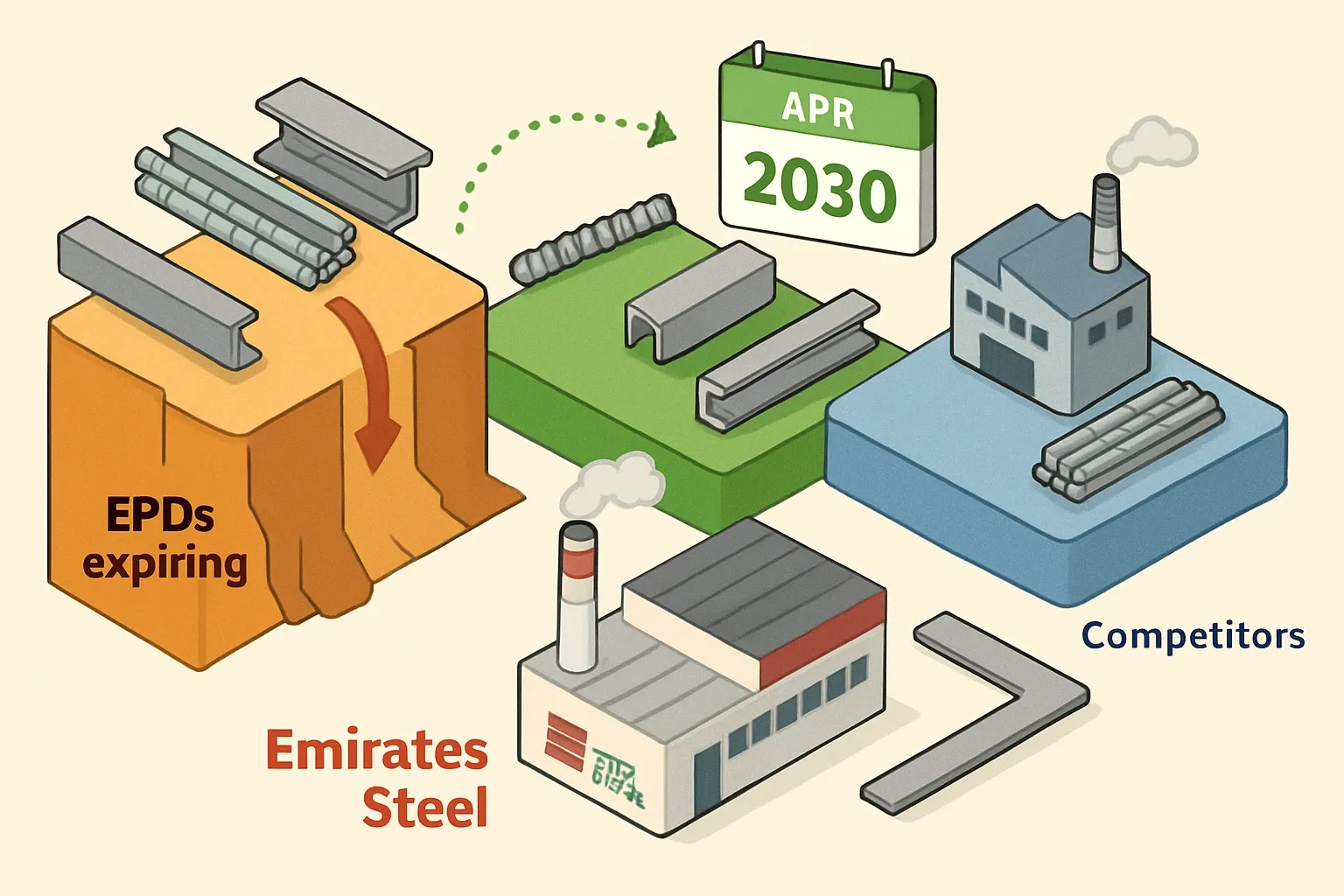


Five expiries that aren't what they seem
On paper, A & S Building Systems, Inc. has five EPDs that run out in July 2027, about eight months from now. That sounds like routine renewal work for a metal building manufacturer based in Caryville, Tennessee. It isn't.
None of the five declarations describe metal building systems. Four belong to VELUX A/S flat roof windows and one to a clay brick from Egernsund Wienerberger in Denmark. The most likely cause is a name collision: "A & S" looks a lot like "A/S", the Danish legal suffix (roughly the equivalent of "Inc."). Hundreds of Scandinavian declarations seem to have landed on the US company's database profile because of it. Think of mail for apartment "A/S" piling up in the box marked "A & S". The letters are real. They just went to the wrong address.
The five declarations, product by product
Here is what actually expires in July 2027:
- VELUX flat roof window CFP (fixed PVC curb with acrylic dome), IBU, valid until 25 July 2027
- VELUX flat roof window CFU (fixed PUR/GRP curb with flat or curved glass top), IBU, valid until 25 July 2027
- VELUX flat roof window CVU, solar powered (motorised venting unit), IBU, valid until 25 July 2027
- VELUX flat roof window CSP, grid connected (smoke ventilation unit with scissor lift), IBU, valid until 25 July 2027
- Red brick without manganese oxide from Petersminde Teglværk, Egernsund Wienerberger, EPD Danmark, valid until 4 July 2027
All four VELUX declarations were published in July 2022 under IBU's Part B rules for windows and doors. The brick EPD covers solid red facing bricks fired with biogas and certified green electricity.
The metadata on the brick record also has a problem. It points to a PCR for steel construction products, while the manufacturer's own EPD document references a clay construction products PCR. Two errors stacked on one record should make any specifier double check the original PDF before pulling numbers.
Book a free 30-min. consultation
Discuss ideas to mobilize your EPDs, review your portfolio, and generate strategies to make LCA insights impactful across your organization.
Replacement check: VELUX
We found no newer EPDs for the CFP, CFU, CVU or CSP lines as of November 2026. A duplicate CFP listing under VELUX Company Ltd expires one day earlier, on 24 July 2027. The French INIES declarations for CFP and the motorised CVP expire even sooner, on 1 December 2026.
VELUX is clearly not idle, though. Through 2025 and 2026 the group published a wave of commercial rooflight EPDs through Smart EPD: Modular Skylights, Coxdome domes, X Dome units, Top 90 domes and smoke vents. Most run to 2030 or 2031 (we covered part of that push in Congrats VELUX: 16 new EPDs in one big batch). The full portfolio is on VELUX's EPD Directory page. So the commercial daylighting range is covered. The residential flat roof window family just hasn't been renewed yet.
Replacement check: Egernsund Wienerberger
The brick picture is tighter. Egernsund's yellow, rose and brown Petersminde bricks all expire on the same day, 4 July 2027. The Helligsø Teglværk declarations lapse even earlier, in February 2027. Its only long dated EPD covers lintel and beam products, valid until September 2029.
That timing matters in Denmark. Since 1 July 2025, most new buildings must stay under an average limit of 7.1 kg CO2e per m² per year (Nordic Sustainable Construction, 2024). With a cap that tight, every facade material gets weighed in the LCA. Designers who can't use product specific data fall back on conservative generic values, and that usually makes the product look worse than it is.
Where specifiers could turn instead
If the VELUX flat roof window EPDs lapse without successors, a few alternatives already have current declarations. LAMILUX holds an ift Rosenheim EPD for its FE F100G flat roof window, plus F100 rooflight domes, all valid until March 2030. FAKRO's access roof lights carry an ITB declaration valid until September 2029.
For Danish clay brick, Randers Tegl stands out with 56 current EPDs through EPD Danmark. Many were issued between late 2025 and early 2026 and run to 2030 or 2031. Strøjer Tegl is in the same boat as Egernsund, with its brick EPDs expiring in February 2027. That leaves fewer verified Danish brick options in mid 2027 than the market might expect.
What this means for A & S itself
For A & S Building Systems the real story is the reverse. We found no current EPD in its profile for its core product, pre-engineered metal building systems. The handful of structural and metal entries we found were expired or belonged to other companies. A buyer filtering for a metal building EPD under the A & S name would find window and brick data instead. That could be confusing at best and misleading at worst.
Cleaning up the profile is a database task. Filling the gap with real declarations for frames, purlins and wall panels is a commercial decision. Metal building competitors that already have verified EPDs avoid the generic data penalty on carbon tracked projects.
Renewal timing is the whole game
An EPD stays usable right up to its expiry date, and most buyers don't care whether it is two years old or four. What they do care about is a lapse in the middle of a project. Design, procurement and LCA reporting can stretch past a year. A declaration that expires before the project's carbon report is due puts the product at risk of being swapped out.
A renewal takes real time. Gathering a full reference year of energy, material and waste data, updating to the current PCR, getting third party verification and publishing can easily take several months. When the data collection has to come from busy plant and R&D teams, it often slips. For declarations expiring in July 2027, the comfortable window to start is now.
Reading the label carefully
This case has two lessons. First, check who actually owns an EPD before relying on it. A suffix like "A/S" can put a Danish rooflight on a Tennessee steel company's profile. Second, July 2027 is a real deadline for VELUX's flat roof window line and Egernsund's Petersminde bricks, and both manufacturers have competitors with declarations valid well into the next decade.
If the renewals arrive in time, specifiers won't notice any gap. If they don't, LAMILUX, FAKRO and Randers Tegl will be the ones still showing current, verified data when Danish carbon limits are checked.