Why allocation matters for sales, not just compliance
If a product lacks a product‑specific EPD, many project teams must model it with conservative defaults, which can push it out of contention even when performance is solid. Good allocation unlocks product‑level EPDs across a portfolio, so sales teams stop losing quiet, invisible bids where carbon targets rule the short‑list.
Start with the rulebook
Check the PCR and the program operator’s instructions first. They set the hierarchy for allocation and documentation. EN 15804’s cut‑off guidance often used in construction requires that neglected flows are below 1 percent per unit process and that at least 95 percent of mass and energy are covered in total (CEN EN 15804+A2, 2019).
Pick one primary allocator, then prove it fits
Think like a fair pizza split. If ovens are the bottleneck, machine time usually wins. If the same line cranks out similar items at similar speeds, production volume or mass can be simplest. If SKUs differ wildly in run speed and changeover, time on constrained equipment tells the truest story. Revenue should be a last resort because prices move for reasons unrelated to resource use.
When product families share equipment
Two fast ways to stay sane: group near‑identical SKUs under one family model, then weight results by sales or output across that family. For edge cases that run on the same line but behave differently, layer a correction factor from measured cycle time or scrap rate so the heavy users carry their fair share.
Turn invoices into SKU footprints
Work from a single reference year so the math is replicable. Tie plant electricity, fuel, and water invoices to meter reads, then adjust for on‑site generation and line‑level submeters where they exist. Convert production logs to the same time base, account for scheduled downtime, and spread unavoidable base loads using operating hours so slow shifts do not get over‑allocated.
Want to unlock product-level EPDs for your SKUs?
Follow us on LinkedIn for insights that help you avoid losing bids and improve compliance with better allocation strategies.
Handle waste with care
Separate routine process scrap, changeover losses, quality rejects, and packaging. Allocate routine scrap with the same basis as the parent process. Assign setup and cleaning losses by setup frequency or time on the equipment that caused them. If materials are recycled in‑house, document whether you apply the recycled content method or avoided burden per the PCR and ISO 14044, and keep it consistent year to year (ISO 14044, 2020).
Revenue weighting without greenwashing
Revenue can be acceptable when the PCR allows it and physical drivers are weak or unknowable. Guardrails help. Cap extreme price swings with a rolling average, and publish both the revenue share and the physical check so reviewers see that the method isn’t gaming the result. If the two diverge materially, revert to a physical allocator and explain why.
What verifiers look for
- A clear map from plant invoices to process totals, and from process totals to SKUs.
- One primary allocation rule per flow, with a short note on why it fits.
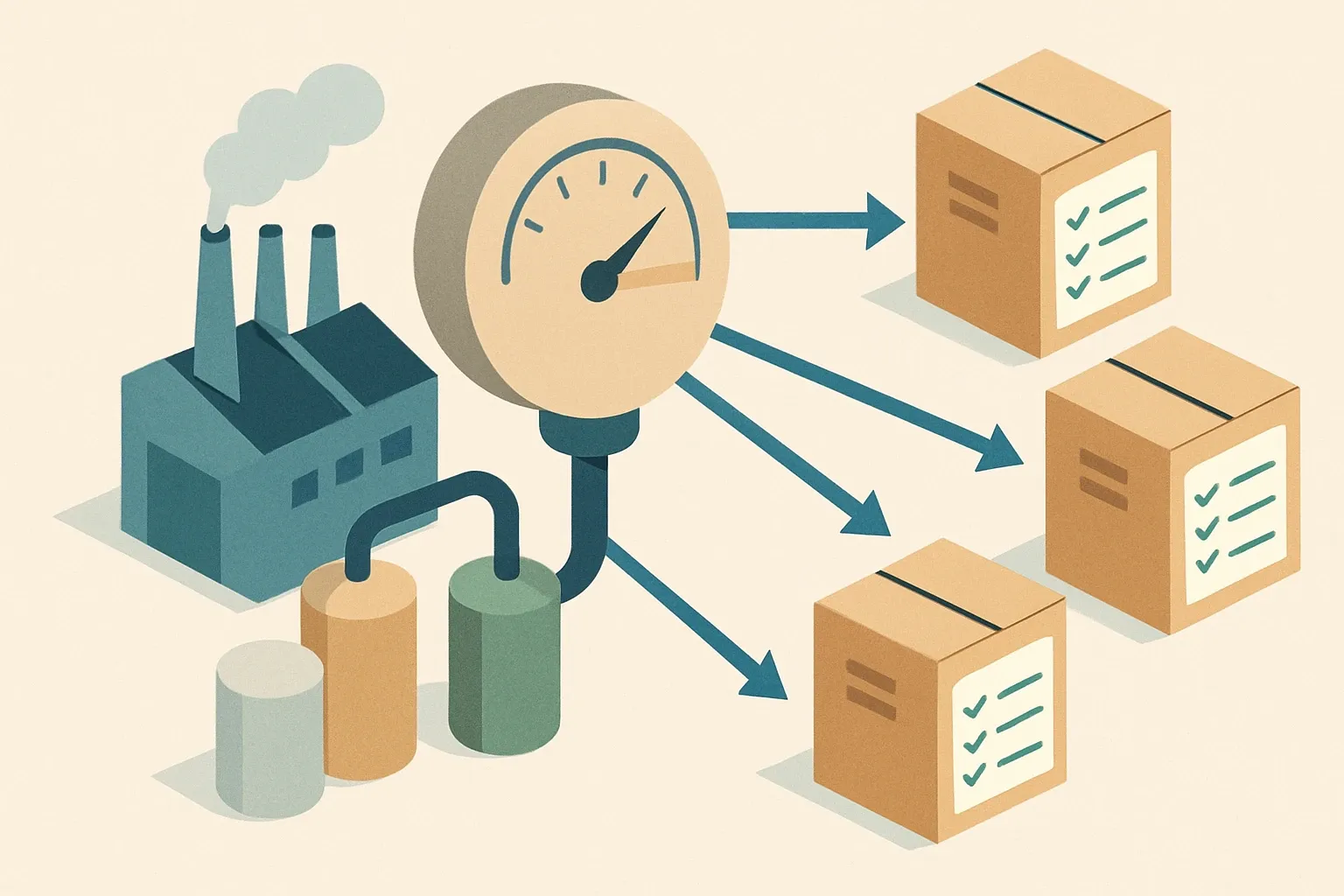
- Reconciliation tables that tie allocated energy and waste back to 95 to 100 percent of the plant totals.
- Versioned data sources, dates, and who signed off. Small thing, big trust.
Stress‑test the math
Pull three very different SKUs and rerun the allocation with an alternative credible basis such as time vs volume. If results swing in ways that defy operations knowledge, the chosen driver is off. This five‑minute “alternate driver” test saves a week of verifier back‑and‑forth later.
Keep it repeatable across renewals
Most EPD programs set a five‑year validity before renewal is needed, so allocation rules should be stable enough to survive portfolio shifts through that horizon (EPD International GPI, 2024). Build the rules once, automate the inputs, and document exceptions so next year’s update is a refresh rather than a rebuild. Your future self will definately thank you.
A lightweight template you can copy
- Define the reference year and scope. List meters, invoices, and submeter coverage.
- Select the primary allocator per major flow: electricity, thermal energy, water, waste.
- Record operational modifiers: setup counts, cycle times, base‑load hours.
- Allocate to product families, then to SKUs using production or sales mix as needed.
- Reconcile back to plant totals and sign off with operations and finance.
The quiet advantage
Allocation rarely wins a headline. Yet when it is transparent, conservative where needed, and grounded in how the line actually runs, it removes friction at verification and keeps EPDs flowing across the catalog. That is how teams move from one flagship EPD to full‑line coverage without burning out the floor or the finance crew.