What people mean by “the HPD database”
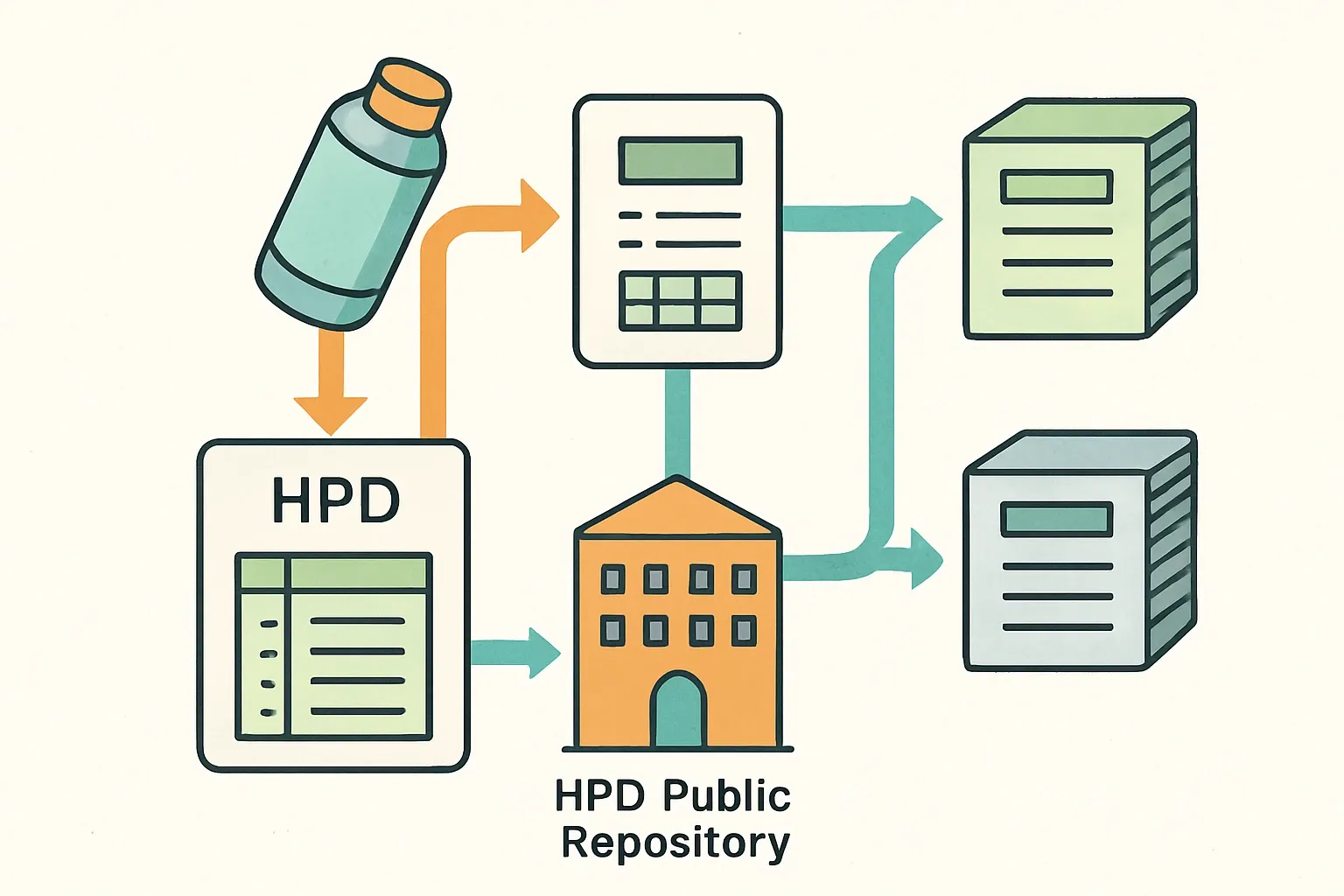
In practice, the term health product declaration database points to the HPD Collaborative’s HPD Public Repository. It is the official home for published HPDs and the first place AEC teams look when documenting material ingredients for projects.
The HPD Public Repository in two minutes
The Repository hosts over 13,000 published HPDs representing more than 40,000 products, and it adds roughly 250 new HPDs per month (HPD Collaborative, 2025) (HPD Collaborative, 2025). You can search by manufacturer, product name, CSI MasterFormat, or HPD version, then download the HPD PDF for submittals.
Why it matters for LEED v5 and WELL
LEED v5 was ratified by USGBC members on March 28, 2025, and Material Ingredients remains a supported pathway where HPDs count as acceptable documentation (USGBC, 2025) (USGBC, 2025). The LEED guidance also anchors disclosure at 0.1 percent, or 1,000 ppm, for ingredient reporting thresholds (USGBC, 2025) (USGBC, 2025). WELL’s Material Transparency feature accepts HPDs and sets a 50 percent by cost target for eligible interior products (IWBI, 2025).
Versions and freshness signals
HPD Open Standard v3.0 became the current effective version in August 2025, with v2.3 used widely before that (HPD Collaborative, 2025). When you publish, include the version, publication date, and any third‑party verification on the front page so project teams can check compliance quickly. It sounds small, yet it often decides whether a specifier moves forward or moves on.
Navigating EPD data hubs for project success?
Follow us on LinkedIn for insights that streamline your access to critical specifications and boost your competitive edge.
Where else do teams look
Manufacturers often host HPDs on their own sites. Declare’s database is another familiar stop, now listing 1,600 plus labels from 400 plus manufacturers, which some teams use as a quick material health signal alongside HPDs (ILFI, 2025) (ILFI, 2025). mindful MATERIALS is shifting from a single portal to embedding its Common Materials Framework across partner platforms in 2025, so ingredient data will increasingly surface inside tools firms already use (mindful MATERIALS, 2025).
HPD vs EPD, and why both show up in specs
HPDs disclose product contents and associated health hazards. EPDs report environmental impacts like global warming potential. Owners, designers, and GCs often want both, since LEED v5 separately rewards environmental declarations and ingredient reporting (USGBC, 2025). Having one without the other creates gaps in submittals that slow decisions or push a product out of contention.
Make your HPDs findable, not just published
Think like a librarian. Use consistent product names and model identifiers, map the correct MasterFormat codes, and keep the company domain current in your Repository profile. If you sell families with dozens of SKUs, publish line‑level HPDs when feasible so search results match how specifiers buy. And renew before the question lands in your inbox.
A fast, low‑friction path for manufacturers
Internal data wrangling eats time. The most efficient path is to centralize data collection once, across plants and BOMs, then prepare HPDs, EPDs, and any third‑party checks in parallel. Choose a partner that handles outreach to upstream suppliers, quality control, and publishing with the operator you prefer, so your team stays focused on design and production instead of chasing CAS numbers. The speed shows up in bid windows and in fewer last‑minute submittal scrambles. It is definately worth it.
Quick checklist to show up in every search
- Confirm HPD Open Standard v3.0 format, include publication date and verification status.
- Publish to the HPD Public Repository and link from your product pages.
- Align internal naming with what sales and reps use in quotes and finish schedules.
- Track LEED v5 and WELL requirements that reference 1,000 ppm and related thresholds so your disclosures match what project teams must document (USGBC, 2025; IWBI, 2025).
Bringing it together
If a specifier types health product declaration database, they expect to find a current, complete HPD in the HPD Public Repository, plus supporting signals in their favorite libraries. Give them one clear, verified record and a breadcrumb trail back to your site. That small act of clarity can be the difference between being considered and being replaced.