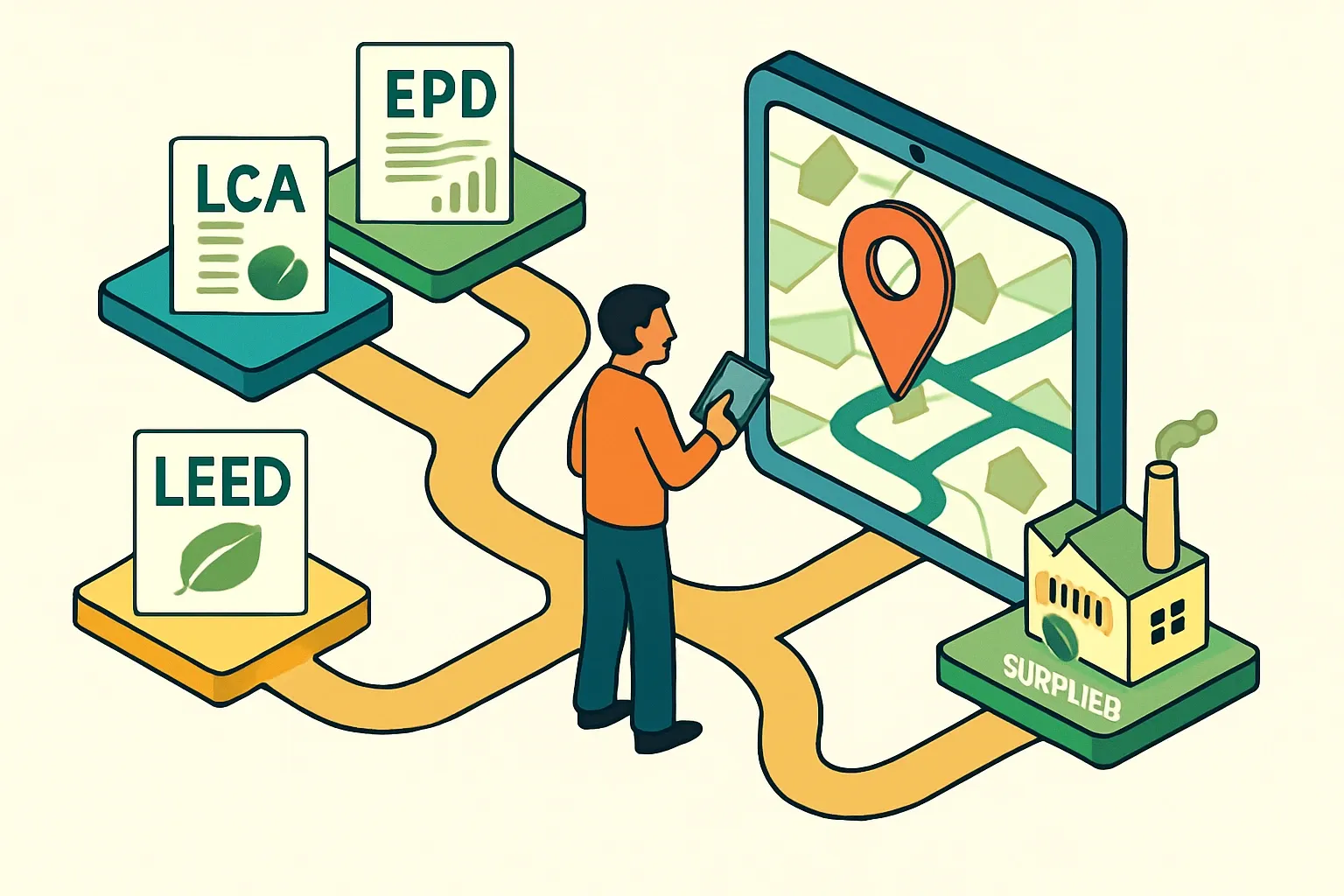
What Pathwaysai.co is, and where it fits
Pathwaysai.co positions itself as an AI platform for material manufacturers that automates data ingestion, keeps live data pipelines, and outputs LCAs and EPDs aligned with ISO and EN conventions. Treat it as a workflow hub that still relies on sound inputs, clear PCR choices, and disciplined verification through a program operator. That mix is what unlocks commercial traction, not the interface alone.
Set the data table before you sit down
Enterprise systems rarely speak the same language out of the box. Create a lean data dictionary that maps supplier names, facility IDs, SKUs, units, and transport legs to the fields Pathways expects. Make one plant the pilot so you can validate field mappings and unit conversions before scaling. This sounds simple, but it isnt.
A short, no‑nonsense setup sequence
- Inventory sources that matter to A1 to A3 first. Start with procurement, utility meters, fuel logs, and inbound freight.
- Normalize units. Lock kWh, MJ, kg, km, and density factors so nothing drifts during import.
- Define product boundaries and variants. Decide which SKUs roll into one declaration and which need separate models.
- Pick the PCR and operator up front. Align modeling choices to the rulebook you will be verified against.
- Dry‑run an EPD. Export draft results, check module totals, and compare to a known competitor template for sanity.
PCR and program operator choices still rule the game
ISO 14025 governs Type III EPDs and program operators set practical rules, including typical five‑year validity that determines renewals and sales planning. Confirm the platform’s templates and exports match the operator you plan to use, such as Smart EPD in the United States or IBU in Europe. Most programs set five years as the validity window, which you should plan against in your roadmap (EPD International, 2024) (EPD International, 2024) (IBU, 2025) (IBU, 2025).
At Pathwaysai.co or working with competitors?
Follow us for product-by-product competitive insights to see how your EPDs stack up against others in the market.
Model plants and products the way auditors see them
Mirror real production. Separate models when mix designs, recycled content, or energy profiles differ materially. Document allocation rules in plain English inside your project notes so the verifier does not have to reverse‑engineer intent. Keep a running log of background datasets and versions to avoid last‑minute scrambles.
Use benchmarking and scenarios with guardrails
Scenario tools can reveal quick wins on fuel switches or clinker factor, yet they do not replace PCR logic. When you test a swap, state the assumption, the dataset source, and the transport deltas. Keep scenarios traceable so sales materials never outrun what the verified EPD actually claims.
Verification and publication, without the drift
Build in time for third‑party verification. IBU advises that several weeks should be planned for verification, depending on complexity and quality of data, which is a realistic benchmark for other operators as well (IBU, 2025) (IBU, 2025). The output only becomes market‑ready when it is published by the operator. LEED v5 was ratified on March 28, 2025 and continues to elevate embodied‑carbon accounting, so verified, current EPDs remain a common submittal ask in bids (USGBC, 2025) (USGBC, 2025).
Sales enablement that respects the rules
Create a one‑page cut sheet per product that translates the EPD into three items buyers recognize. Scope and modules covered, the declared unit, and the latest validity date. Add a QR code to the operator registry entry so project teams can confirm authenticity without emailing back and forth.
Ongoing governance that keeps EPDs buyer‑ready
Nominate a data owner per plant and a single LCA steward for the portfolio. Refresh utility and procurement feeds monthly. Track PCR expiry horizons and program operator changes so renewals land in your quiet season. Most programs run on five‑year validity, so the 42 to 48 month window is a smart time to start the next cycle (EPD International, 2024) (EPD International, 2024).
Common pitfalls to avoid
- Treating unlimited publication claims as unlimited capacity. Verifier bandwidth and operator queues still set real‑world pacing.
- Rolling unlike SKUs into one EPD. If buyers cannot understand what was averaged, trust falls fast.
- Mixing A1 to A3 and A1 to A5 results in the same conversation. Label the scope clearly every time.
A quick win checklist for Pathwaysai.co
If Pathways is your chosen platform, keep the play tight. Lock a clean reference year, publish operator‑specific drafts early for format checks, and document every scenario with datasets and transport notes. Verify one flagship product end to end, then scale the pattern across plants and families. Momentum beats perfection when revenue depends on staying in the spec race.
The practical take
Pathwaysai.co can centralize the work, but outcomes rise or fall with data discipline, right‑sized PCR choices, and timely verification. Set the table once, keep it tidy, and your EPDs stay credible, comparable, and commercially useful when it counts.