What the Strategy means in 2026
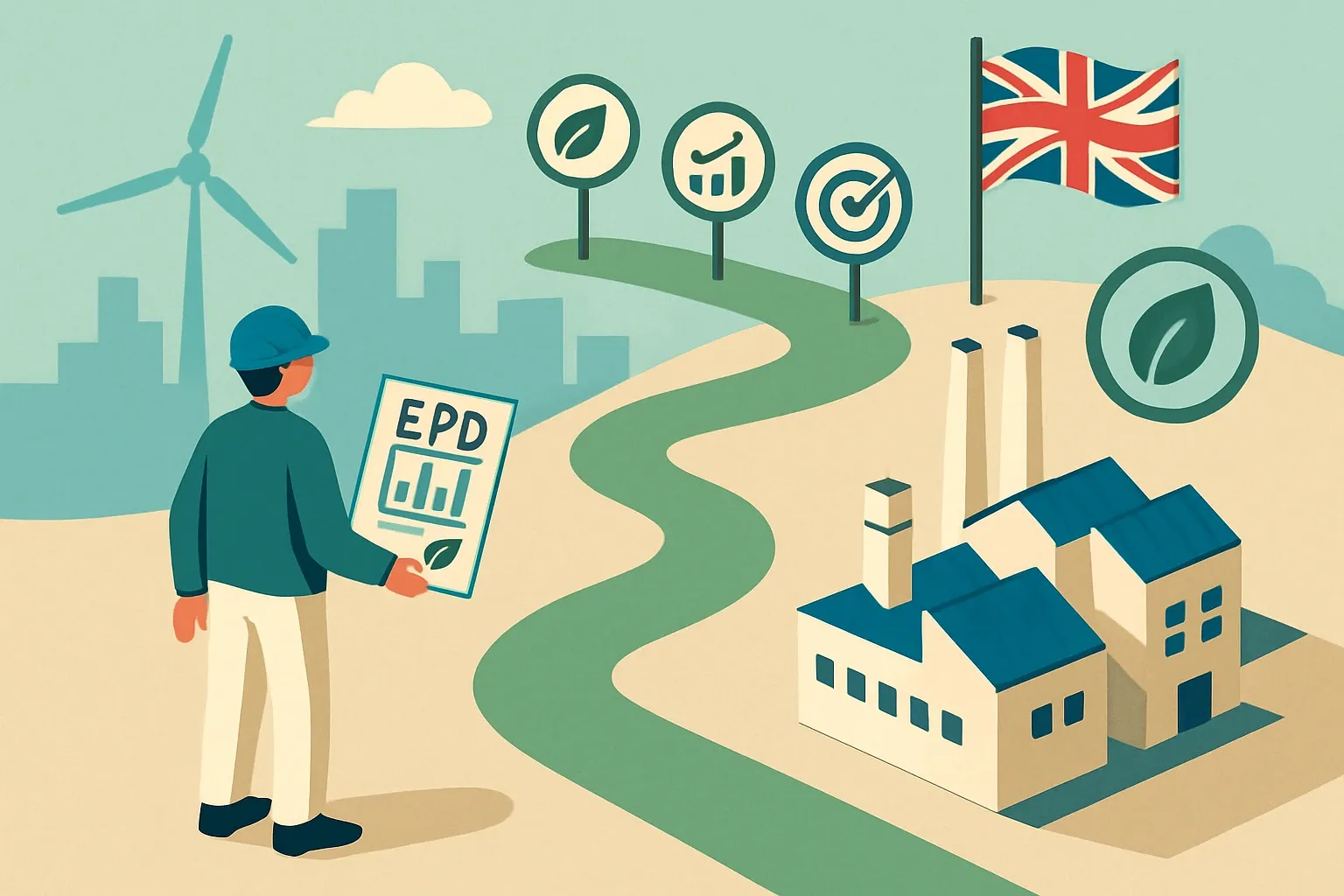
Published in 2017, the Clean Growth Strategy set the direction that later policies built on, including the Net Zero Strategy and Powering Up Britain. For manufacturers, the through‑line is simple. Project teams must evidence whole‑life carbon, and they prefer products with third‑party verified impacts they can trust.
Where EPDs plug into credits fast
BREEAM UK New Construction awards up to 1.5 credits when at least 20 products have their own product‑specific, third‑party verified EPDs. That threshold and cap are explicit in BRE’s guidance (BRE, 2024). An EPD also strengthens Mat 01 by improving LCA data quality. If an EPD is valid at the point of specification, it can count even if it expires before design or post‑construction submissions finish (BREEAM Knowledge Base, 2025).
Planning rules that demand whole‑life views
Major London schemes must submit Whole Life‑Cycle Carbon Assessments under London Plan Policy SI2 and the city’s adopted guidance (GLA, 2022). The RICS Whole Life Carbon Assessment standard, second edition, has been in full effect since 1 July 2024, giving a common method to quantify A1 to C stages across buildings and infrastructure (RICS, 2024). EPDs supply the product‑level A1 to A3 evidence these assessments expect.
Procurement pressure is real
Central government buyers use PPN 06/21 to require Carbon Reduction Plans on larger contracts, and the NHS extended CRP requirements to all new procurements from April 2024 (NHS, 2023). While CRPs focus on organisational emissions, project teams still lean on EPDs to scope embodied impacts credibly at product level. Clean data shortens review cycles. Messy data slows awards.
Navigating UK environmental regulations for better tenders?
Follow us on LinkedIn for clear insights that keep your EPDs competitive and compliant.
Materials under the microscope
UK construction’s embodied carbon in 2018 totalled about 43 MtCO2e, with materials and site activities driving most of it (Resources, Conservation and Recycling, 2023). Concrete accounted for roughly half of that embodied carbon and steel for about 22%, putting intense scrutiny on mix designs and steel grades (ICE, 2023). If your declarations are absent or outdated, designers will swap to options with clear numbers.
Standards that shape client expectations
PAS 2080 was updated in 2023 to cover carbon management across buildings and infrastructure, emphasising whole‑life accounting and early collaboration (BSI, 2023). That language now appears in employer requirements and framework briefs. Having product‑specific, third‑party verified EPDs shows you are not just compliant. You are ready for systems‑level carbon trade‑offs.
Operator choices that work in the UK
Teams commonly publish to recognised operators active in the UK market such as BRE or European operators aligned to EN 15804. What matters most is third‑party verification, EN 15804 or ISO 21930 conformity, and clarity on declared unit and scenarios. Choose the outlet your specifiers already accept to minimise friction.
A quick playbook to stay spec‑ready
- Map products against BREEAM material classifications and typical UK project scopes. Prioritise SKUs that unlock Mat 02 coverage across multiple classifications.
- Align LCA modeling to the RICS WLCA second edition. Confirm modules, scenarios, and data quality so results drop cleanly into project WLCAs.
- Plan a tidy data year. Utilities, raw materials, and waste for a recent 12‑month period keep verifiers happy and speed publication. Prospective EPDs can bridge new lines, then be refreshed.
- Track expiry. Most EPDs run five years, and BREEAM cares about validity at specification. Time renewals so you never miss a bid window.
The commercial angle
The Clean Growth Strategy’s legacy shows up in credits, planning conditions, and buyer expectations. EPDs reduce the carbon uncertainty penalty that can push a product out of a shortlist. One mid‑sized win often covers the credential. Getting your numbers verified is not just greener, it is definately faster to revenue in the UK context.