What the rule requires right now
Sweden requires a climate declaration for new buildings that need a permit, covering projects with permit applications from 1 January 2022 (Boverket, 2024) (Boverket, 2024). The scope is construction stage only, modules A1 to A5 under EN 15978, not use stage or end of life (Boverket, 2025).
Only specific building parts are included. The envelope, load‑bearing structures, and interior walls count. Building services and interior surface layers are out of scope. Buildings under 100.0 square metres GFA and certain industrial or defense projects are exempt (Boverket, 2026).
Who files and when approval hinges on it
The developer is responsible for producing and submitting the declaration. Municipalities cannot issue final clearance without a submitted declaration, so timing matters to handover and revenue recognition (Boverket, 2026). No fixed submission date exists, but leaving it late risks a scramble.
Your data choices, and the 25 percent “generic” uplift
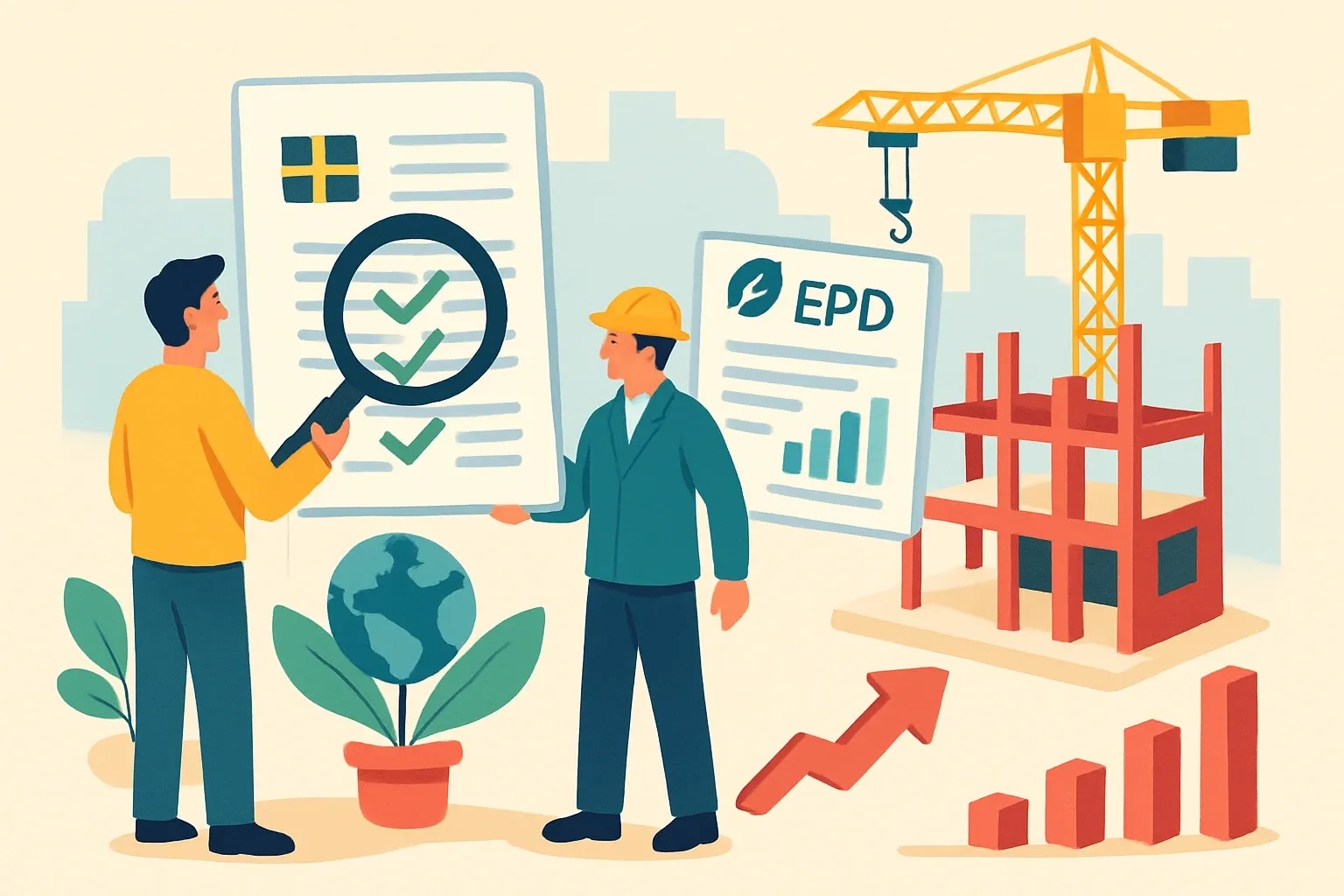
Boverket’s open climate database can be used where product‑specific data is missing. Its generic product values are intentionally conservative, approximately 25 percent higher than average. That design pushes teams toward specific data like product EPDs that reflect thier real performance (Boverket, 2024) (Boverket, 2024). Using your own EPDs often lowers the declared A1–A3 result and smooths reviewer questions.
Navigating environmental regulations for winning bids?
Follow us on LinkedIn for clear insights that help you stay compliant and competitive in the Nordic market.
Where EPDs fit in Swedish workflows
Product‑specific, third‑party verified EPDs plug straight into A1–A3 and support cleaner A4 and A5 inputs. The International EPD System is headquartered in Stockholm and reported more than 18,000 valid EPDs in 2025, which signals strong market familiarity among Swedish reviewers (EPD International, 2025). European operators like IBU are also commonly recognized by project teams.
What could change next
Limit values are expected. The government tasked Boverket on 22 January 2025 to accelerate proposals for caps on building climate impact. Earlier proposals targeted A1–A5 limit values starting 2027 with step‑downs in 2035 and 2043, with discussion of an earlier start in 2025. These are policy proposals, so watch for formal adoption and exact numbers (OECD, 2025) (OECD, 2025).
Manufacturer playbook to stay ahead
Aim for specific data, fast. The proccess rewards organized teams.
- Lock a reference year and gather utilities, material inputs, transport lanes, and waste for each plant so A1–A3 is complete.
- Collect supplier EPDs for top contributors like cement, steel, glass, and insulation to avoid generic factors.
- Decide operator and PCR early, then hold scope steady to keep modeling moving.
- Build a short evidence file and save it for five years, matching Boverket guidance on documentation retention (Boverket, 2025).
Why this matters commercially
Generic data increases the reported footprint and can push a product out of a tight spec. The 25 percent uplift on generic values makes that visible to buyers who compare options line by line (Boverket, 2024). An EPD turns rough estimates into credible numbers, shortens back‑and‑forth with reviewers, and reduces the risk of late‑stage swaps when projects chase carbon budgets.
Final word
Treat Sweden’s climate declaration as a predictable checklist. Use product EPDs wherever you can, keep A1–A5 data clean, and watch the limit‑value rulemaking. That combination protects margin and keeps your products selectable when projects are on the clock.