What Scotland’s 2026 strategy actually does
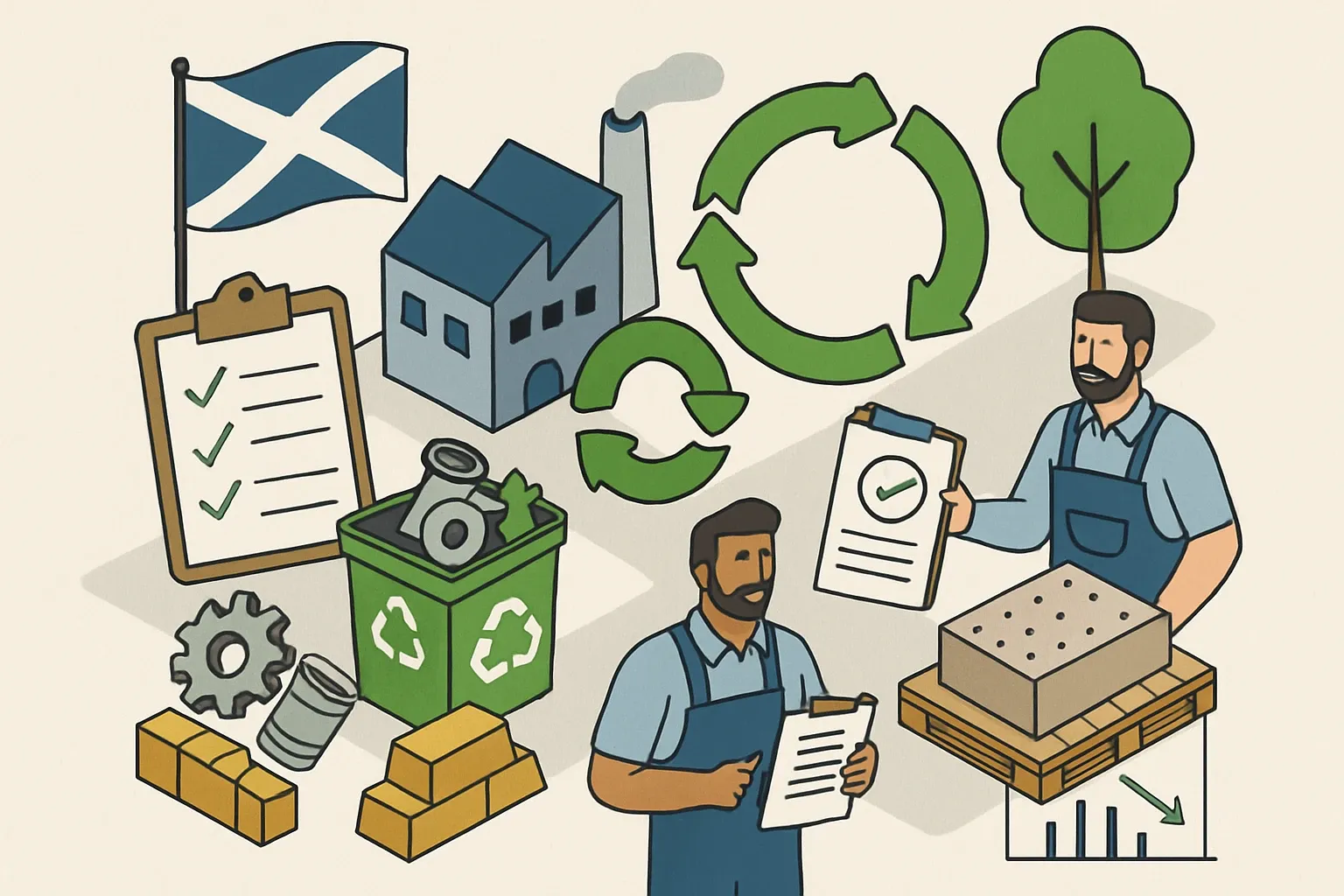
Scotland’s Circular Economy (Scotland) Act 2024 requires Ministers to publish or refresh a circular economy strategy every five years, a cadence that began with the strategy issued in March 2026 (Scottish Government, 2026) (Scottish Government, 2026). The Act also creates powers that tighten reuse and recycling outcomes, which will ripple through construction material choices and site practices (Scottish Parliament, 2025).
Why construction is the main event
Construction and demolition activity generates around half of Scotland’s total waste, and was linked to about 10% of national greenhouse gas emissions in 2022. That puts the built environment squarely in the spotlight for near‑term circular wins (Zero Waste Scotland, 2026) (Zero Waste Scotland, 2026). When buyers push for lower embodied carbon and more recovery at end of life, it is because this is where the biggest gains live.
Targets that shape specs and bids
Policy signals are not vague. Scotland set a target for recycling 70% of construction and demolition waste by 2025, a benchmark used by regulators and councils when shaping requirements for projects and waste contracts (SEPA, 2025) (SEPA, 2025). Current performance figures for 2025 are still being consolidated across datasets, so treat any sweeping claims with caution if a supplier cannot show verifiable evidence.
EPDs are your passport, not a pamphlet
An EPD proves a product’s embodied carbon and key impacts in a comparable, standardised format under EN 15804. BREEAM and other European clients increasingly expect that level of disclosure, while global owners running LEED v5 projects also look for product‑specific EPDs to avoid conservative default factors in carbon accounting. Without one, you often inherit a penalty in models that can push you out of the shortlist.
Join Parq Pulse!
Stay ahead with weekly insights on environmental and product data to excel in Scotland’s circular economy and win more projects.
Align your next EPD with Scotland’s playbook
Work from the rules first, like a good chess opening. Pick the PCR competitors use, confirm it is current, and scope the declaration to the modules specifiers ask about most in your segment. Document recycled content with real supplier attestations, not marketing copy. Capture site transport distances, packaging choices, and deconstruction pathways so the circular story is complete, not just “low CO₂ at the gate.”
Program operators that show up in UK projects
Manufacturers in Scotland commonly publish through BRE, IBU, or Environdec, and large portfolios often mix operators to match market access. What buyers care about is third‑party verification, EN 15804 compliance, and clarity on declared unit and system boundaries. Keep the focus on comparability so procurement can line your EPDs up beside rivals without mental gymnastics.
Procurement signals to watch
Public bodies are aligning with the strategy’s reuse and recycling aims and are modernising collection and reporting systems that feed into contract conditions (Scottish Government, 2026). Expect tighter requirements for source‑segregation on sites, minimum recycled content in certain packages, and clearer evidence pathways for take‑back or remanufacture. If a claim cannot be traced to data, assume it will be discounted.
Data buyers will actually check
EPDs are strongest when supported by primary data from energy, materials, and waste streams. Buyers increasingly ask for plant‑level utility data for the LCA reference year, audited recycled content, logistics modes, and end‑of‑life assumptions that match Scotland’s real recovery options. Do the simple thing early, like collecting supplier EPDs for high‑mass inputs, and you save weeks later.
Timing and renewals that fit Scotland’s rhythm
Because the national strategy refreshes every five years, it is smart to schedule EPD renewals and PCR updates on a similar beat so your declarations never look out of step. EPDs typically carry five‑year validity where relevant, which means you can plan portfolio updates against policy checkpoints without scrambling right before a tender. Miss this window and you risk arriving with stale data just as buyers tighten rules. It is a small but critical bit of calendar craft.
The move that pays for itself
Circularity in Scotland is now a playbook with dates, not a moodboard. Publish product‑specific EPDs, document real recycled content, and show credible recovery pathways. That combination removes guesswork from carbon models and turns more specs into wins. Do teh boring data work once, and it will keep compounding across bids for years.