The plan in one breath
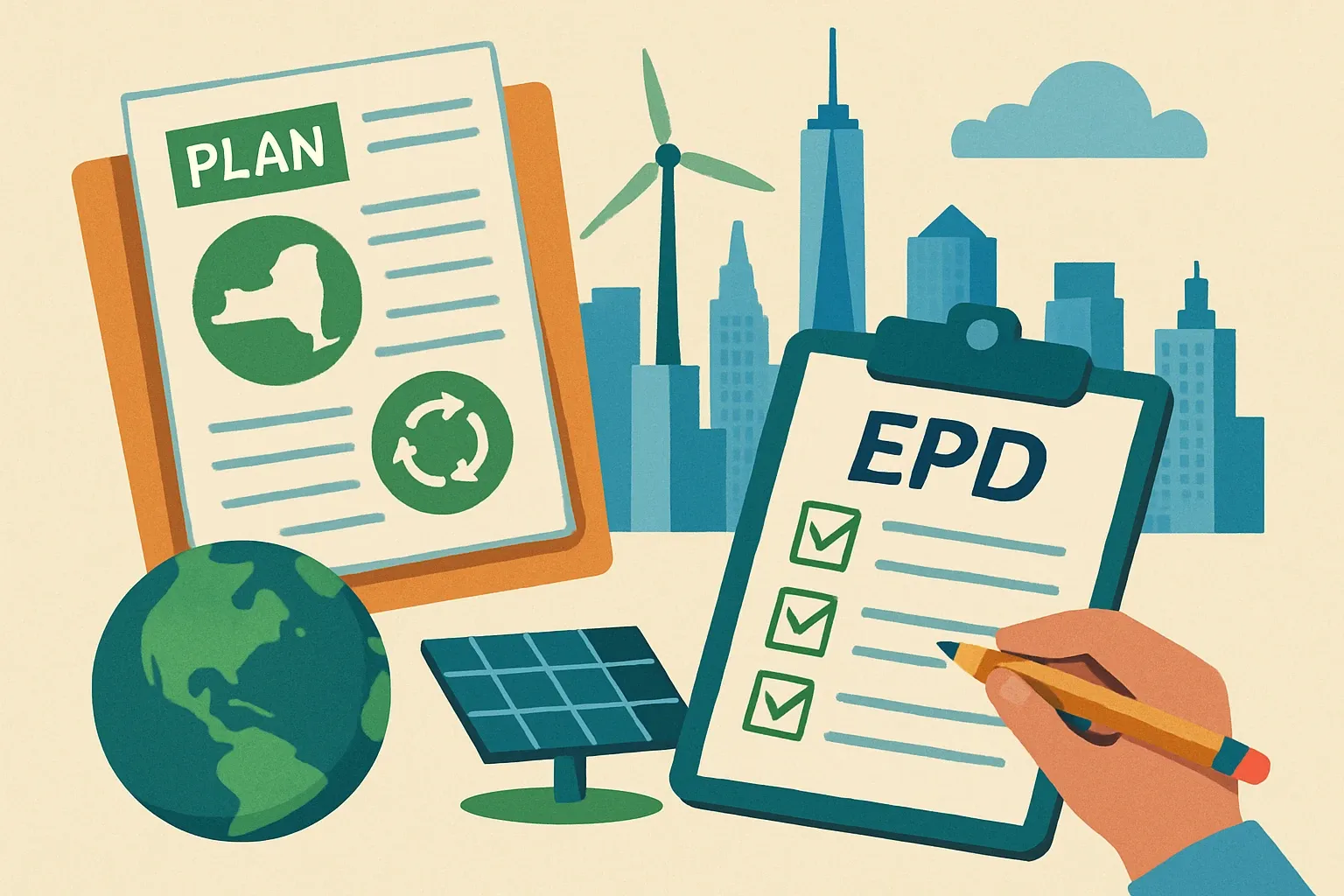
New York’s Climate Act targets a 40% emissions cut by 2030 and 85% by 2050 versus 1990 levels (NYSERDA, 2025). Buildings alone account for roughly 30% of statewide emissions, so construction materials sit squarely in scope (NYSERDA, 2025). The Scoping Plan is the playbook that turns those targets into sector actions, and procurement is one of its sharpest tools.
Why EPDs matter here
The state’s approach is simple to explain and hard to ignore. If public money buys materials, the environmental profile must be measurable and comparable. That is exactly what third‑party verified EPDs provide, with cradle‑to‑gate GWP as the headline metric. Teams that can supply specific, recent EPDs avoid conservative default assumptions that quietly sink specs.
Concrete is the test case
New York’s Buy Clean Concrete guidelines make EPDs mandatory on qualifying state projects starting January 1, 2025, and set maximum GWP limits by strength class (OGS, 2024). For example, 3001–4000 psi mixes must be at or below 360 kg CO2e per cubic yard. Limits for other common classes include 275 kg for 0–2500 psi and 434 kg for 4001–5000 psi, with the table anchored to 150% of NRMCA Eastern averages (OGS, 2024). These are procurement gates, not suggestions.
Who is covered and when
Thresholds matter. The mandate applies to agency building contracts over 1 million dollars with at least 50 cubic yards of concrete, and DOT contracts over 3 million dollars that include at least 200 cubic yards, with narrow exceptions for emergency, high‑early, or quick‑cure work (OGS, 2024). The state plans to revise, and likely lower, these GWP limits in 2027 based on in‑state data collection (OGS, 2024).
Are environmental regulations impacting your bids?
Follow us on LinkedIn for updates that help you navigate compliance and win more projects.
Beyond concrete
Executive Order 22 pushes embodied‑carbon reporting for other materials, including steel, asphalt, and glass. That means EPDs are quickly becoming table stakes across packages, even where strict limits are not yet codified. Expect specs to ask for transparency first, then performance.
What this means commercially
On public work, lacking a product‑specific EPD forces evaluators to assume higher impacts. That often comes with a penalty multiplier that nudges a product out of contention even when price looks fine. An EPD keeps your product in the running and shortens decision time. One mid‑sized state project can pay back the documentation lift, then the next one is pure upside.
Fastest path to compliant submittals
Think of the Scoping Plan as a deadline generator. To stay ahead of bids, organize around three moves.
- Map exposure. List SKUs that flow into New York state‑funded projects and prioritize high‑volume mixes or assemblies likely to be spec’d repeatedly.
- Lock data now. Pull a clean 12‑month reference year for energy, materials, and waste, or build a prospective dataset if the product is new. Do not wait for a perfect meter readout to start.
- Choose an LCA partner that handles data collection end‑to‑end, is comfortable publishing with multiple program operators, and knows Buy Clean submittal quirks. White‑glove data wrangling saves engineering hours you definately need elsewhere.
Watchouts that trip teams up
Generic EPDs rarely help on state work when product‑specific numbers are expected. Facility‑specific or supply‑chain specific EPDs win trust. Keep an eye on PCR currency so renewals do not collide with bid week. And do not let marketing carry this alone, operations and quality own key inputs.
What to expect next
Concrete is first through the gate, but the Scoping Plan points to broader procurement rules as data improves. The agencies will keep tuning limits as they gather New York specific performance. Manufacturers that systematize EPD creation now will find themselves quietly at the front of the line when specs tighten.