What buyers actually score in the Netherlands
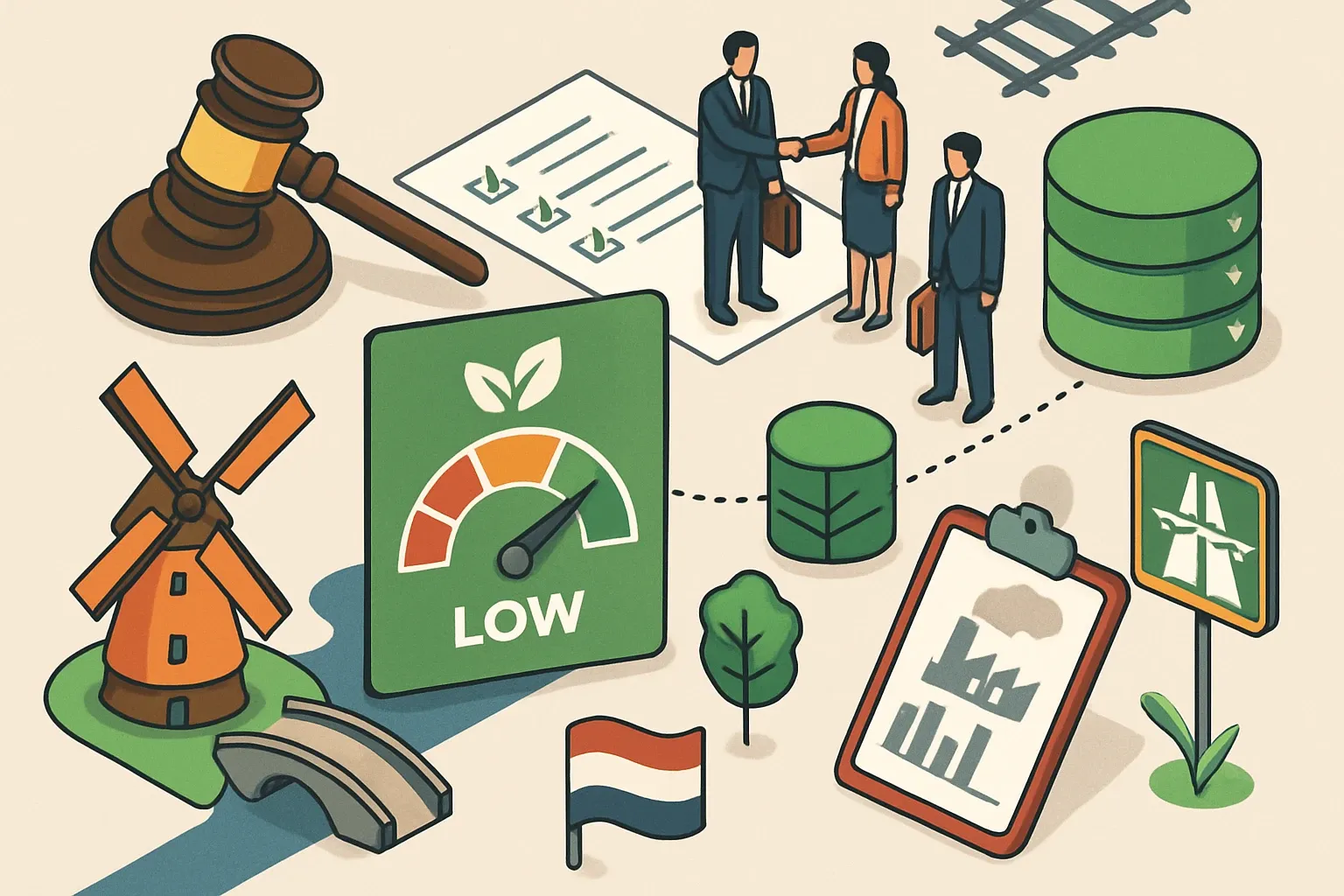
Public clients award on best price quality, not price alone. Rijkswaterstaat now monetizes environmental impact during evaluation using MKI valuation, a method announced on May 27, 2024 for use in tenders that summer (Rijkswaterstaat, 2024) (Rijkswaterstaat, 2024). A lower MKI means a better quality score, which can offset part of your bid price and lift your ranking.
MKI in one line
MKI is a single euro value derived from an LCA that sums multiple impact categories. PIANOo, the national procurement expertise center, frames it as the common language to compare sustainability in purchasing, for both public and private buyers (PIANOo, 2025). If your EPD is robust, your MKI is credible. If data is missing, models fill the gaps and the number works against you.
The tools and data that drive scores
Authorities and bidders calculate infrastructure impacts with DuboCalc, which pulls building and civil data from the Nationale Milieudatabase. Rijkswaterstaat uses it to request an MKI in the bid and to verify results against a published protocol (Rijkswaterstaat, 2025). Product specific EPDs that sit in NMD plug in cleanly, so estimators do not scramble near the deadline.
Navigating Dutch EPD requirements for tenders?
Follow us on LinkedIn for critical updates that help you stay compliant and competitive.
CO₂ Performance Ladder often tips the scale
Many Dutch contracting authorities give award advantage to certified bidders. More than 8,000 organisations hold a certificate and over 300 contracting authorities use the Ladder in tenders, which makes it a frequent tie breaker in practice (SKAO, 2025) (SKAO, 2025). Version 4.0 rolls out with a two year transition. Contracting authorities are advised to use 4.0 in tenders from 2026, with full implementation by early 2027 (SKAO, 2024).
Where to publish so your EPD “counts”
For the Dutch market, EPDs recognized by NMD are the safest route, and MRPI is the local program operator aligned with that system. MRPI marked its 1000th EPD in November 2025, a clear signal that specifiers expect product specific data that lands in NMD without friction (MRPI, 2025) (MRPI, 2025). NMD entries carry a five year validity cycle before update is required, so plan renewals early to avoid gaps (NMD, 2025).
How your EPD affects MKI in tenders
Think of MKI as the box score that bidders cannot edit on game day. Category 1 product data in NMD reflects your verified product, category 2 reflects industry data, and category 3 is generic. Generic data can come with conservative assumptions that push your MKI up. Getting your product into NMD moves you into the category that reduces guesswork and improves comparability for your product family.
Practical plays for manufacturers
Start by aligning on the right PCR and any Dutch c PCR additions used in NMD. Use a verifier recognized by the program operator and by NMD review rules. Publish, then have your estimator or LCA partner dry run the DuboCalc bill of quantities so surprises are found before the first tender. If key customers ask for the CO₂ Performance Ladder, map which Step they require and what emissions boundaries they audit so you do not scramble later.
Watch the 2025 to 2027 rule shifts
Rijkswaterstaat’s MKI protocol updated to version 4.1 with effect from January 1, 2025, which changes reporting and certain fuel treatments in calculations (Rijkswaterstaat, 2024). SKAO’s Ladder 4.0 transition runs through 2026, with certificate holders switching at the latest by their first audit after January 14, 2027 (SKAO, 2024). These are practical dates that determine what the contracting side can accept in a live tender.
Why speed matters here
Dutch tenders move quickly once announced. A product specific EPD already live in NMD makes MKI calculations straightforward, cuts friction for estimators, and keeps award points on the table. We prefer to remove the admin weight so engineering and plant teams can focus on the data that actually shifts MKI, then publish fast. Miss the window and you may still submit, but you will not recieve the scoring head start you earned.